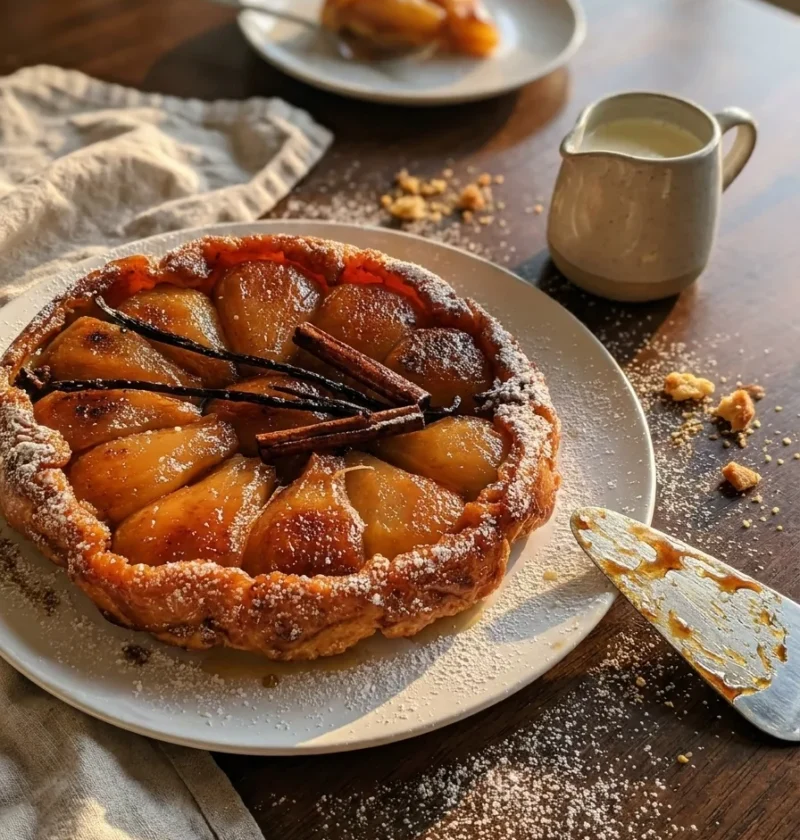
Gordon Ramsay’s pear tarte tatin is a caramelised French dessert with pears cooked in butter, sugar and star anise, topped with shortcrust pastry and baked until golden. Flip it onto a plate and the pears sit on top in dark, sticky caramel. Serves 4-6, ready in about an hour.
Ramsay demonstrates this on MasterChef, calling it “one of my favourites” and warning: “this is one of the challenges that either makes a chef or breaks a chef.” He walks through every step on camera: the caramel, the pear placement, the pastry tuck, and finishes with a cognac flambé.
The detail that separates a great tarte tatin from a soggy one is the pastry tuck. Ramsay lifts each pear and tucks the pastry underneath: “lift up the pear and tuck the pastry in, twist.” This seals the edges so steam escapes upward through the pierced holes instead of soaking the base.
Cooked this recipe? Send a photo or tell me what you changed at fans@gordonramsayrecipes.uk and I’ll share your experience live on this page.
Gordon Ramsay Pear Tarte Tatin
Course: DessertCuisine: FrenchDifficulty: Intermediate4-6
servings20
minutes25
minutes380
kcal45 minutes
From MasterChef: caramelised pears in a cast-iron pan with star anise, cinnamon and vanilla, topped with shortcrust pastry baked at 190C. Flipped and flambéed with cognac to serve.
Ingredients
- For the shortcrust pastry:
250g (9 oz) plain flour (all-purpose)
125g (4½ oz) cold unsalted butter, cubed
1 tbsp caster sugar (superfine sugar)
Pinch of salt
2-3 tbsp ice-cold water
- For the caramel and pears:
100g (3½ oz) unsalted butter
150g (5 oz) caster sugar (superfine sugar)
2 star anise
1 cinnamon stick
1 vanilla pod (vanilla bean), split
4-5 firm pears (Conference or Comice), peeled, halved and cored
- To finish:
2 tbsp cognac (optional, for flambé)
Icing sugar (powdered sugar), for dusting
Crème anglaise or vanilla ice cream, to serve
Directions
- Make the pastry: Rub the flour, butter, sugar and salt together until it resembles breadcrumbs. Add ice-cold water a tablespoon at a time until the dough just comes together. Wrap and chill for 30 minutes.
- Build the caramel: Place the butter in a cast-iron ovenproof pan. Push it down lightly and sprinkle the sugar over the top. Add the star anise, cinnamon stick and vanilla pod seeds.
- Arrange the pears: Place the pear halves round side down into the butter and sugar, pointing inward in a circle. Put the pan on medium heat and cook until the sugar and butter melt into a dark caramel.
- Roll the pastry: Preheat oven to 190C (375F/Gas 5). Roll out the pastry to about ¾cm thick. Cut a circle slightly larger than the pan.
- Top and tuck: Take the pan off the heat. Drape the pastry over the pears. Lift each pear edge and tuck the pastry underneath, twisting as you go. Pierce the pastry a few times with a knife.
- Bake: Cook for 18-20 minutes until the pastry is golden and crisp.
- Flip: Remove from the oven. Place a plate over the pan, hold firmly and flip in one confident motion.
- Flambé and serve: Heat cognac in a small pan, ignite and pour over the tarte tatin. Dust with icing sugar. Cut into wedges and serve with crème anglaise or vanilla ice cream.
Notes
- Lift each pear and tuck the pastry underneath. This seals the edges so caramel stays below during baking and the flip comes out clean.
FAQs
Why shortcrust and not puff pastry?
On MasterChef, Ramsay uses shortcrust for this tarte tatin, not puff. Shortcrust holds its shape when you flip the tart. Puff is flakier but can collapse under the weight of the caramelised pears.
Roll it “about three-quarters of a centimetre thick.” Thinner and it tears during the flip. Thicker and it won’t cook through in 18 minutes.
Why pierce the pastry?
“If we don’t pierce that pastry you’re gonna steam it underneath.” The pears release moisture as they bake. Without holes, that steam gets trapped and makes it soggy.
Two or three small cuts with a sharp knife is enough. Don’t go overboard or the caramel bubbles up through the holes.
Why does the caramel need to go dark?
Ramsay says “take this caramel nice and dark.” Light caramel tastes like sugar. Dark caramel tastes like toffee with a slight bitterness that balances the sweet pears.
The star anise, cinnamon and vanilla need that heat too. They only release their oils into hot caramel.
Why tuck the pastry under the pears?
Ramsay’s technique: “lift up the pear and tuck the pastry in, twist.” It seals the edges so the caramel stays underneath during baking instead of bubbling over.
It also creates a neat rim when you flip. Without the tuck, the edges crumble and caramel runs everywhere.
Can you use different fruit?
Ramsay says on MasterChef: “You’ve got apples, pineapples, peaches, take it any direction you wish.” The technique is identical for any firm fruit.
The apple tarte tatin from Bread Street Kitchen adds one extra step: drying the fruit overnight in the fridge. “This draws out the moisture and concentrates the flavour.” Works for pears too.
The banana tarte tatin uses the same method but adds black pepper and pink peppercorns for heat. A rhubarb crumble is the simpler option if you want seasonal fruit without the pastry flip.