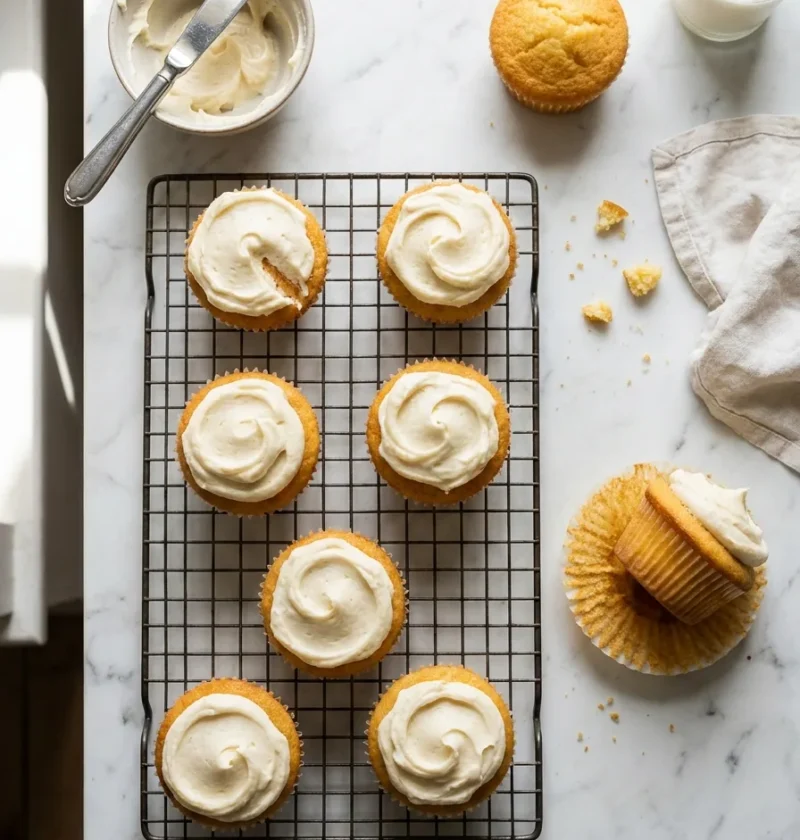
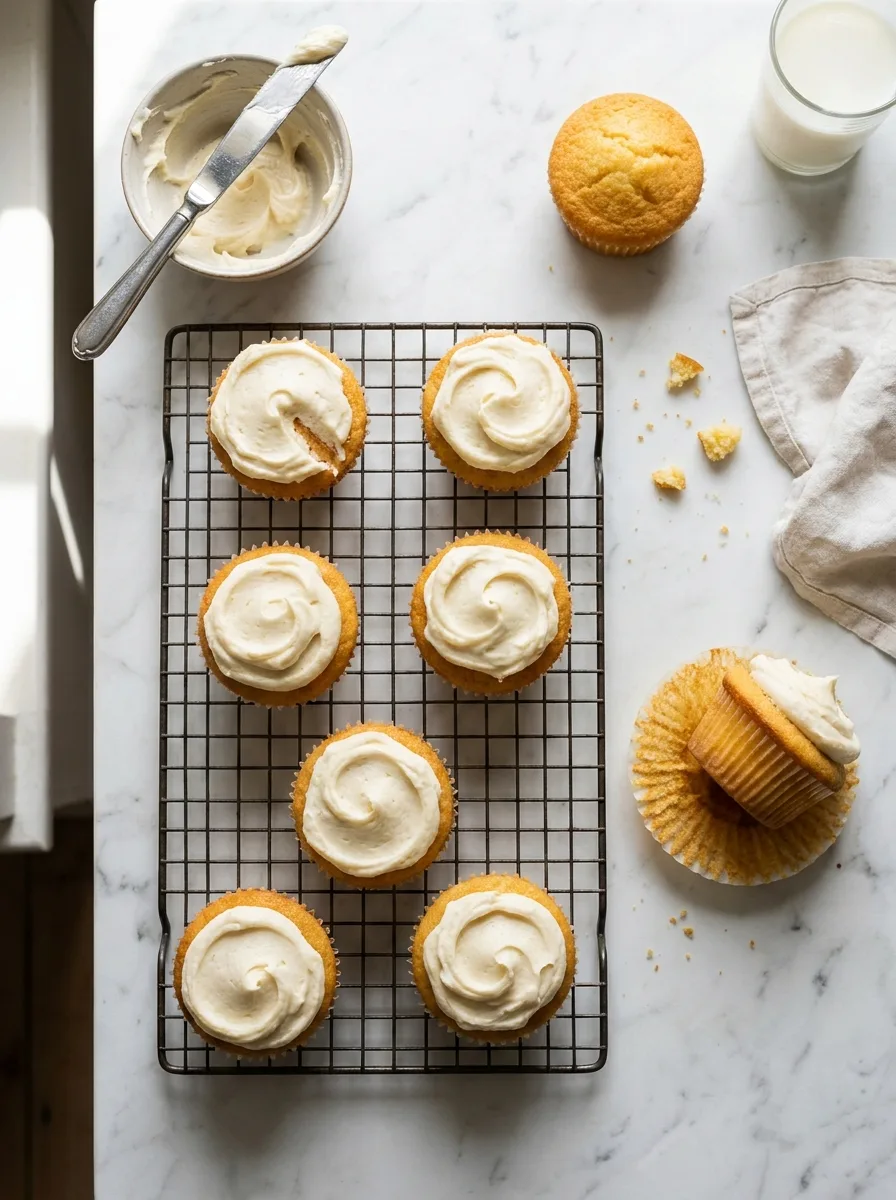
Gordon Ramsay’s vanilla cupcakes are light, moist sponges built on his creaming method from Ultimate Cookery Course, where butter and sugar get beaten for a full five minutes before eggs go in one at a time and self-raising flour gets folded through with a metal spoon. They bake at 180°C for 18–20 minutes and make 12.
Ramsay hasn’t actually published a cupcake recipe in any of his cookbooks, and every other site claiming to have one is making that up. What he has published is the exact sponge technique that cupcakes are built on, plus a full chapter in UCC explaining why baking fails and how to stop it, so this recipe follows his method to the gram.
On MasterChef USA, he judged a cupcake pressure test where most contestants fell apart. He called one batch “really eggy, super dense” and another “visually underwhelming and dry,” but the one he loved was a simple vanilla bean cupcake made without a mixer because the contestant’s had been taken away. His verdict: “delicious, 100% safe.” Technique mattered more than equipment.
Cooked this recipe? Send a photo or tell me what you changed at fans@gordonramsayrecipes.uk and I’ll share your experience live on this page.
Gordon Ramsay’s Vanilla Cupcakes
Course: DessertCuisine: BritishDifficulty: Easy12
cupcakes15
minutes20
minutes340
kcal35
minutesBuilt from Gordon Ramsay’s creaming method in Ultimate Cookery Course and his cupcake judging criteria from MasterChef USA. No published cupcake recipe exists in his books, so this follows his sponge technique exactly.
Ingredients
- For the cupcakes:
175g unsalted butter, at room temperature
175g caster sugar
3 large eggs, at room temperature
175g self-raising flour
1 tsp vanilla extract (or seeds from 1 vanilla pod)
2 tbsp whole milk
- For the buttercream:
150g unsalted butter, softened
300g icing sugar, sifted
1 tsp vanilla extract
1-2 tbsp whole milk
Directions
- Preheat: Set the oven to 180°C (350°F)/160°C fan/Gas 4. Line a 12-hole muffin tin with cupcake cases.
- Cream the butter and sugar: Beat the butter on its own until creamy, then add the caster sugar and whisk for at least 5 minutes until pale and fluffy. Ramsay says in UCC that this aeration stage is where so much cake-making fails, so don’t rush it.
- Add the eggs: Beat in the eggs one at a time, mixing well after each. Both butter and eggs must be at room temperature or the mixture will curdle. If it starts to split, stir in a tablespoon of flour to bring it back together.
- Fold in the flour: Sift the self-raising flour over the mixture and use a metal spoon or spatula to cut and fold it in gently. Do not whisk or beat at this stage. Add the vanilla and milk, fold again until you reach a dropping consistency where the mixture falls slowly from the spoon.
- Fill and settle: Divide the batter evenly between the 12 cases, filling each about two-thirds full. Bang the tin on the worktop twice to knock out any air pockets that would make them rise unevenly.
- Bake: Cook for 18–20 minutes until golden and a skewer comes out clean. Ramsay says you can always smell when a cake is ready, so trust your instincts more than the timer.
- Cool: Leave in the tin for 5 minutes, then transfer to a wire rack to cool completely before frosting.
- Make the buttercream: Beat the softened butter until smooth, then gradually add the sifted icing sugar, beating well between additions. Add the vanilla and enough milk to reach a smooth, pipeable consistency. Swirl onto the cooled cupcakes.
FAQs
Why does Ramsay say to beat butter and sugar for five full minutes?
Most home bakers cream for about 30 seconds and move on, which is why their cupcakes come out flat. Ramsay says in his UCC baking chapter that this stage is “where so much cake-making fails,” because those five minutes of beating trap tiny air bubbles into the butter that expand in the oven and give the cupcake its lift.
Skip this and you get a dense sponge no matter what else you do right. You’ll know it’s ready when the mixture turns visibly paler, almost white, and feels light when you lift the spoon. If it still looks yellow and heavy, keep going.
What did Ramsay say makes cupcakes fail on MasterChef?
He tasted one batch and said it was “really eggy, which gives it that super dense kind of feel,” because too much egg relative to flour weighs the batter down and kills the lightness. Another contestant’s came out dry because the flour ratio was wrong between two batches, so the vanilla ones didn’t rise while the chocolate ones did. Ramsay told her it was “your worst performance in this competition.”
The winning cupcake was a simple vanilla bean with mascarpone frosting, made by a contestant whose mixer had been taken away, so he creamed everything by hand. Ramsay called it “delicious” and said he was “100% safe,” which tells you that technique beats equipment every time.
Why must everything be at room temperature?
Ramsay is specific about this in UCC because cold butter won’t cream properly, so you get lumps instead of air, and cold eggs curdle when they hit the warm creamed mixture, which breaks the emulsion you just spent five minutes building.
Take butter and eggs out of the fridge at least an hour before you start. If you forget, cut the butter into small cubes and microwave for 10 seconds at a time, and for eggs just sit them in a bowl of warm water for about 5 minutes. If the mixture does curdle despite all this, Ramsay’s rescue is simple: stir in a tablespoon of your measured flour to bond the fat and liquid back together.
Why a metal spoon and not a whisk for the flour?
A whisk knocks the air out, so those five minutes of creaming that built all those bubbles get destroyed in seconds. Ramsay says to use a metal spoon or spatula and to “cut and fold the mixture together,” which means slicing down through the centre, sweeping along the bottom, and bringing it up over the top until the flour just disappears.
Every extra fold after that costs you lightness, so stop the moment you can’t see dry flour.
How does the buttercream frosting stay smooth and not gritty?
Sift the icing sugar before you add it, because any lumps get trapped in the butter and you’ll feel them on your tongue. Ramsay uses this same principle across his baking: in Ultimate Home Cooking he calls icing sugar “ideal for buttercreams and icings” specifically because it dissolves so easily.
Beat the butter on its own first until it’s completely smooth, then add the icing sugar gradually. If you dump it all in at once, it won’t incorporate evenly and you’ll get a heavy, gritty texture instead of something light enough to swirl on top.