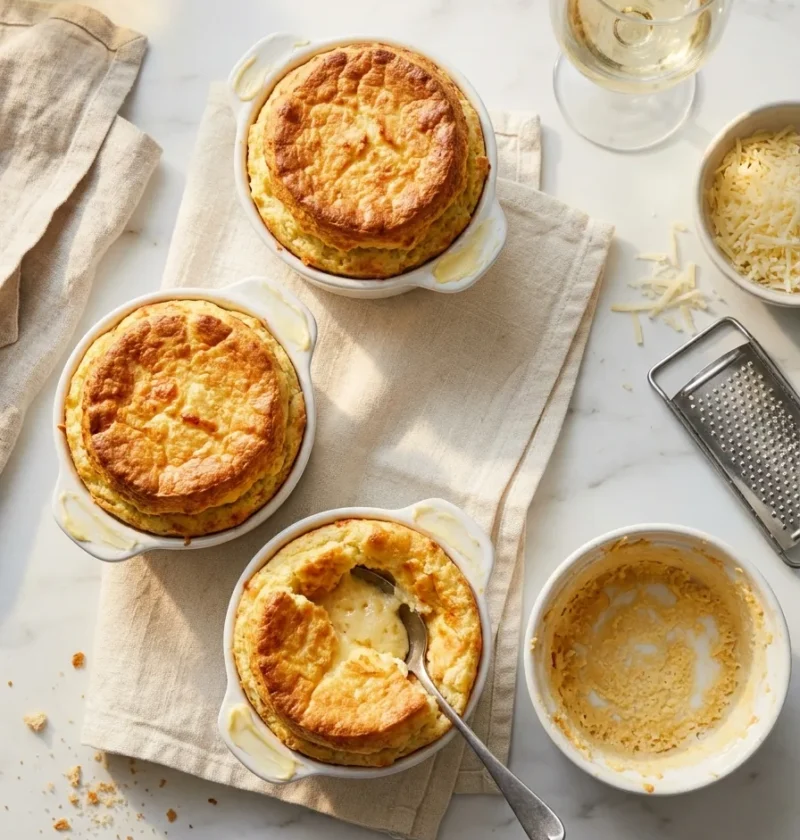
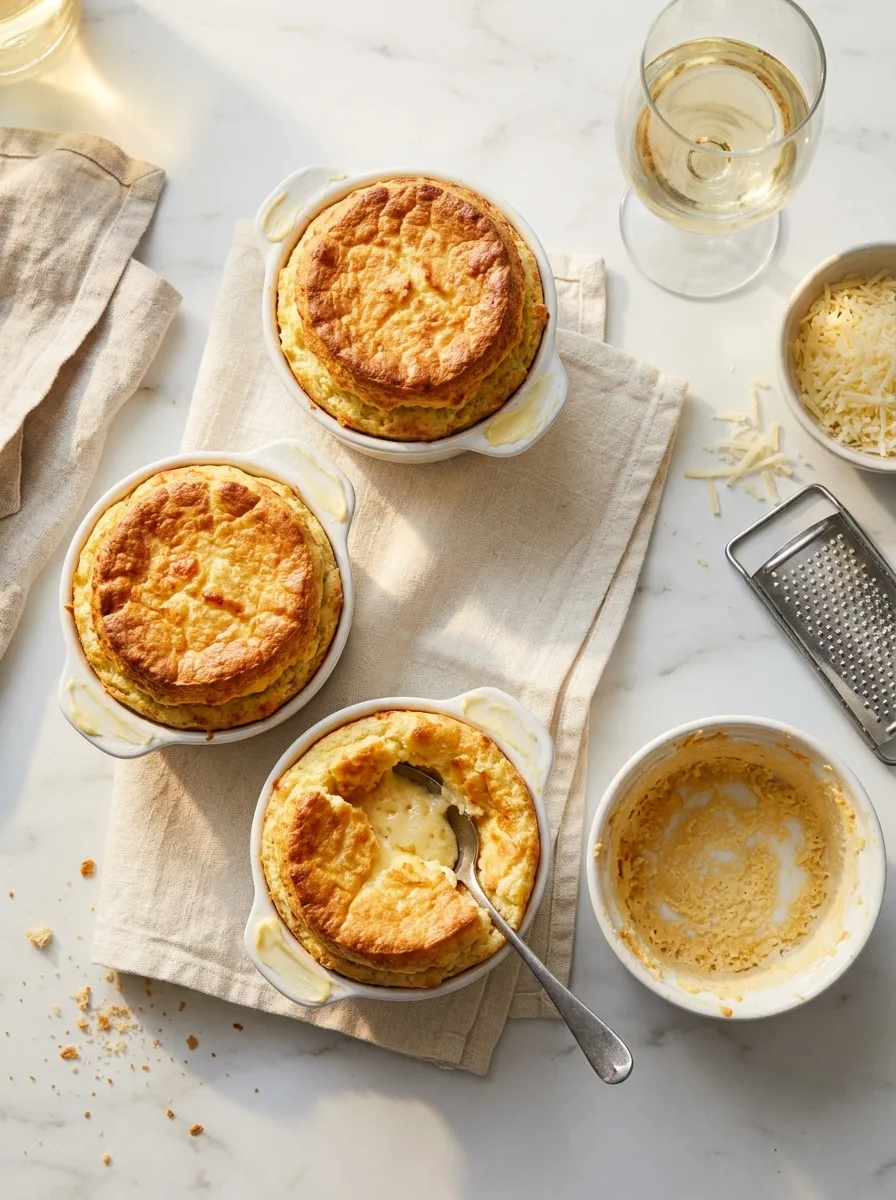
Gordon Ramsay’s cheese soufflé uses Gruyère and Parmesan in a béchamel base with whisked egg whites, baked at 200°C for 15–18 minutes in ramekins double-coated with butter. The whole thing takes about 45 minutes, and if you follow Ramsay’s technique properly, it rises every single time.
In UCC he writes “soufflés have a reputation for being difficult to pull off, but they really aren’t so long as you fold the egg whites carefully into the base so they retain their air, and you have your oven at the right temperature.” On MasterClass, he calls it “the science of soufflé” and says that science has never failed him. The secret is precision: he weighs everything to the gram because this is baking, not cooking.
The technique that separates his soufflé from every recipe online is the ramekin prep. He applies a “double varnish” of softened butter in vertical upward strokes, chills the ramekins, then coats the inside with finely grated Parmesan. Those vertical grooves give the mixture tracks to climb as it rises, and the Parmesan crust adds salt and crunch to every bite from the outside in.
Cooked this recipe? Send a photo or tell me what you changed at fans@gordonramsayrecipes.uk and I’ll share your experience live on this page.
Gordon Ramsay Cheese Soufflé
Course: Appetiser, DinnerCuisine: French, BritishDifficulty: Medium4
soufflés25
minutes18
minutes320
kcal45
minutesBuilt from Gordon Ramsay’s soufflé technique in Ultimate Cookery Course and his MasterClass. Double-buttered ramekins lined with Parmesan, béchamel base with Gruyère, whisked egg whites folded in by hand. At his Chelsea restaurant he makes three for every order: one for the guest, one to taste, one just in case.
Ingredients
- For the ramekins:
40g unsalted butter, softened
40g Parmesan, finely grated
- For the soufflé:
40g unsalted butter
30g plain flour
300ml whole milk
100g Gruyère, finely grated
1 tsp Dijon mustard
Pinch of cayenne pepper
Sea salt and freshly ground black pepper
4 large egg yolks
5 large egg whites
Directions
- Prep the ramekins: Brush four 250ml ramekins with softened butter using firm vertical upward strokes. Chill for a few minutes, then brush a second layer the same way. Ramsay calls this the double varnish and says the vertical strokes help the soufflé climb the sides evenly. Tip Parmesan into each ramekin, roll it around to coat the inside completely, and tap out the excess. Chill until needed.
- Make the base: Preheat the oven to 200°C (400°F)/180°C fan/Gas 6. Melt the butter in a heavy-based saucepan over a medium heat, stir in the flour, and cook for 1 minute. Gradually whisk in the milk and keep stirring for 3–4 minutes until you have a thick, smooth sauce. Take off the heat.
- Add the cheese: Stir the grated Gruyère, mustard, cayenne, and seasoning into the hot sauce until the cheese melts. Leave to cool for a few minutes, then beat in the egg yolks one at a time.
- Whip the whites: Put the egg whites in a spotlessly clean bowl. Ramsay says any water can ruin the texture, so your bowl and whisk must be completely dry. Whisk to stiff peaks.
- Fold: Whisk one-third of the whites into the cheese base to loosen it. Then carefully fold in the rest with a large metal spoon, turning the bowl as you go. Stop the moment you can’t see white streaks.
- Fill and clean the edge: Spoon the mixture into the prepared ramekins, filling to the top. Tap each one once on the worktop to settle, then smooth the surface with a palette knife. Run the tip of your finger around the inside edge to create the crisp love handles as it rises.
- Bake: Place on a baking sheet and bake for 15–18 minutes until risen, golden on top, and wobbling gently in the middle. Do not open the oven door before 15 minutes. Dust with a little extra Parmesan and serve immediately.
FAQs
Why does Ramsay butter the ramekins twice in vertical strokes?
The first layer seals the surface so nothing sticks. The second layer, applied after chilling, creates tiny ridged grooves from the brush strokes that run from bottom to top. The soufflé batter grips these grooves as it rises, which is why Ramsay calls it a “double varnish” on MasterClass.
Without it the mixture slides back down the sides and you get a lopsided dome instead of a straight, even rise. The Parmesan dusting does double duty: it gives the climbing batter something gritty to grip, and it bakes into a savoury crust you taste in every bite from the outside in.
Can you make the base ahead of time?
Ramsay says in UCC that the soufflé mixture “will hold in the fridge for up to 1½ hours, so you can make it in advance and cook it just when you need to.” On MasterClass he goes further: the pastry cream base can be refrigerated for up to three days, and the buttered ramekins can be prepared and chilled for a few days before use.
So you make the cheese base on Saturday, prep the ramekins on Saturday, and on Sunday you just whip the whites and fold. The hard work is already done. If even that feels like too much, Ramsay’s cheat’s soufflé from the same book skips the egg whites entirely and uses baking powder in a single baking dish instead.
What does a perfect soufflé look like when it’s ready?
Ramsay says it should have “crisp love handles” hanging over the edge of the ramekin, golden brown on top, and “a slight wobble in the middle” when you give the tray a gentle nudge. If the centre is completely set, you’ve overbaked it and the inside will be dry.
He learned this in Paris as a young cook, and at his Chelsea restaurant he still makes three soufflés for every single order: one for the guest, one to taste test, and one just in case something goes wrong. That tells you even he respects how precise the timing has to be.
What about a twice-baked cheese soufflé?
Twice baked means you bake the soufflés once, let them cool completely and sink in the ramekins, then turn them out onto a baking dish, pour cream around them, and bake again at 200°C for 10–12 minutes until they puff back up.
The advantage is you can do the first bake hours or even a day ahead. The soufflés sit in the fridge looking deflated and sad, then resurrect in the second bake. This is the version Ramsay serves at the Savoy Grill as a signature dish with walnut, honey, and truffle.