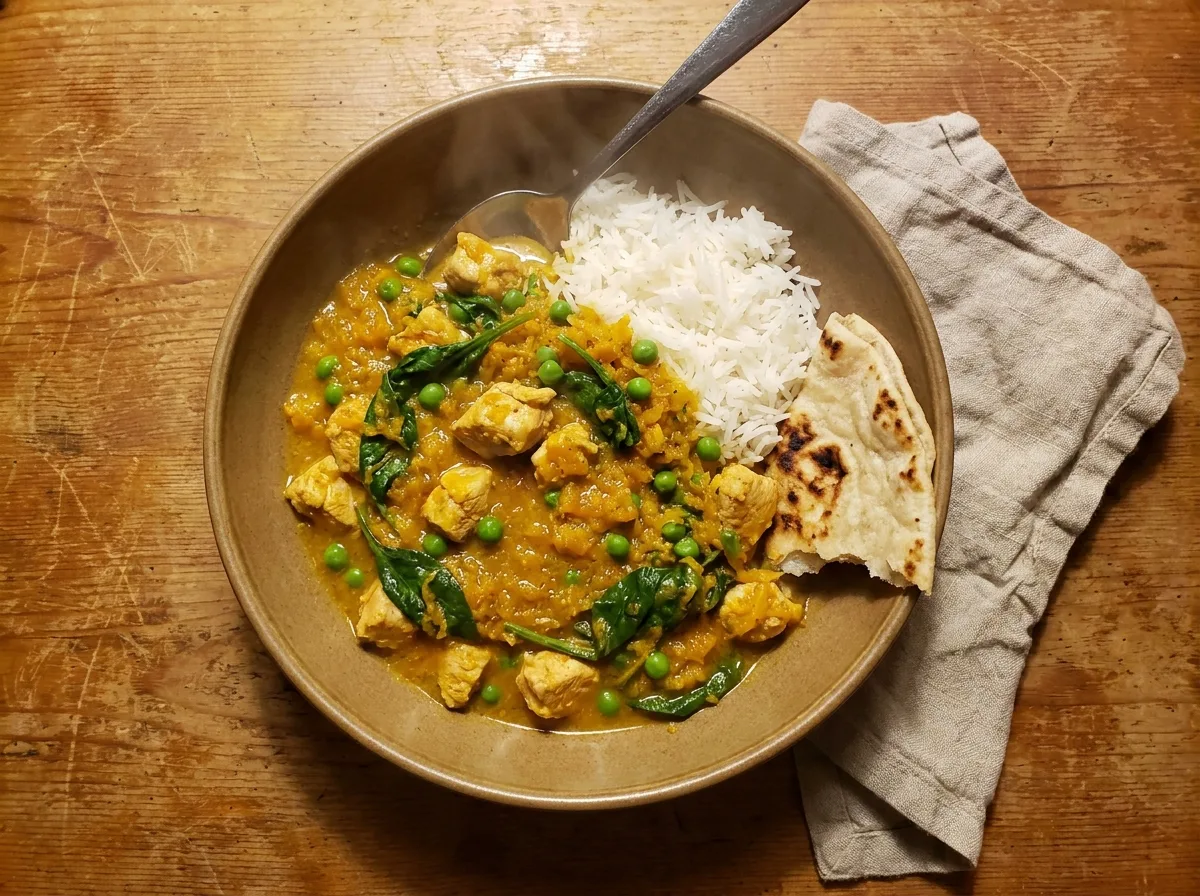
Gordon Ramsay’s chicken curry grates butternut squash and red onion straight into the pan. They melt into a thick coconut sauce around diced chicken, peas and spinach. One pan, no chopping board pile-up, about 25 minutes start to finish.
It’s the chicken and butternut squash curry from his Ramsay in 10 book, and his own headnote admits the badge slipped: “I didn’t cut the chicken small enough when I cooked this on YouTube and ended up going two minutes over… Tilly said it should be Ramsay in 12!”
The grating is the whole trick. Shredded squash and onion have huge surface area, so they collapse in a couple of minutes and their starch melts straight into the liquid. That’s what thickens the sauce, no cream, no flour, no hour of simmering.
Cooked this recipe? Send a photo or tell me what you changed at fans@gordonramsayrecipes.uk and I’ll share your experience live on this page.
Gordon Ramsay’s Chicken Curry with Butternut Squash
Course: DinnersCuisine: IndianDifficulty: Easy4
servings10
minutes15
minutes350
kcal25
minutesThe Ramsay in 10 one-pan curry: two chicken breasts, half a butternut squash on the coarse grater, and dinner in under half an hour.
Ingredients
½ butternut squash, preferably the seed-free ‘neck’ end, peeled
Vegetable oil, for frying
2½ tsp garam masala
1 large red onion, peeled
1 chilli, deseeded if you want a milder heat
2.5cm (1 in) piece of fresh ginger, peeled
2 chicken breasts, diced into small cubes
50g (⅓ cup) frozen peas
240g (1 cup) canned tomatoes
250ml (1 cup) coconut milk
2 tbsp chicken or vegetable stock
30g (1 cup) fresh spinach
Sea salt and freshly ground black pepper
Directions
- Heat the pan: Place a high-sided, non-stick frying pan over a medium-high heat.
- Grate the squash: Meanwhile, use the large side of a box grater to coarsely grate the squash.
- Start the base: Add a drizzle of oil to the pan, then add the grated squash. Season with salt, then stir in the garam masala.
- Grate in the onion: As the squash cooks, peel and grate the onion and add it to the pan. Stir well and allow to cook for 1 to 2 minutes.
- Chilli and ginger: Roughly chop the chilli and add to the pan, then grate in the ginger and allow to cook for 1 to 2 minutes.
- Make a well: Make a well in the middle of the pan and drizzle in a little oil. Add the diced chicken, season with salt and toss to combine. Cook for 1 to 2 minutes, then add the peas and cook for a further minute.
- Build the sauce: Add the tomatoes, coconut milk and stock, stir well, then bring to the boil and allow to simmer for 4 to 5 minutes, until the chicken is cooked.
- Wilt and serve: Stir in the spinach and cook until it has wilted. Remove the pan from the heat and serve with rice and roti.
Notes
- He cooked this on camera in twelve minutes, not ten. Give yourself twenty-five and enjoy the head start on him.
FAQs
Is Gordon Ramsay’s chicken curry really ready in 10 minutes?
Not quite, and he’s the first to admit it. He cooked this live for his Ramsay in 10 series and overran because his chicken cubes were too big. That’s why the book stresses dicing it small, and the attempt is still on YouTube, overrun included.
For a normal kitchen, 25 minutes is the honest number including grating and clearing up as you go. If raw speed is the actual goal, his butter chicken curry in a hurry is the other contender, built for the clock in a different way.
Do I have to use butternut squash?
He asks for the neck end specifically, because it’s solid flesh with no seed cavity, so every gram grates cleanly. Tesco and Sainsbury’s both sell ready-prepared butternut chunks, which grate fine and save the peeling, the hardest part of the whole recipe.
Grated sweet potato works as a swap and behaves almost identically in the pan. Carrot works too but sweeter and looser, so the sauce ends up thinner. Whatever you use, it needs to grate, chunks won’t melt into the sauce in time.
Garam masala or curry powder?
Both are his, and it depends which source you follow. The book prints 2½ teaspoons of garam masala, but in the video he reaches for curry powder, and his official site kept that version. I follow the book.
The difference is real: garam masala, the northern Indian blend, runs warm and sweet with cinnamon and cardamom, while curry powder is turmeric-led and earthier. If you’d rather build the flavour from fresh ingredients instead of either jar, his Malaysian chicken curry does exactly that with a blitzed paste.
Can I use chicken thighs instead of breasts?
Yes, cut small they’re actually more forgiving, needing just 2 to 3 extra minutes at the simmer. He uses breast here because the 4 to 5 minute cook suits it, and small dice is the insurance either way.
The book flags this recipe as gluten-free and dairy-free as written. It converts to vegetarian cleanly too: skip the chicken, use vegetable stock, and load in extra squash, courgette and spinach. And if mince is what’s in the fridge, his minced lamb curry runs the same 30-minute logic.
What about the roti?
The book includes them as an “if you have more time” extra, and the timing trick matters. Make the dough FIRST, because its 15-minute rest is conveniently the length of the curry. Mix 120g plain flour, a pinch of salt, a glug of olive oil and 120ml water into a dough, then leave it.
When the curry is bubbling, divide the dough into four and roll each piece thin. Cook in a hot, salted, lightly oiled pan for 1 to 2 minutes a side until slightly charred. Four fresh rotis for pennies, timed to land with the curry.
How long does this chicken curry keep?
Three days in the fridge and the flavour holds, but the texture shifts. The grated squash keeps softening, so the sauce turns thicker and more porridgey each day. Loosen it with a splash of water when reheating.
It freezes for a month with two honest caveats: the squash goes softer still, and coconut milk can split on thawing. A gentle stir over low heat brings it back together, and my roundup of his curry recipes is where to choose the next one.