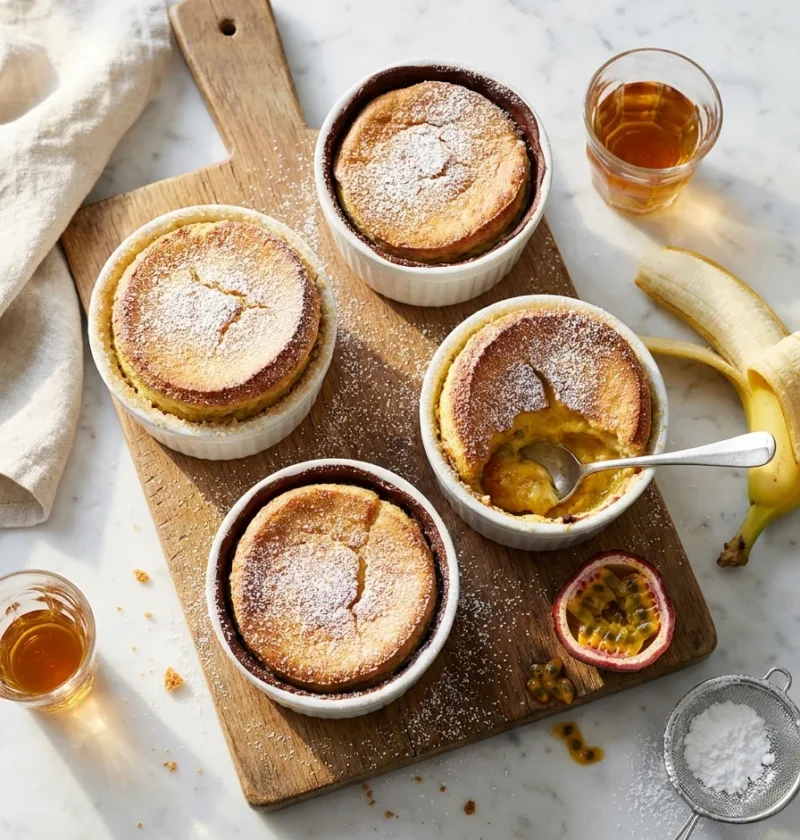
Gordon Ramsay’s passion fruit and banana soufflé uses fresh passion fruit juice and blended banana stirred into a crème pâtissière base, with whisked egg whites folded in and baked at 190°C for 10–12 minutes. The recipe comes from Sunday Lunch and makes 6–8.
Ramsay credits this soufflé to Angela Hartnett at the Connaught, writing “it is amazingly good, the banana and passion fruit marry perfectly, giving the soufflé an extraordinary, delicate and subtle flavour.” In the YouTube video with 1.9 million views, he calls it “the perfect way of ending a Sunday lunch” and walks through every step of the technique.
The detail nobody else mentions is the two-stage fill. Ramsay ladles the mixture halfway, bangs the ramekin on a folded cloth to push it into the corners, then tops it off. Without this the mixture sits unevenly and the soufflé rises skewed to one side, which is why most home attempts come out lopsided.
Cooked this recipe? Send a photo or tell me what you changed at fans@gordonramsayrecipes.uk and I’ll share your experience live on this page.
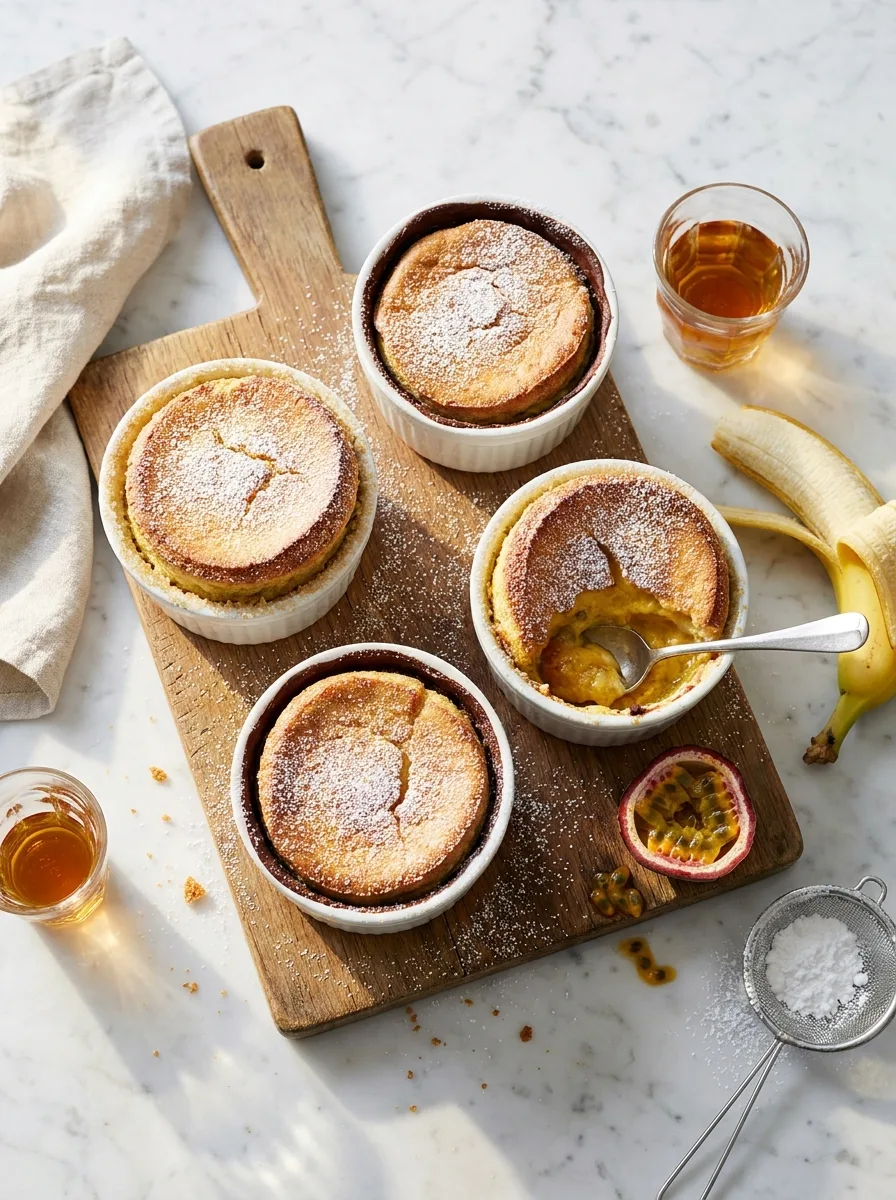
Gordon Ramsay Passion Fruit and Banana Soufflé
Course: DessertCuisine: French, BritishDifficulty: Medium6-8
soufflés30
minutes12
minutes240
kcal45
minutesFrom Gordon Ramsay Sunday Lunch and his YouTube video with 1.9 million views. Passion fruit and banana blended into a crème pâtissière base, baked in ramekins lined with sugar or chocolate. Ramsay credits this to Angela Hartnett at the Connaught.
Ingredients
- For the crème pâtissière:
150ml whole milk
100ml double cream
15g plain flour
10g cornflour
3 large egg yolks
50g caster sugar
- For the soufflé:
4 ripe passion fruit
1 ripe banana, about 100g, peeled
Squeeze of lemon juice
2 tbsp banana liqueur (optional)
About 20g butter, softened, to brush
50g caster sugar, plus extra to dust
Grated dark chocolate to dust (optional)
2 large egg whites
Icing sugar to dust
Directions
- Make the crème pâtissière: Heat the milk and cream until almost boiling. Sift the flour and cornflour together. Beat the egg yolks and sugar in a bowl, then mix in the flour. Add a splash of the hot milk and whisk until smooth, then gradually whisk in the rest. Pour back into the pan and whisk over a medium-low heat for 3–5 minutes until thick and smooth. Cover and cool to room temperature. This can be made 2–3 days ahead.
- Make the fruit base: Halve the passion fruit and scoop the seeds into a sieve over a bowl. Press to extract the juice. Pour into a blender with the banana, lemon juice, and liqueur if using. Blend until smooth. Stir into the cooled crème pâtissière.
- Prep the ramekins: Brush 6–8 deep ramekins with softened butter using upward vertical strokes. Ramsay says to touch your skin, that’s how soft the butter should be, and make sure your moulds are dry because buttering something wet makes it stick and rise unevenly. Dust the insides with caster sugar or grated chocolate. Chill to set.
- Whip the whites: Preheat the oven to 190°C (375°F)/170°C fan/Gas 5. Whisk the egg whites in a clean bowl with a drop of lemon juice to firm peaks. Add the sugar a spoonful at a time, counting to 10 between each spoon so it distributes evenly. Whisk to a firm, glossy meringue.
- Fold: Whisk a third of the meringue into the crème pâtissière base hard. Ramsay says everyone thinks you got to be delicate and dainty but no, that’s what causes lumpy soufflés. Then carefully fold in the remaining two-thirds with a large metal spoon.
- Two-stage fill: Ladle mixture into the ramekins halfway. Bang each one on a folded cloth to push the mixture into the corners. Top off to the rim. Smooth with a palette knife and run your thumb around the inside edge.
- Bake: Place on a baking tray with a couple of inches between them. Bake for 10–12 minutes until well risen, lightly golden, and wobbling gently in the middle. Don’t open the oven door until they’re almost ready. Dust with icing sugar and serve immediately.
FAQs
How do you pick the right passion fruit?
Ramsay says in the video “they look like unwanted kiwis, wrinkled means they’re nice and ripe.” Smooth, shiny passion fruit are underripe and the juice will be too sour and thin for the soufflé base.
You want the ugliest ones in the box, heavily wrinkled with leathery skin that gives slightly when you press it. The juice inside will be sweeter, more concentrated, and the aroma should fill the room when you cut them open.
Why does Ramsay whisk the first third hard instead of folding gently?
Because the crème pâtissière base is thick and heavy compared to the egg whites. If you fold gently from the start, you get lumps of cream surrounded by deflated meringue, which bakes into an uneven soufflé with dense pockets.
Whisking the first third vigorously loosens the base and brings it closer to the consistency of the remaining whites. Once it’s smooth and lighter, you can fold the rest in gently without fighting against two completely different textures.
Why the two-stage fill with the cloth bang?
Ramsay fills each ramekin halfway, then bangs it on a folded cloth to force the mixture into every corner of the mould. Without this, air gets trapped at the bottom and the soufflé rises unevenly, tilting left or right.
He says in the video “if it didn’t hit all the corners it goes skew-whiff left and right and that’s what you don’t want.” The cloth absorbs the shock so the ramekin doesn’t crack. Then you top off and smooth with a palette knife.
Can you make this ahead?
Ramsay says in both the cookbook and the video that the crème pâtissière base with the fruit stirred in “can be made 2 or 3 days before, in the fridge, and just take it out when you need it.” The buttered and lined ramekins can also be chilled for a few days.
So for a Sunday lunch you make the base on Friday, prep the ramekins on Saturday, and on Sunday you just whip the whites, fold, fill, and bake while everyone eats the main course. Ten minutes in the oven and it’s done. If you want a dessert soufflé with a quicker base, Ramsay’s chocolate soufflé skips the crème pâtissière entirely and uses milk thickened with cornflour instead, which means less prep and only 6 minutes in the oven.