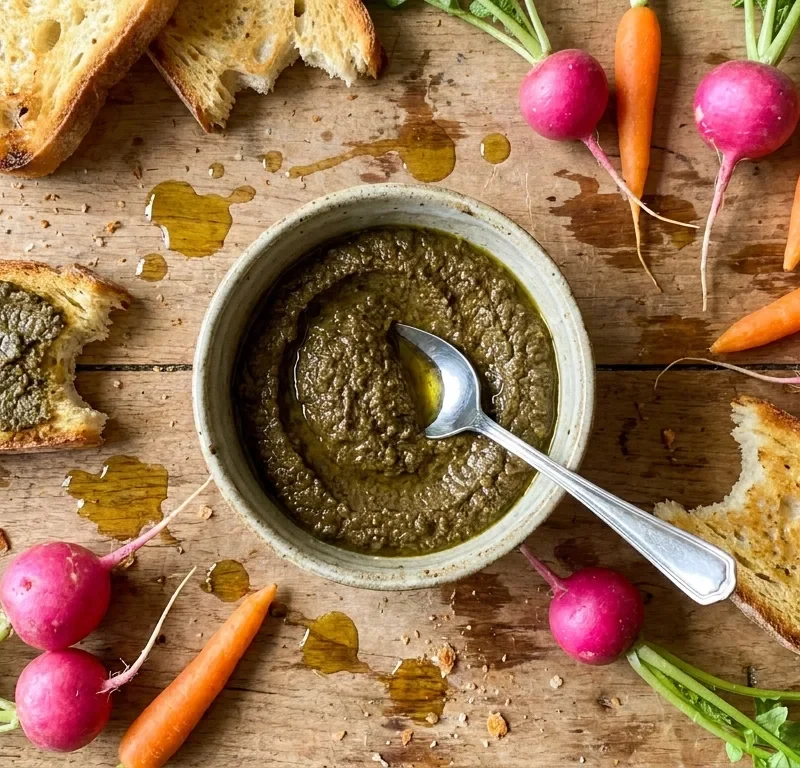
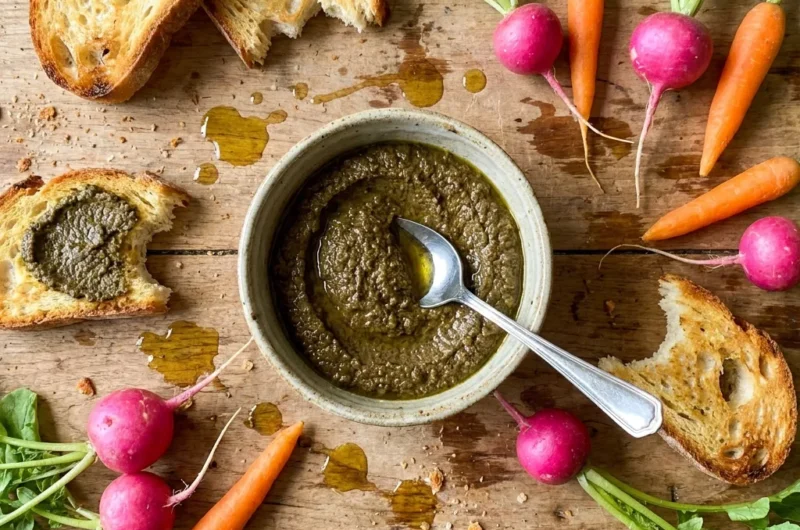
Gordon Ramsay’s anchovy dip is anchovies, garlic, shallot, parsley and black olives blitzed in a food processor with the oil from the anchovy jar and a splash of red wine vinegar. The recipe comes from Ultimate Home Cooking, serves 4 to 6 as a starter and takes about 20 minutes including toasting the ciabatta.
He says “the secret to the anchovy dip is to use the oil from the anchovies as it is packed with flavour.” Rather than draining the jar, he pours all of the reserved oil straight into the processor with the motor running, then follows with olive oil until the consistency is right. That anchovy oil gives the dip a deeper, rounder flavour than the fillets alone.
What makes this different from a standard anchovy paste is the black olives. At 125g they are the largest ingredient by weight, and they add a salty, meaty depth that turns a simple blitz into something closer to a tapenade. He serves it at room temperature with radishes, baby carrots and toasted ciabatta, not warm like a bagna cauda.
Cooked this recipe? Send a photo or tell me what you changed at fans@gordonramsayrecipes.uk and I’ll share your experience live on this page.
Gordon Ramsay Anchovy Dip Recipe (With Crudités)
Course: AppetisersCuisine: ItalianDifficulty: Easy6
servings15
minutes6
minutes250
kcal21
minutesAnchovy dip with crudités from Ultimate Home Cooking. Ramsay says the secret is using the oil from the anchovy jar. Blitzed with black olives, garlic, shallot and parsley, served at room temperature with radishes, baby carrots and toasted ciabatta.
Ingredients
- For the dip:
100g jar of best-quality anchovies (60g / 2 oz drained weight), oil reserved
2 garlic cloves, peeled and chopped
1 banana shallot, peeled and diced
Small handful of flat-leaf parsley
125g (4½ oz) pitted black olives
1 to 2 tsp red wine vinegar
Up to 4 tbsp olive oil
Freshly ground black pepper
- For serving:
½ ciabatta loaf, cut into 8 slices
Olive oil, for drizzling
200g (7 oz) radishes, trimmed
Bunch of baby carrots, about 8, tops still on
Directions
- Toast the ciabatta: Preheat the grill. Place the ciabatta slices on a baking tray, drizzle lightly with olive oil on each side and toast under the grill for 6 minutes, turning over halfway through, until golden brown and crisp.
- Blend the dip: Put the anchovies, garlic, shallot, parsley and olives into a food processor and whiz until puréed. Add 1 teaspoon of vinegar and a couple of twists of pepper.
- Add the oils: With the motor still running, pour in the reserved anchovy oil (about 4 tablespoons), then pour in up to 4 tablespoons of olive oil until you reach your preferred consistency.
- Taste and adjust: Check the seasoning and vinegar level. If the dip is too thick, add a little more olive oil with the motor running.
- Serve: Transfer to a serving dish and place in the middle of a platter. Arrange the radishes, baby carrots and toasted ciabatta around the dip.
FAQs
Why does Ramsay use the oil from the anchovy jar?
He calls it “the secret” to the dip because good-quality anchovies are packed in olive oil that absorbs the salt and umami from the fish during storage. By the time you open the jar, that oil is essentially an anchovy-flavoured condiment. He pours all of it into the processor with the motor running, which emulsifies it into the dip and builds a flavour the fillets alone cannot give.
He specifies “best-quality anchovies” in the ingredients, which matters because the quality of the oil depends entirely on the quality of the fish packed in it.
What is the difference between this and bagna cauda?
Bagna cauda is a warm Italian anchovy dip from Piedmont made with butter, olive oil and garlic, simmered gently until the anchovies dissolve. Ramsay’s version is served at room temperature, uses no butter at all, and adds black olives, shallot and parsley, which gives it a sharper, punchier flavour.
The texture is different too. Bagna cauda stays liquid and pourable because the warm butter keeps it loose, while this dip is thicker at room temperature because the olive oil firms up as it cools. Both are served with raw vegetables for dipping, but bagna cauda is rich and buttery while this one is sharp and olive-forward.
What is anchovy butter and how is it different from the dip?
In the same book, Ramsay has a separate anchovy butter: fillets pounded smooth in a mortar with butter, then spread on toasted sourdough bread or pain de campagne alongside soft-boiled eggs. It also appears in Great British Pub Food as part of his anchovies on toast with poached egg and spinach.
The butter is rich and meant for spreading, while the dip is looser and designed for dunking vegetables and bread into. The butter uses butter as the fat. The dip uses the reserved anchovy oil plus olive oil. Two different applications of the same ingredient from the same cookbook.
Can you use cream cheese or sour cream instead of oil?
Ramsay doesn’t use either, but he offers an option in the headnote: “For a richer consistency, you can always blend in a bit of cream or egg yolk.” So if you want it thicker and milder, a tablespoon of double cream blended in at the end is the route he suggests.
His version stays punchy and olive-oil based on purpose. The vinegar and olives give it an edge that a cream or cheese base would soften. If you want something milder, his option of cream or egg yolk adds richness without changing the character of the dip.
How long does anchovy dip keep?
Ramsay says to “store any leftovers refrigerated in a Kilner jar for future use.” The olive oil base means it keeps longer than dairy-based dips. Let it come back to room temperature before serving again so the oil loosens and the dip returns to a scoopable consistency.
For a two-dip platter, serve it alongside his beetroot hummus with za’atar from the same book. Both are served at room temperature with crudités, both come from Ultimate Home Cooking, and the colours contrast well on a board: deep magenta hummus against dark olive-green anchovy dip.