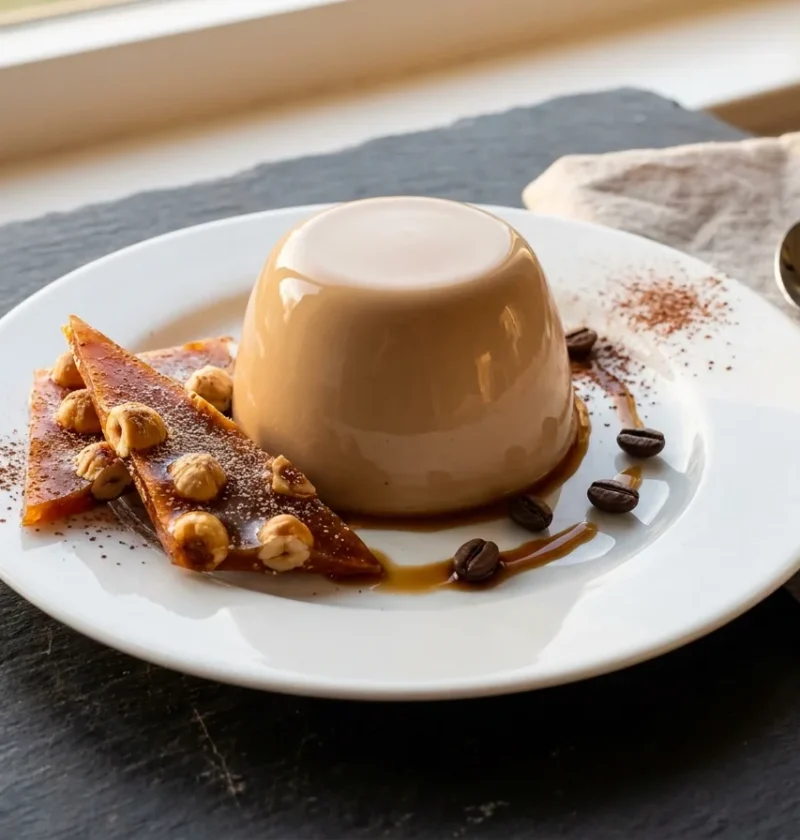
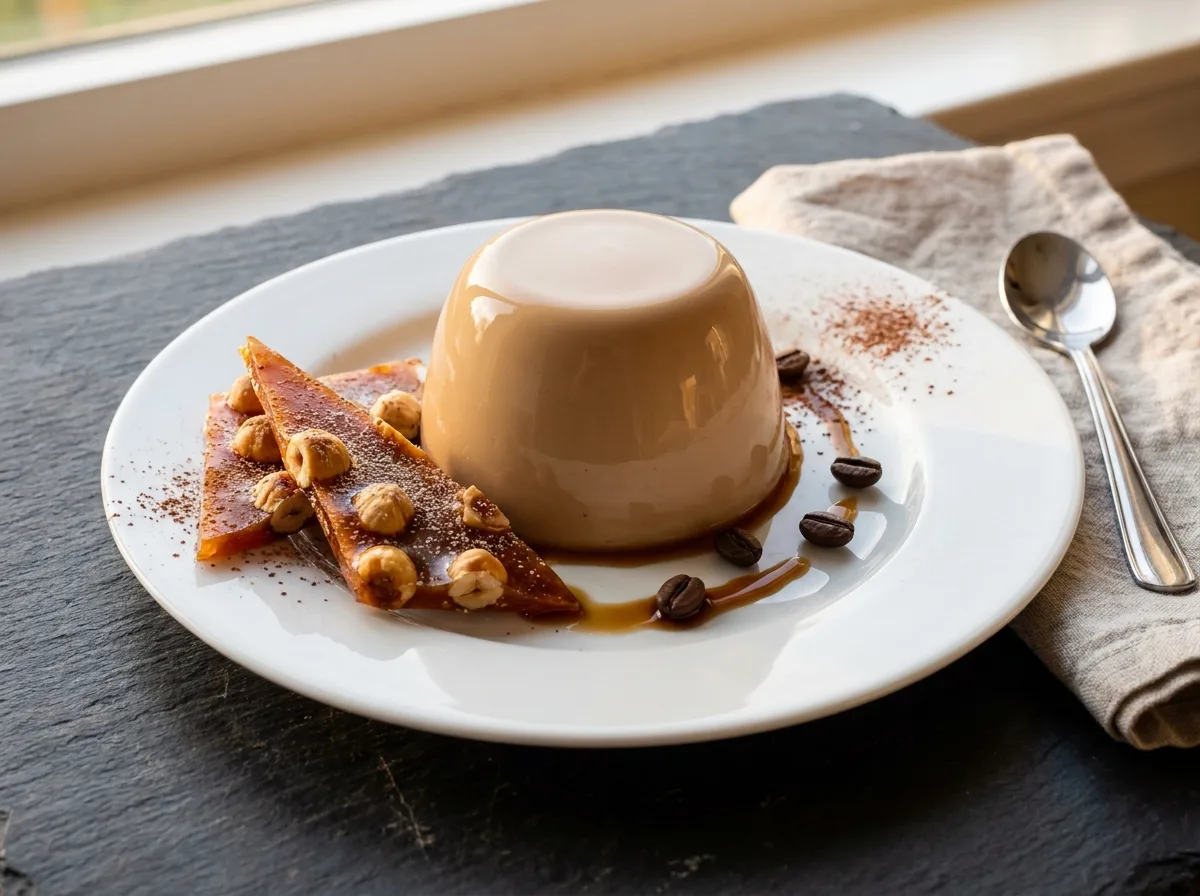
Gordon Ramsay’s panna cotta is espresso-flavoured cream set with leaf gelatine and served with cinnamon hazelnut brittle. The recipe comes from Ultimate Home Cooking and needs overnight setting in the fridge. It takes about 20 minutes of active work, then the fridge does the rest.
Ramsay calls it “the posh Italian equivalent of our own blancmange.” He says it can be flavoured with anything from vanilla to chocolate. He has five different versions across five cookbooks.
The technique that matters most is the gelatine. It goes into cold water first, gets squeezed dry, then stirred into hot cream off the heat. Add it to boiling cream and the setting power dies.
Cooked this recipe? Send a photo or tell me what you changed at fans@gordonramsayrecipes.uk and I’ll share your experience live on this page.
Gordon Ramsay’s Espresso Panna Cotta
Course: DessertCuisine: ItalianDifficulty: Easy4
servings15
minutes20
minutes830
kcal8
hours8 hr 35 min
Five panna cotta recipes exist across five of Ramsay’s cookbooks: espresso with hazelnut brittle, pomegranate with chocolate shards, lime with mint and tequila, honey with elderflower, and caramel-orange with Cointreau. This espresso version from Ultimate Home Cooking is the simplest and most elegant.
Ingredients
- For the panna cotta:
3 sheets leaf gelatine (1½ tsp powdered gelatine)
400ml double cream (1⅔ cups heavy cream)
75ml whole milk (⅓ cup)
100g caster sugar (½ cup superfine sugar)
50ml espresso, cooled (3½ tbsp)
- For the brittle:
50g blanched hazelnuts (⅓ cup)
200g caster sugar (1 cup superfine sugar)
1 tsp ground cinnamon
Directions
- Soak the gelatine: Place the gelatine sheets in a bowl of cold water and leave for 5-10 minutes until softened.
- Heat the cream: Put the cream, milk, sugar and espresso into a small heavy-based pan. Bring to a simmer over a medium-low heat, then immediately remove from the heat.
- Add the gelatine: Squeeze the soaked gelatine leaves dry and stir into the hot cream, mixing until completely dissolved.
- Fill the moulds: Rinse 4 dariole moulds or ramekins in cold water but do not dry them. Pour the mixture through a sieve into a jug, then pour into the moulds. Refrigerate overnight.
- Make the brittle: Toast the hazelnuts at 180C (350F) for 10 minutes. Melt the sugar in a frying pan until dark golden, add the hazelnuts and cinnamon, swirl and tip onto a lined tray. Leave to set completely, then break into shards.
- Serve: Dip each mould in boiling water for 5 seconds. Place a plate over the top, invert and give a little shake to release. Serve with the brittle shards.
Notes
- No espresso machine? Dissolve 1½ tbsp instant coffee in 50ml boiling water and cool it before it goes near the cream. Ramsay has five other panna cotta versions across his cookbooks: pomegranate with chocolate shards, lime with mint and tequila, honey with elderflower, and caramel-orange with Cointreau.
FAQs
How does the Christmas pomegranate version differ?
In the YouTube video, Ramsay uses only 2 gelatine leaves instead of 3 and adds rum for a “grown-up kick.” He tops it with a pomegranate glaze reduced to a sticky syrup and finishes with frozen chocolate shards scraped from a chilled bar.
He calls it “one of the world’s sexiest desserts” and the texture should be “not too firm, just slightly bouncing, springy on top.” His tiramisu uses the same espresso-and-cream combination but without the gelatine.
Why does the gelatine ratio change between recipes?
More gelatine gives a firmer set. UHC uses 3 sheets for 475ml liquid, which gives a clean unmoulding. Make It Easy uses 4-5 sheets for 750ml because the lime and tequila version needs to hold its shape against the alcohol.
Fewer sheets give a softer, wobblier texture. The Christmas version uses only 2 for 300ml, so it stays in the glass rather than being turned out. Match the gelatine to how you plan to serve: firm for plates, soft for glasses.
Why do some versions reduce the cream first?
Three of the five recipes, Make It Easy, Secrets and BSK, say to reduce the cream by a third before adding gelatine. Boiling off the water concentrates the fat and flavour, giving a richer, denser set without extra gelatine.
The UHC espresso version skips this step because the coffee already adds intensity. His crème brûlée uses a similar principle: concentrated cream for a richer custard.
What other flavours does Ramsay use?
Across the five cookbooks the flavours range widely. Make It Easy has lime with mint and tequila, BSK uses honey with elderflower, and Secrets goes for caramel-orange with Cointreau. Each version matches its topping to the base flavour.
For your own version, swap the espresso for any strong flavour. Try 2 tsp vanilla extract, the zest of 2 lemons, or 50g melted white chocolate stirred into the hot cream.
How do you unmould panna cotta without breaking it?
Rinsing the moulds in cold water before filling is the trick. The thin water layer stops the cream gripping the sides. To release, dip each mould in boiling water for exactly 5 seconds, no longer or the outside melts.
Place a plate over the top, hold both tightly and flip. His chocolate mousse serves in glasses to avoid this step, while the soufflé rises in its ramekin so unmoulding is never needed.