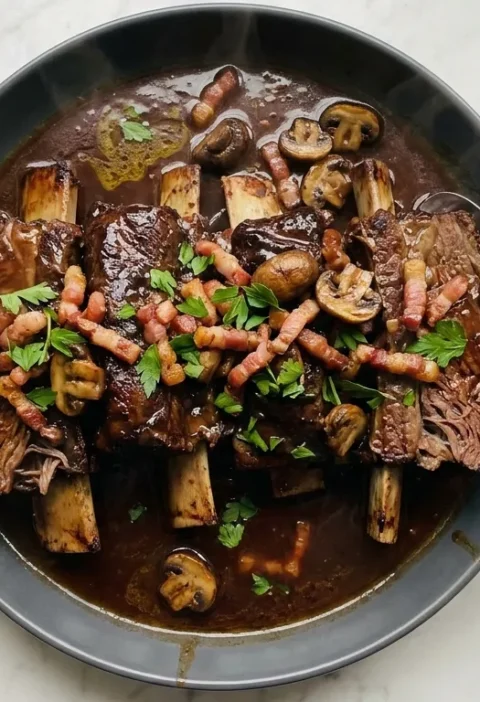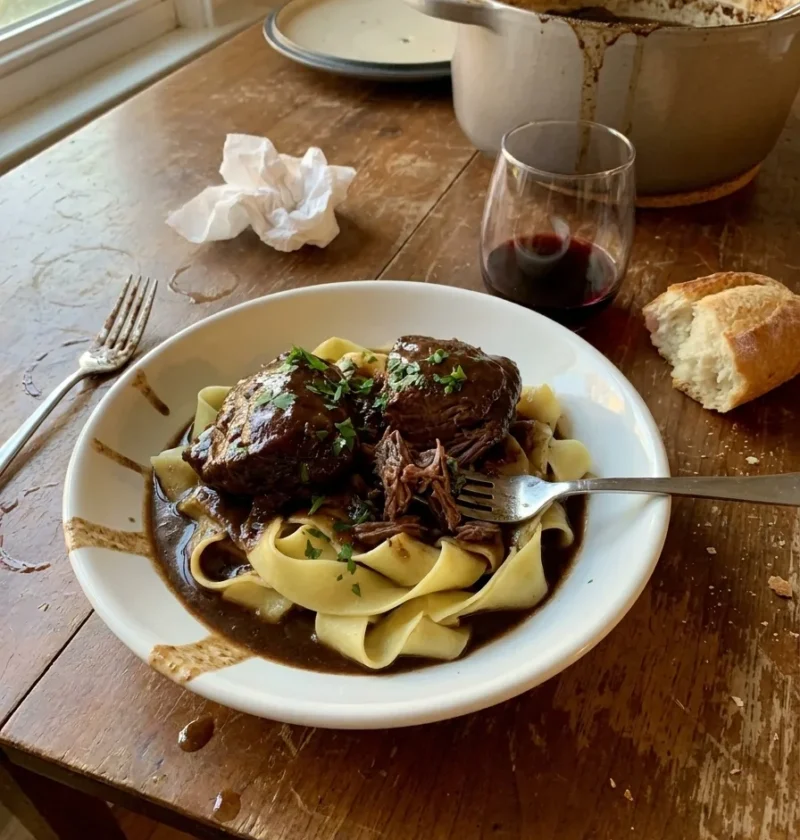
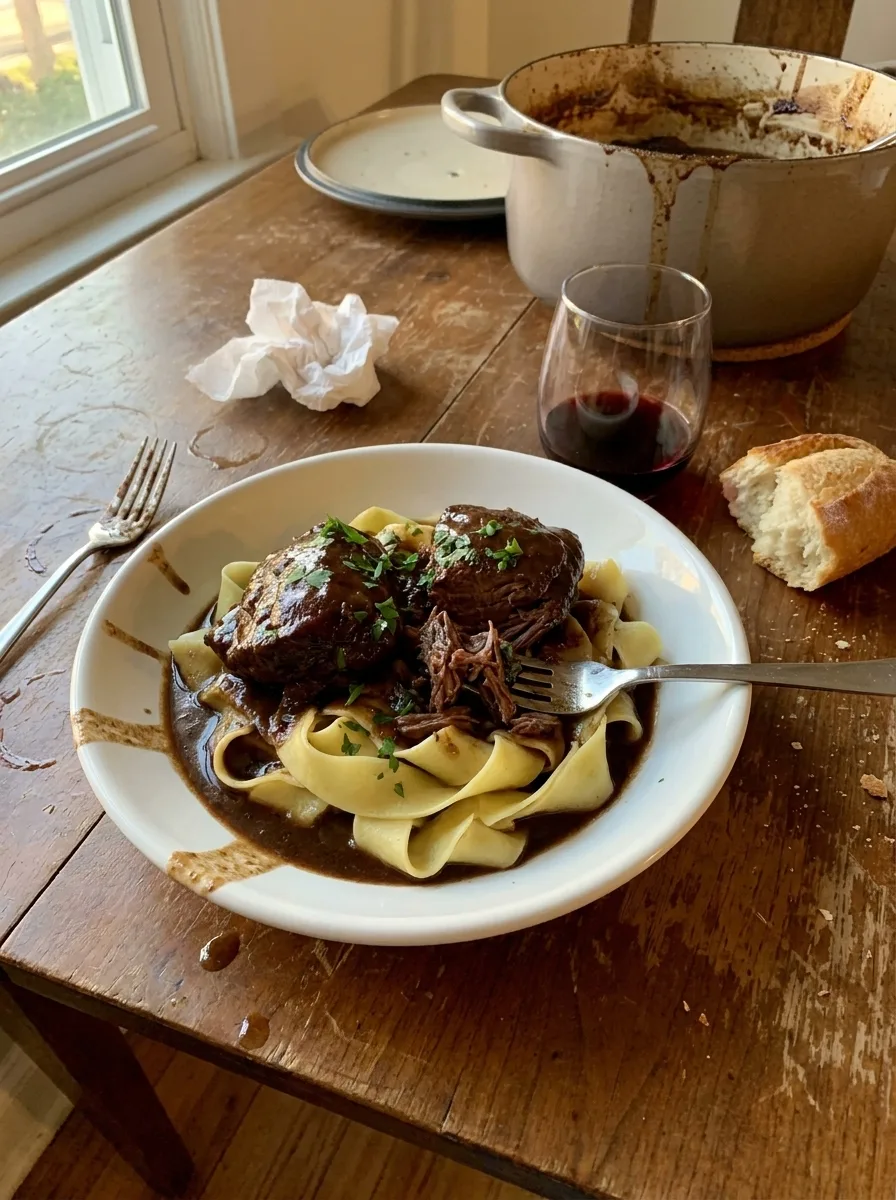
Gordon Ramsay’s beef cheek ragu is slow, rich and falling-apart tender, made with 1kg beef cheeks braised in red wine, tinned tomatoes and beef stock for 3.5 to 4 hours until the meat shreds with a fork. Served over pappardelle with parsley and the braising liquid spooned on top.
This recipe appears in Ultimate Home Cooking as “Slow-Braised Beef Cheeks with Pappardelle,” where Ramsay writes: “Don’t skimp on that cooking time, it’s the secret of the richly complex sauce.” He demonstrates it on YouTube too, calling beef cheeks “very cheap, a cut that takes a long time to cook, but give it a bit of love, let it cook in the oven, it comes out like a dream.”
Ramsay leaves the lid slightly ajar in the oven, not fully sealed. In the video he explains: “if we had to cover it completely the steam hits the top and the water comes right back.” With the lid cracked, moisture escapes as steam so the braising liquid reduces and thickens on its own over 4 hours. That’s how you end up with a glossy, concentrated sauce instead of watery stew.
Cooked this recipe? Send a photo or tell me what you changed at fans@gordonramsayrecipes.uk and I’ll share your experience live on this page.
Gordon Ramsay Beef Cheek Ragu
Course: DinnerCuisine: British, ItalianDifficulty: Easy4-6
servings15
minutes4
hours620
kcal255
minutesFrom Ultimate Home Cooking: 1kg beef cheeks slow-braised in red wine and tomatoes at 150C for 3.5-4 hours, shredded and served over pappardelle. A weekend dish that gets better the next day.
Ingredients
Olive oil, for frying
1kg (2.2 lb) beef cheeks or stewing beef
1 onion, roughly diced
2 garlic cloves, roughly crushed
1 bay leaf
400ml (14 fl oz) red wine
1 x 400g tin chopped tomatoes
500ml (2 cups) beef stock
500g (1 lb) dried pappardelle
Handful of flat-leaf parsley, finely chopped
Salt and freshly ground black pepper
Directions
- Preheat: Set the oven to 150C (300F/Gas 2).
- Brown the cheeks: Heat a dash of olive oil in a heavy-based casserole over high heat. Season the beef cheeks well on both sides and brown all over until deeply coloured. Transfer to a plate.
- Cook the aromatics: Add the onion, garlic and bay leaf to the empty pan. Cook for a couple of minutes until softened and colouring at the edges.
- Deglaze and build: Return the cheeks to the pan. Pour in the red wine and scrape up the bits from the bottom. Stir in the tomatoes and beef stock. Season lightly and bring to a simmer.
- Braise: Cover with the lid slightly ajar to let steam escape. Place in the oven for 3.5-4 hours until the meat is completely tender and the sauce is rich and thick. Check the liquid after 2 hours and top up with water if needed.
- Cook the pappardelle: Boil in well-salted water until al dente. Drain, drizzle with olive oil, season with salt and pepper.
- Serve: Spoon a ladle of sauce into the bottom of each serving dish. Top with the pappardelle. Finish with the beef cheeks, shredded if you like, more sauce spooned over and a scattering of chopped parsley.
FAQs
Why beef cheeks instead of stewing steak?
Ramsay calls beef cheeks “very cheap” and “well worthy of any dinner table” in Ultimate Home Cooking. Cheeks have more collagen than standard stewing beef, so they break down into a silkier, more gelatinous sauce after 4 hours. Stewing steak gives you tender chunks but the liquid stays thin.
The cookbook gives you an alternative though: “1kg beef cheeks or stewing beef.” So if your butcher doesn’t stock cheeks, stewing beef works. It just won’t have the same body in the sauce.
Why chopped tomatoes instead of tomato puree?
In the YouTube video, Ramsay is direct: “you could use tomato puree but chopped canned tomatoes make a much better sauce.” Puree is concentrated and can taste metallic over a long braise. Tinned tomatoes break down gradually, keeping their freshness and giving the sauce texture.
This is the opposite of his quick spaghetti bolognese, where he uses puree because the sauce only cooks for 6 minutes. Different tools for different timelines.
Why leave the lid ajar?
With the lid slightly off, moisture escapes as steam so the braising liquid reduces and concentrates as the meat cooks. After 4 hours you end up with a thick, glossy sauce instead of the same amount of watery liquid you started with.
Ramsay wants the cheeks mostly submerged though. In the video he says “the secret of braising is having a little of the meat exposed and 90% of it submerged,” comparing them to “little crocodile heads popping up out of the water.”
Why sauce on the bottom, pasta on top?
Ramsay’s serving method in the video is specific: ladle of sauce first, then the pappardelle, then the shredded beef and more sauce over the top. Most people dump everything into one bowl and mix.
His way means every layer is visible when it arrives at the table. The pasta sits in the sauce and absorbs it from underneath, and the beef sits proudly on top. A simple green bean salad on the side is all it needs.
How far ahead can you make this?
In Bread Street Kitchen, Ramsay says his venison ragu “can be made a day or so in advance, then reheated, in fact it will be better for it as the flavours really develop over time.” The same applies here. Braise the cheeks on Saturday, cool, fridge overnight, reheat Sunday.
The sauce sets into a thick jelly in the fridge because of the collagen from the cheeks. When you reheat it, that jelly melts back into a rich, glossy sauce. Fridge 3-4 days, freezer 3 months.