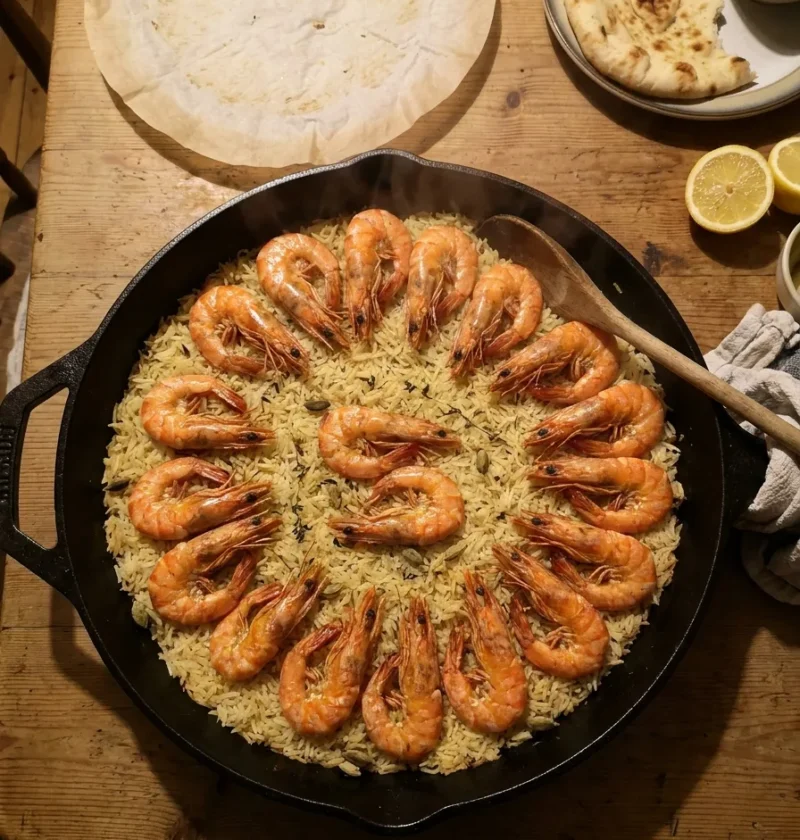
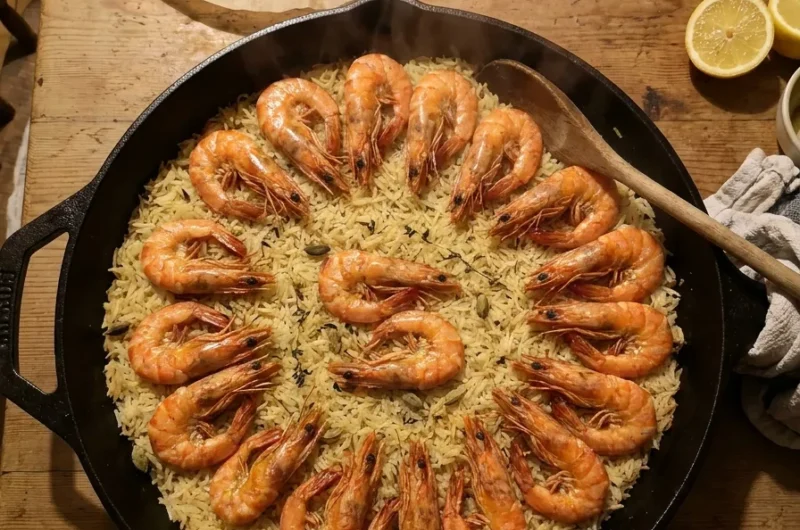
Gordon Ramsay’s prawn pilaf is tiger prawns arranged on top of cumin, coriander and cardamom-spiced basmati rice, covered with a parchment cartouche and baked in the oven at 200C for 10-12 minutes. One pot, one tray of prawns, no stirring. Ready in 20 minutes.
The recipe is from Fast Food, where Ramsay calls it “a terrific, easy one-pot supper” based on southern Indian cooking. He also makes it on The F Word with Dara O’Briain, where he tells him “no stress, it cooks itself” and calls it a “one pot wonder.” The oven does the work while you do nothing, which is the entire point. You can watch the full cook in his Tiger Prawn Pilau video.
The technique that makes this different from stovetop rice is the parchment cartouche with a steam hole cut in the centre. It traps enough steam to cook the prawns gently on top while letting just enough escape so the rice does not go soggy. Ramsay says “we’re sealing the rice off so the whole thing cooks a lot quicker,” and the result is prawns that steam in their shells while the rice absorbs the stock below them.
Cooked this recipe? Send a photo or tell me what you changed at fans@gordonramsayrecipes.uk and I’ll share your experience live on this page.
Gordon Ramsay Prawn Pilaf
Course: DinnerCuisine: IndianDifficulty: Easy4
servings5
minutes12
minutes410
kcal20
minutesTiger prawn pilaf baked in the oven from Fast Food. Spiced basmati rice with cumin, coriander, curry powder and cardamom, prawns arranged on top and baked under a parchment cartouche. One pot, no stirring, 20 minutes. Source: Gordon Ramsay’s Fast Food (Quadrille, 2007).
Ingredients
500ml (2 cups) chicken stock
4 tbsp olive oil
1 large onion, peeled and finely chopped
1 garlic clove, peeled and chopped
1 tsp ground cumin
1 tsp ground coriander
1½ tsp mild curry powder
10 cardamom pods
Few thyme sprigs, leaves only
200g (1 cup) basmati rice
Sea salt and freshly ground black pepper
20 large tiger prawns, shell on
Directions
- Preheat the oven: Heat to 200C (400F). Cut a circle of baking parchment big enough to cover a wide ovenproof pan. Fold the paper into segments and snip off the tip to create a small steam hole in the centre, then open it out.
- Boil the stock: Bring the chicken stock to the boil in a separate saucepan.
- Cook the spice base: Heat the olive oil in a wide ovenproof pan over medium heat. Add the onion, garlic, cumin, coriander, curry powder, cardamom and thyme leaves. Stir for 2-3 minutes until the onion softens and the spices are fragrant.
- Toast the rice: Tip in the basmati rice and stir well to coat in the spiced oil. Season with salt and pepper. Toast the rice for 1 minute, stirring constantly.
- Add stock and prawns: Pour in the boiling stock and quickly arrange the prawns on top of the rice in a single layer. Lay the parchment cartouche on top to cover.
- Bake: Transfer the pan to the oven and bake for 10-12 minutes until the rice is just tender and has absorbed most of the liquid.
- Rest and serve: Remove from the oven and leave to stand, still covered with the parchment, for 5 minutes before serving.
FAQs
Why does Ramsay bake the rice in the oven instead of the hob?
The oven gives even, all-around heat so the rice cooks uniformly without you standing over it stirring. On the hob the bottom scorches while the top stays undercooked, which is why most home pilaf turns out with a burnt layer on the bottom and crunchy grains on top.
Ramsay tells Dara O’Briain “by this time I would have sat down, I’d be reading a paper” because the oven does the work for you. Ten minutes baking, five minutes resting, no intervention.
Why does he leave the shells on the prawns?
The shells act as a barrier between the oven heat and the delicate flesh, so the prawns steam gently in their own juice rather than drying out. You peel them at the table, and each one comes with spiced rice steam trapped inside the shell which adds flavour you do not get from peeled prawns.
On The F Word he peels them first and stirs them in after the rice bakes, which works if you prefer a neater eat. But the book version with shells on is the way he wrote it, and the prawns stay juicier because of it. It is the same reasoning behind his shell-on approach across all his cookbooks: the shell does the work so the flesh does not have to.
Does the video version differ from the book?
Yes, in a few ways. On The F Word, Ramsay uses fish stock instead of chicken, adds chorizo for richness, throws in saffron and a cinnamon stick, and peels the prawns before stirring them in after the first bake for an extra 5 minutes. The book version is simpler: chicken stock, no chorizo, shell-on prawns from the start.
Both work. The book version is the quick weeknight one. The F Word version with saffron, cinnamon and chorizo is the dinner party upgrade if you have the extra ingredients and want more depth.
What is a parchment cartouche?
A circle of baking parchment cut to fit your pan with a small steam hole snipped in the centre. It sits directly on top of the food rather than being stretched across the rim like a lid. The cartouche traps most of the steam so the rice and prawns cook evenly, while the hole lets just enough escape so nothing gets waterlogged.
Ramsay says “this is called a cartouche, cover and put in the oven” like it is the simplest thing in the world, and it is. Fold the parchment into quarters, snip the corner, unfold, done.
Can you use this spice base for plain rice?
Yes, and Ramsay does exactly that. His saffron pilau rice from Quick and Delicious uses ghee instead of olive oil and swaps the curry powder for saffron and curry leaves, but the technique is identical: toast the rice in spiced fat, add boiling stock, bake.
The difference is the pilau rice is a side dish designed to go next to a curry or grilled meat, while this prawn pilaf is the whole dinner in one pot. Same method, different purpose.
What goes alongside prawn pilaf?
It is a complete dinner on its own, but warm homemade naan bread torn and dragged through the spiced rice is how most people actually eat pilaf in practice. The naan soaks up the cumin and coriander flavoured stock at the bottom of the pan, which is the best part of the whole dish.
A simple cucumber raita or a squeeze of lemon over the top is all it needs beyond that. The pilaf is already seasoned with five spices so anything heavy alongside fights the flavours instead of complementing them.