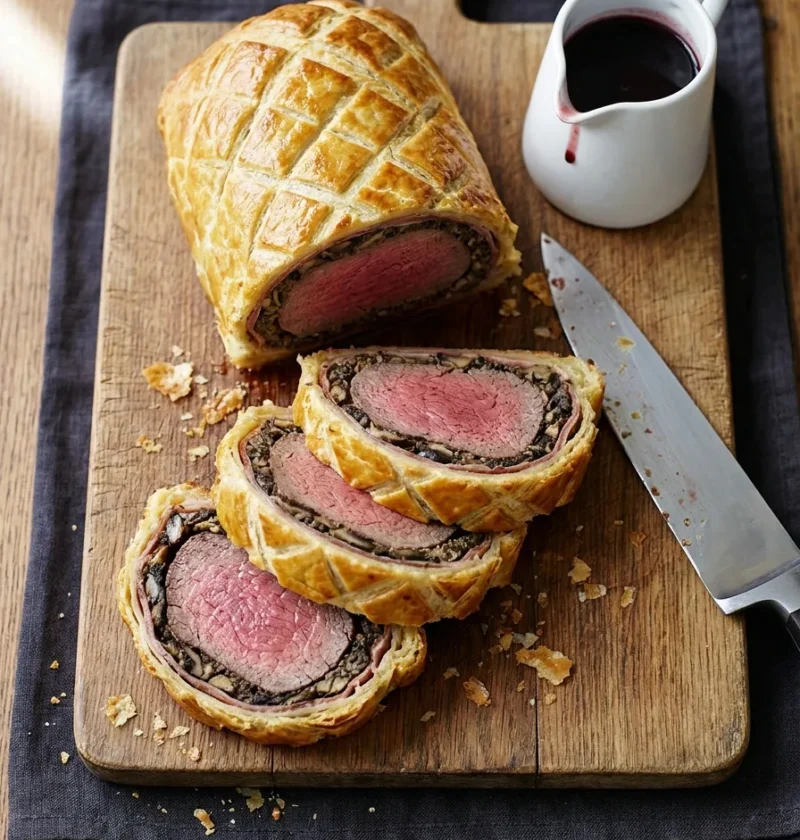
Gordon Ramsay’s beef wellington recipe wraps a seared beef fillet in mushroom duxelles and Parma ham, then bakes it inside puff pastry at 200°C (400°F) for 20 to 35 minutes until the pastry is deep gold and the centre is pink. Also called steak wellington or boeuf wellington, his restaurants have sold over a million of these since 1998.
Ramsay has four published versions of this dish, each slightly different. His MasterClass uses Dijon mustard and savoury crepes. Sunday Lunch uses English mustard and no crepes. UCC skips mustard entirely but includes a full red wine sauce from the beef trimmings. In his Christmas video he crumbles chestnuts into the duxelles for a sweeter, nuttier filling.
What stays the same across every version is the duxelles. Cook the mushrooms over high heat for 10 minutes until bone dry, because wet mushrooms are why most wellingtons end up with soggy pastry. In his MasterClass he also salts the inside of the pastry before wrapping, saying “not many chefs do that, it takes the moisture out.” I use his Sunday Lunch method below because it works with a single fillet and shop-bought pastry.
Cooked this recipe? Send a photo or tell me what you changed at fans@gordonramsayrecipes.uk and I’ll share your experience live on this page.

Gordon Ramsay Beef Wellington
Course: MainCuisine: BritishDifficulty: Intermediate4
servings30
minutes35
minutes650
kcal1 hr 5 min
(plus chilling)Intermediate
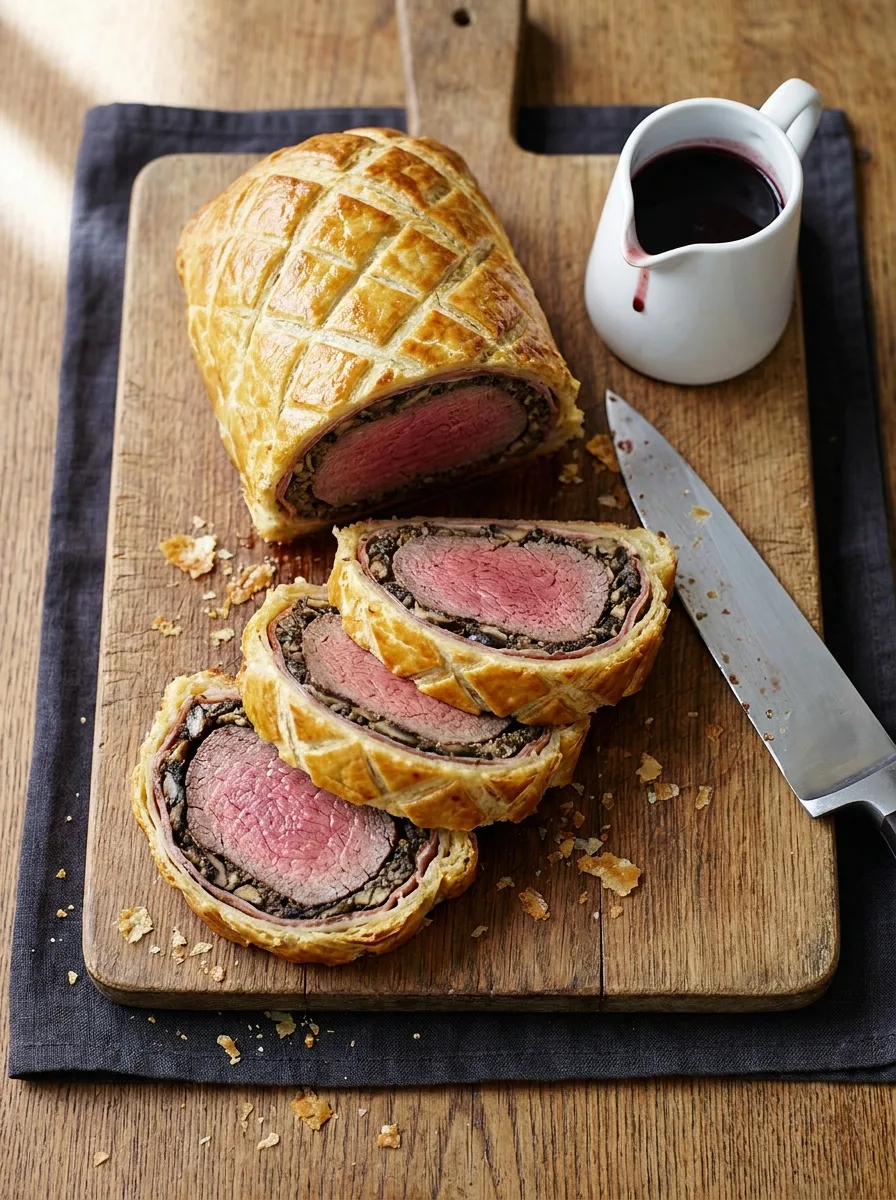
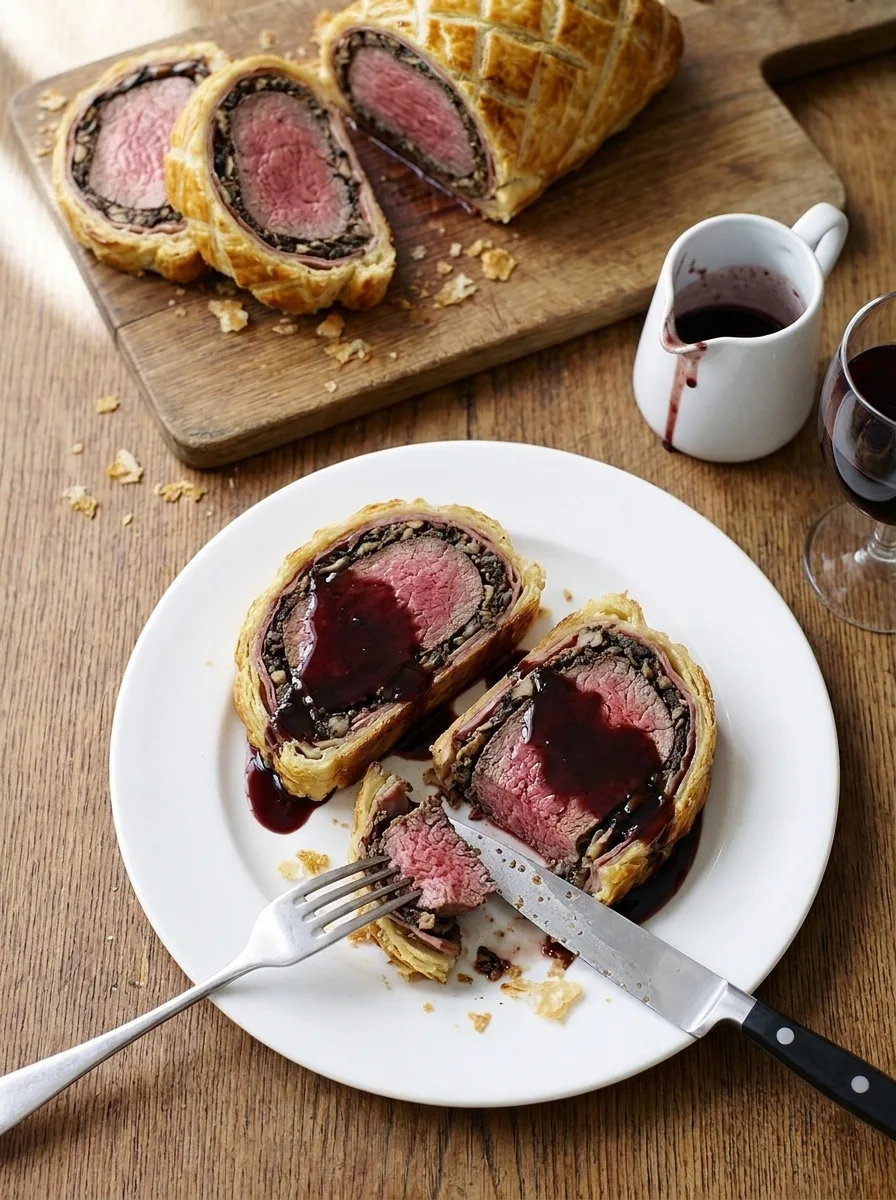
Gordon Ramsay’s beef wellington from his Sunday Lunch cookbook, made with a seared beef fillet, mushroom duxelles, English mustard, Parma ham and puff pastry, with notes from all four of his published methods.
Ingredients
750g (1 lb 10 oz) piece of centre-cut beef fillet (tenderloin)
400g (14 oz) flat cap mushrooms, roughly chopped
1-2 tbsp English mustard
6-8 slices of Parma ham
500g (1 lb 2 oz) ready-made puff pastry
Flour, for dusting
2 egg yolks, beaten
Olive oil, for cooking
Sea salt and freshly ground black pepper
Directions
- Blitz the duxelles: Pulse the mushrooms in a food processor with seasoning to a rough paste. Cook in a hot dry pan over high heat for about 10 minutes, tossing frequently, until all moisture has gone. Spread on a plate to cool completely.
- Sear the beef: Heat a little olive oil in a hot frying pan. Season the fillet well on all sides and sear for 30 seconds per side, just enough to colour it. In his MasterClass, Ramsay says “once you’ve cooked it, you can’t season it, so you got to season it properly beforehand.” Remove and leave to cool, then brush all over with English mustard while still warm so it absorbs into the meat.
- Wrap in ham: Lay cling film on a work surface and arrange the Parma ham slices in slightly overlapping rows. Spread the cooled mushroom paste over the ham with a palette knife. Place the seared beef in the middle, then use the cling film to roll the ham and mushrooms tightly around the beef into a barrel shape. Twist the ends to secure. Chill for 15-20 minutes.
- Wrap in pastry: Roll out puff pastry on a floured surface to a large rectangle, the thickness of a £1 coin. Remove the cling film from the beef and place in the centre. Brush the surrounding pastry with egg yolk. Fold the ends over, then wrap the pastry around the beef, cutting off excess. Turn seam-side down onto a baking sheet. Brush all over with egg yolk. Chill for 15 minutes.
- Score and bake: Heat oven to 200°C (400°F/Gas 6). Score the pastry lightly at 1cm intervals with the back of a knife. Brush with egg yolk again and sprinkle with a little sea salt. Bake for 20 minutes, then lower to 180°C (350°F/Gas 4) for another 15 minutes until deep golden.
- Rest and serve: Let the wellington rest for 10-15 minutes before slicing. Check with a probe thermometer: 52°C (125°F) for medium-rare, 57°C (135°F) for medium. The beef should still be pink in the centre.
Notes
- Chill the wrapped wellington before baking. Cold pastry puffs higher because the butter layers stay firm.
FAQs
Did Gordon Ramsay invent beef wellington?
No, but he brought it back. The dish existed for decades as beef en croûte before falling completely out of fashion. In his MasterClass he says “it became passé, we fell out of love with it and we brought it back” in 1998.
Hell’s Kitchen turned it into the most recognised dish on television. He didn’t invent it, but nobody else has sold a million of them either.
What sauce goes with beef wellington?
A red wine jus built from the beef trimmings. The UCC recipe includes the full method: brown the trimmings with shallots, reduce a whole bottle of wine until almost dry, add stock, simmer for an hour and strain through muslin.
Ask your butcher to save the trimmings when they cut your fillet. In UCC, Ramsay writes that the sauce is made while the wellington rests, so both are ready at the same time.
Can you make beef wellington ahead for Christmas?
Yes, and the recipe is designed that way. Sunday Lunch gives a full timeline: wrap the beef several hours ahead, add pastry two hours before, glaze and bake 40 minutes before serving.
His Christmas video goes further: “the big secret is it can be done the night before, the tighter the cling film the better the shape.” That version also crumbles chestnuts into the duxelles, which he says give “a sweet nutty flavour that works brilliantly with the earthy taste of the mushrooms.” You can freeze an unbaked wellington for up to a month and bake from frozen with 10 to 15 extra minutes.
Can you make individual beef wellingtons?
The UCC recipe calls for two 400g fillets rather than one large piece, so every guest gets their own crust with no slicing. They cook faster too, around 15 to 20 minutes. In UCC he writes “you can dress up a beef wellington with foie gras, cep mushrooms, or even truffles, but in my opinion, that beautiful fillet of beef should always be the star.”
For something even smaller, I’ve tested the wellington bites which work well as a canapé.
What to serve with beef wellington?
In Sunday Lunch he pairs it with wilted baby gem lettuce and sautéed potatoes with thyme and garlic. Nothing heavy, because the wellington is rich enough on its own.
I serve it with Ramsay’s mashed potatoes and tenderstem broccoli. If you want a second sauce beyond the jus, a creamy peppercorn sauce works well on the side.
Does beef wellington need crepes?
Depends which version you follow. The MasterClass uses thin savoury crepes with chives and thyme to stop moisture reaching the pastry. His Christmas video skips them, saying Parma ham alone “makes the dish much lighter.”
In Sunday Lunch he writes that the Parma ham is there “to shield the pastry from moisture” and mentions crepes as optional. If your pastry keeps going soggy, try the crepe layer. If it stays crisp without, leave it out.