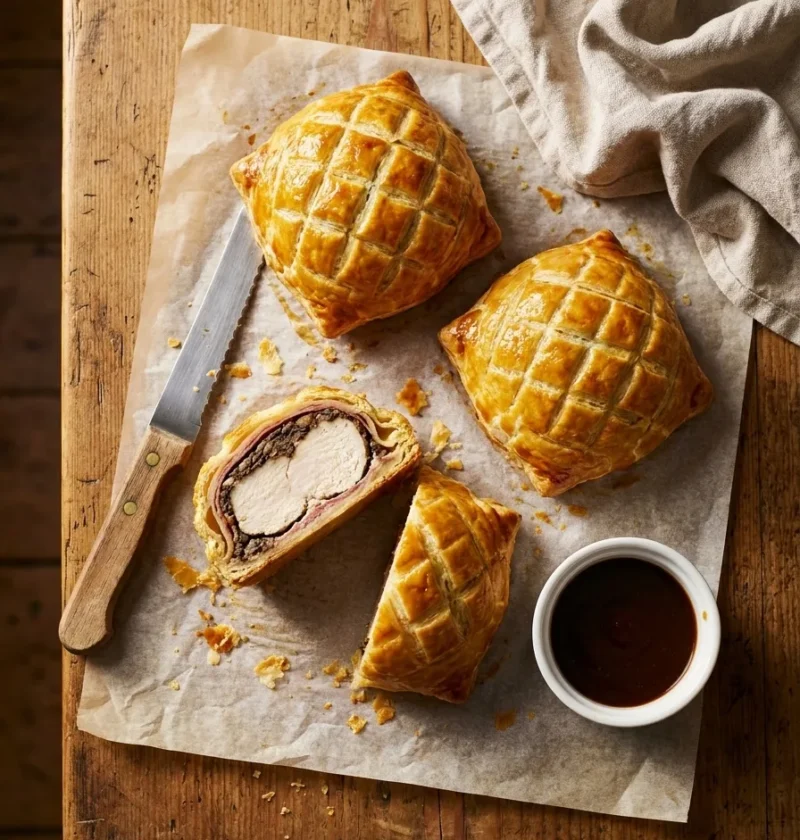
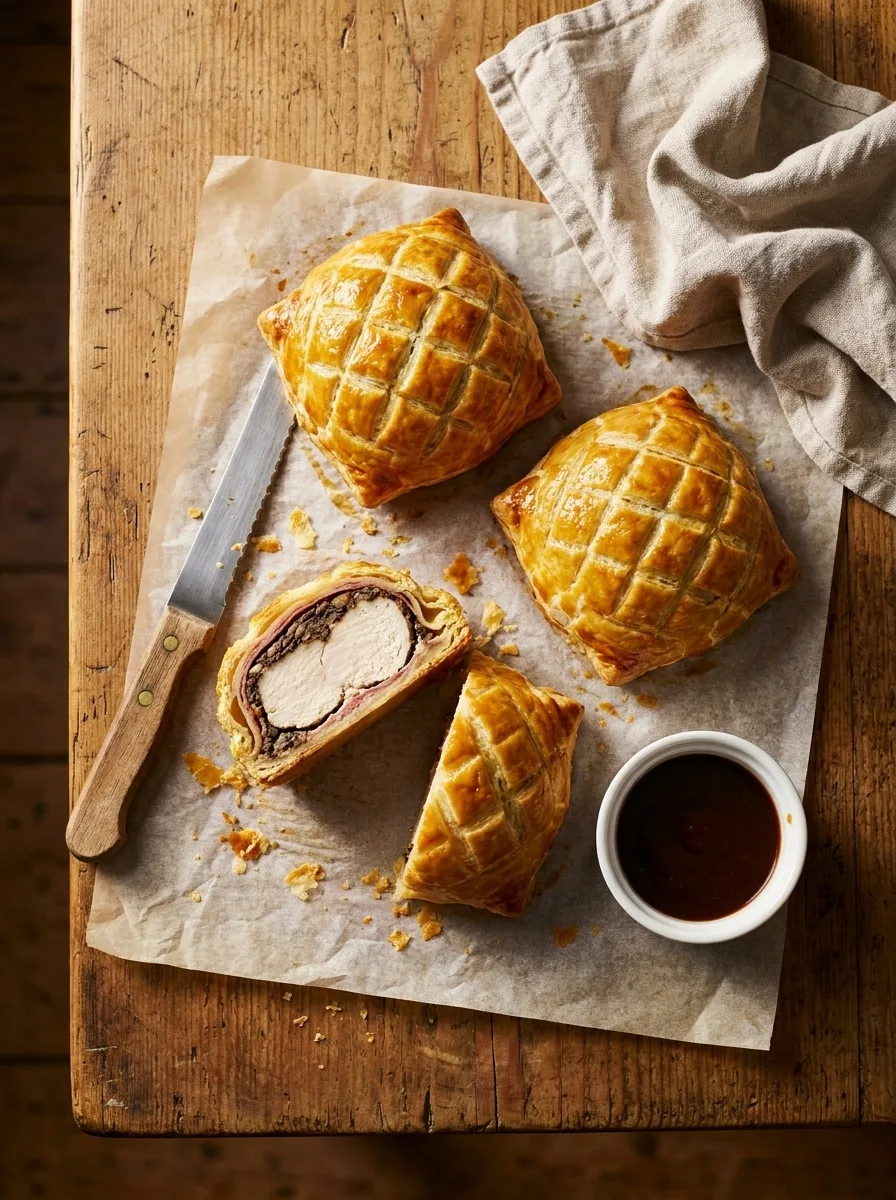
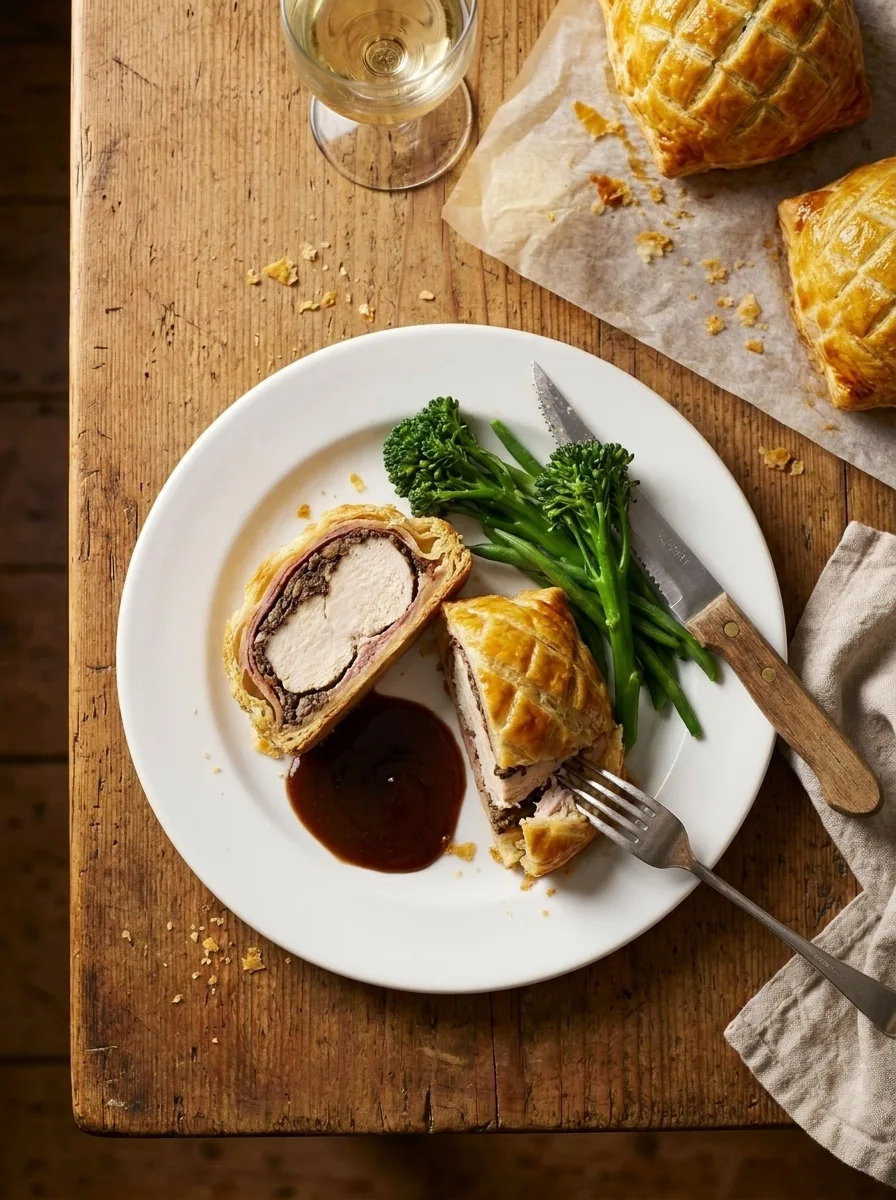
Gordon Ramsay’s chicken wellington recipe wraps seared chicken breasts in mushroom duxelle and Parma ham, then bakes them individually inside puff pastry at 200°C (400°F) for 25 to 30 minutes until golden and cooked through. Each person gets their own wellington, which makes plating easy.
Ramsay doesn’t publish a chicken wellington in any of his cookbooks, but every element comes from his beef wellington technique in Sunday Lunch and Ultimate Cookery Course: the same duxelle cooked until bone dry, the same Parma ham barrier to stop moisture reaching the pastry, the same cling film rolling method to set the shape before wrapping.
The difference is that chicken must be cooked all the way through, so the Parma ham matters even more here. It shields the breast from direct heat and keeps it juicy while the pastry crisps. Without it, the chicken dries out before the puff has time to go golden.
Gordon Ramsay Chicken Wellington
Course: MainCuisine: BritishDifficulty: Easy4
20
minutes30
minutes450
kcal50 min
(plus chilling)Easy
Seared chicken breasts wrapped in mushroom duxelle and Parma ham inside puff pastry, using the same wellington technique from Ramsay’s Sunday Lunch and Ultimate Cookery Course.
Ingredients
- For the chicken:
4 skinless boneless chicken breasts, about 180g (6 oz) each
Sea salt and freshly ground black pepper
1 tbsp olive oil
- For the filling:
300g (10 oz) chestnut mushrooms, finely chopped
1 thyme sprig, leaves only
1 garlic clove, finely chopped
Sea salt and freshly ground black pepper
- For the wrapping:
8 slices of Parma ham
2 sheets puff pastry, each cut in half
1 egg yolk, beaten
Directions
- Sear the chicken: Season the breasts with salt and pepper. Heat olive oil in a pan over high heat and sear for 30 seconds on each side until golden but still raw inside. Set aside to cool completely.
- Make the duxelle: Finely chop the mushrooms and cook in a dry pan over high heat with the thyme, garlic and seasoning for 8 to 10 minutes, stirring often, until all the moisture has gone and you have a dry paste. Spread on a plate to cool completely.
- Wrap in ham: Lay a sheet of cling film on a work surface. Lay two slices of Parma ham overlapping slightly. Spread a quarter of the duxelle over the ham. Place one chicken breast on top. Roll tightly using the cling film into a neat parcel. Twist the ends to seal. Repeat with the other three breasts. Chill for 20 minutes.
- Wrap in pastry: Brush each pastry rectangle with egg yolk. Unwrap a chicken parcel and place seam-side down on the pastry. Fold the pastry around it, press to seal, trim excess. Turn seam-side down onto a lined baking sheet. Repeat with the rest. Egg wash all over. Chill for 15 minutes.
- Bake: Heat oven to 200°C (400°F/Gas 6). Score the pastry lightly and egg wash again. Bake for 25 to 30 minutes until deep golden and puffed. Rest for 5 minutes. Check the thickest part reads 75°C (165°F) on a probe thermometer before serving.
FAQs
How do you stop chicken wellington drying out?
The Parma ham does most of the work. It wraps around the breast and acts as a barrier that holds moisture in while shielding the meat from the direct heat of the oven. Ramsay uses the same trick in his beef wellington, but it matters more here because chicken breast has no fat to keep it juicy on its own.
Don’t skip the searing step either. A quick 30-second sear locks a thin layer of colour on the outside without cooking the inside, so the breast stays juicy during the full bake.
What sauce goes with chicken wellington?
A Madeira sauce is the classic match. The sweet, rich wine flavour works with both the chicken and the mushroom duxelle without fighting either one. Pour it alongside on the plate, not over the top, or the pastry goes soggy.
A simple chicken gravy works too if you don’t want to open a bottle of Madeira.
Can you make chicken wellington ahead?
Assemble up to the pastry wrap, then chill for up to 8 hours before baking. Individual wellingtons hold their shape better when they go into the oven cold because the pastry layers stay firm. Egg wash just before baking, not before chilling.
You can freeze them unbaked for up to a month. Bake from frozen at 200°C and add 10 minutes. Check the internal temperature reaches 75°C before serving.
Can you use chicken thighs instead of breasts?
You can, but they’re harder to wrap neatly because the shape is uneven. Breasts give you a clean, uniform parcel that slices well. If you prefer thighs for the flavour, butterfly them flat before wrapping so the thickness is even. They’re more forgiving than breasts because the extra fat keeps them moist, so they won’t dry out as easily.