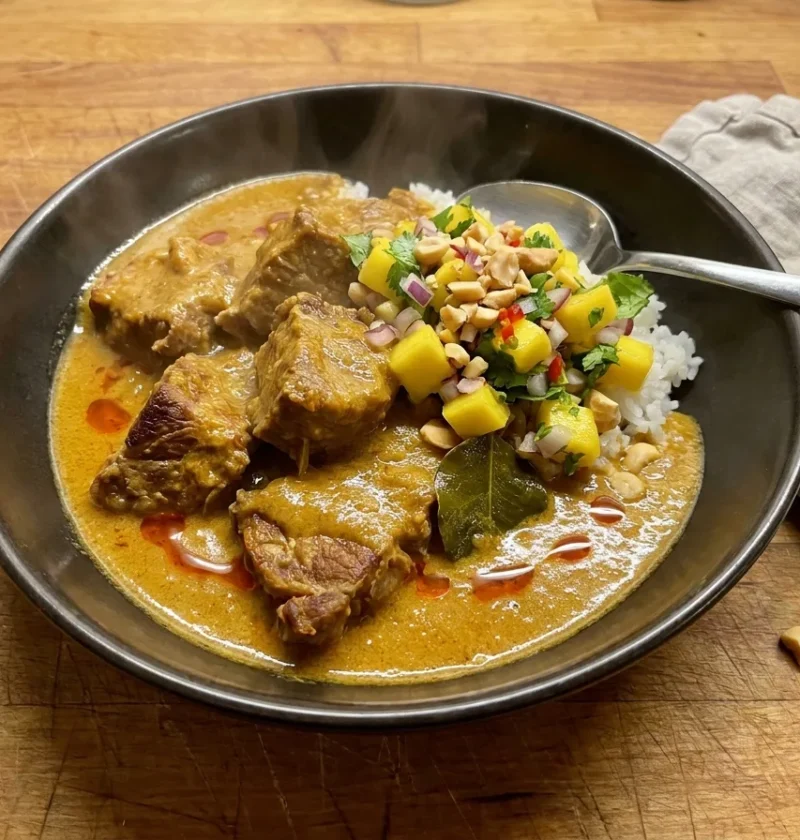
Gordon Ramsay’s pork neck curry simmers chunks of pork in coconut milk with a fresh lemongrass and lime leaf paste for an hour, until the meat is falling apart and the sauce has gone thick. A raw mango salsa goes on top, and it takes about 1 hour 35 minutes.
He calls this “my favourite curry in the world” in Ultimate Cookery Course, which is quite a claim from a man with two travel books full of them. The trick is the cut: pork neck is cheap, marbled, and built for exactly this kind of slow bubble.
The paste sets the dish apart from jar curries, and his method has one detail most people miss. Everything gets blitzed WITHOUT the oil first, then the oil goes in after, just to loosen. It keeps the paste coarse enough to fry properly instead of steaming.
Cooked this recipe? Send a photo or tell me what you changed at fans@gordonramsayrecipes.uk and I’ll share your experience live on this page.
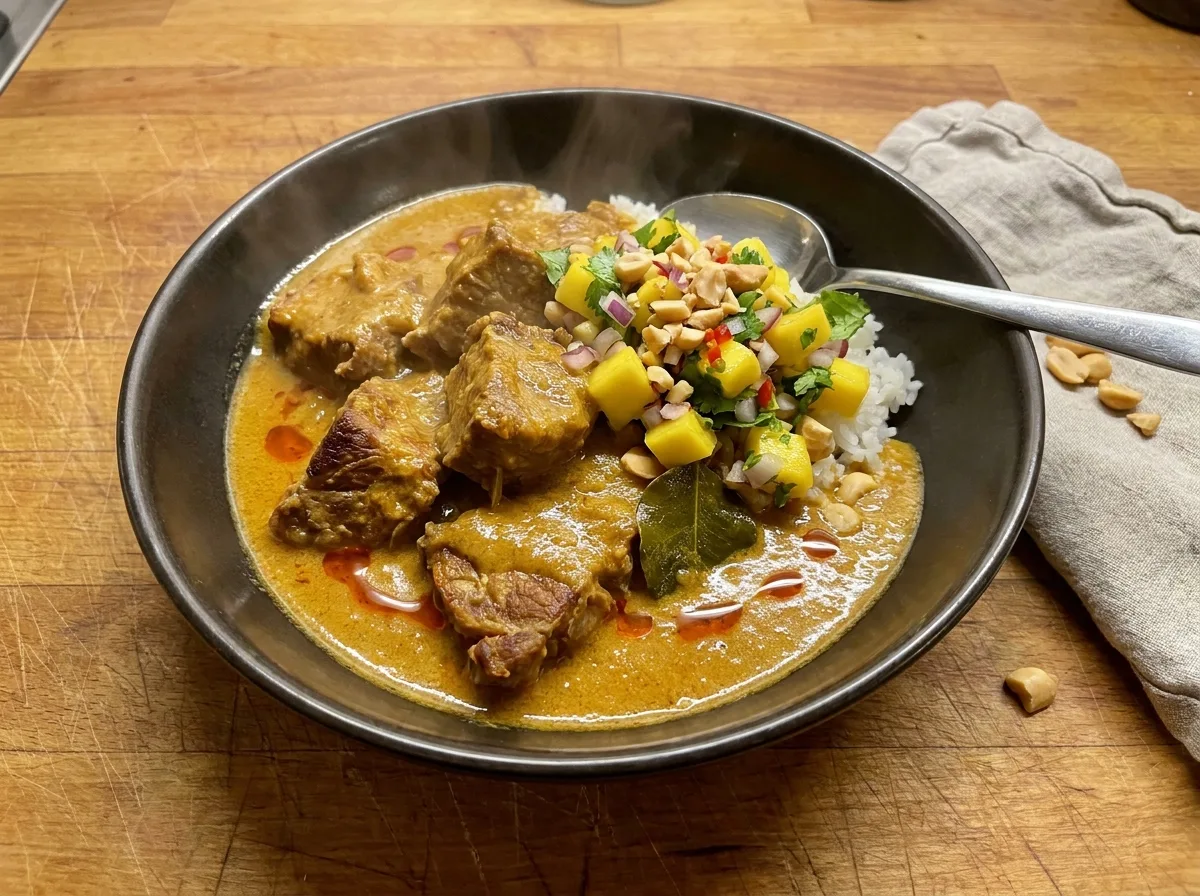
Gordon Ramsay’s Pork Neck Curry with Mango Salsa
Course: DinnersCuisine: Thai, BritishDifficulty: Medium4-6
servings20
minutes1
hour15
minutes770
kcal1 hr 35 min
The dish Ramsay names his favourite curry in the world, printed in Ultimate Cookery Course: slow-simmered pork collar in a coconut lemongrass sauce with a fresh chilli mango salsa spooned over at the table.
Ingredients
- For the curry paste:
1 lemongrass stick, bashed and finely chopped
4 kaffir lime leaves, 2 shredded
1-2 red chillies, deseeded and finely chopped, to taste
4cm (1½ in) piece fresh root ginger, peeled and grated
3 garlic cloves, peeled and roughly chopped
1 tsp ground cinnamon
2 tsp ground coriander
2 tbsp olive oil
Sea salt and freshly ground black pepper
- For the curry:
Olive oil, for frying
1kg (2.2 lb) pork neck (US: pork collar or Boston butt), cut into 2.5cm (1 in) chunks
1 onion, peeled and finely sliced
1 x 400ml (14 fl oz) tin coconut milk
750ml (3¼ cups) chicken stock
1 tbsp palm sugar (or golden caster sugar)
1½ tbsp soy sauce, to taste
1½ tbsp fish sauce, to taste
Rice, to serve
- For the mango salsa:
1 mango, not too ripe, peeled and finely diced
1 small red onion, peeled and finely diced
Small bunch of fresh coriander, roughly chopped
2 tbsp chopped toasted peanuts
Juice of 1 lime
1 red chilli, deseeded and finely chopped
Directions
- Make the paste: Combine the lemongrass, shredded lime leaves, chillies, ginger, garlic, cinnamon and coriander with a good pinch of salt and a generous grinding of pepper in a small food processor. Blitz to a smooth paste, then add the oil to loosen slightly.
- Brown the pork: Heat a glug of oil in a heavy-based pan over medium heat and brown the pork neck for about 5 minutes until coloured all over, in batches if your pan is small. Remove and set aside.
- Cook the onion: Add a little more oil to the pan, then cook the onion for 3-4 minutes until tender and beginning to colour at the edges.
- Fry the paste: Add the curry paste and stir it around until aromatic and well mixed into the onions.
- Coat and add coconut milk: Return the pork to the pan, stir to coat in the paste, then add the coconut milk. Stir thoroughly, scraping up any bits stuck to the bottom.
- Season and simmer: Add the chicken stock, then stir in the sugar, whole lime leaves, soy sauce and fish sauce. Taste and adjust, adding more soy or fish sauce if needed. Bring to the boil, then simmer gently for 1 hour, stirring occasionally, until the sauce is thick and the pork tender.
- Make the salsa: Meanwhile, mix the mango, red onion, coriander, peanuts, lime juice and chilli. Season to taste.
- Serve: Spoon the curry over rice and top with the mango salsa.
Notes
- Taste before the simmer starts, the soy and fish sauce balance is personal. My UK to US conversions guide covers any cup measures you need.
FAQs
What is pork neck and what do I ask for at the shop?
It’s the cut between the head and shoulder, sold in the UK as pork neck or collar, and in the US as pork collar or Boston butt. Ramsay picks it because it’s one of the most overlooked cuts: heavily marbled, so an hour of simmering melts it soft instead of drying it out.
If you can’t find it, boneless shoulder does the same job. Avoid loin or fillet though, because lean cuts turn to sawdust long before the hour is up.
Why does the oil go in after blitzing the paste?
That’s his order in both versions: aromatics first with just salt and pepper, then the oil at the end to loosen. A drier blend stays slightly coarse, and coarse paste fries in the pan instead of steaming.
The book and the video actually disagree on the tool. Ultimate Cookery Course says a small food processor and a smooth paste, while in his video he bashes it rough in a pestle and mortar. The rough version fries with more texture, so pick either, but the oil always goes in last. The same fresh-paste logic runs through his Thai green curry rice.
Why is the salsa raw?
Because everything underneath it is slow and rich. An hour in coconut milk makes a deep, heavy sauce, and the raw mango, lime and chilli land on top like a reset button. Don’t skip the chilli in the salsa, it’s doing half the work.
He actually has two mango salsas: this one uses firm mango and peanuts, while his standalone mango salsa is a mintier version with ripe mango and sesame oil. Different recipes, so check which one you’re shopping for.
Can I make pork neck curry in a slow cooker?
The book does it on the hob, but it converts cleanly to slow cooking because it’s already a gentle simmer, the same low-and-slow coconut treatment as his massaman curry. Brown the pork and fry the paste in a pan first, then transfer to the slow cooker for 4 hours on low.
Don’t skip the browning and paste-frying though. The slow cooker can’t do either, and that’s where the flavour is built. Reduce the stock to 500ml too, since nothing evaporates under the lid.
I can’t find kaffir lime leaves. What works instead?
Check the label first, because UK supermarkets increasingly sell them as makrut lime leaves, fresh in the herb section or dried with the spices. Frozen ones from Asian supermarkets are better than dried.
If you’re truly stuck, the zest of one lime gets you partway there. It misses the perfume of the leaves, so add it with the coconut milk rather than the paste to keep what fragrance it has.
Does pork neck curry keep?
Better than it started. The sauce thickens overnight and the spices settle in, so the curry itself is excellent for 3 days in the fridge and freezes well for 2 months. Leftovers spooned over his egg fried rice make the better second dinner.
The salsa is the opposite: lime and salt pull the juice out of the mango within hours, so it goes watery and dull. Make a fresh one in the five minutes the rice takes. And if you’re planning a full curry night, my roundup of his curry recipes ranks all 27 by where to start.