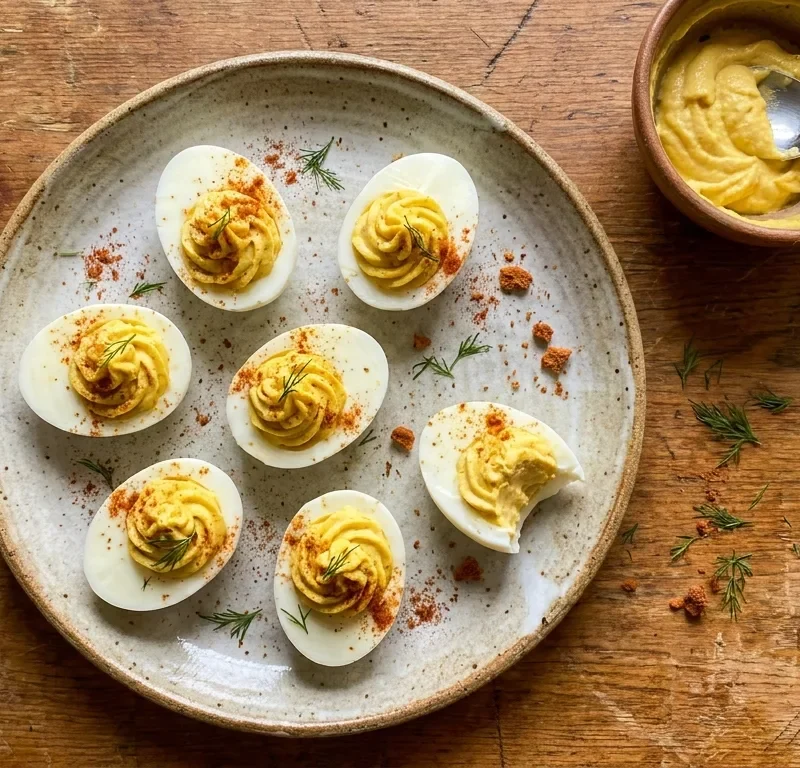
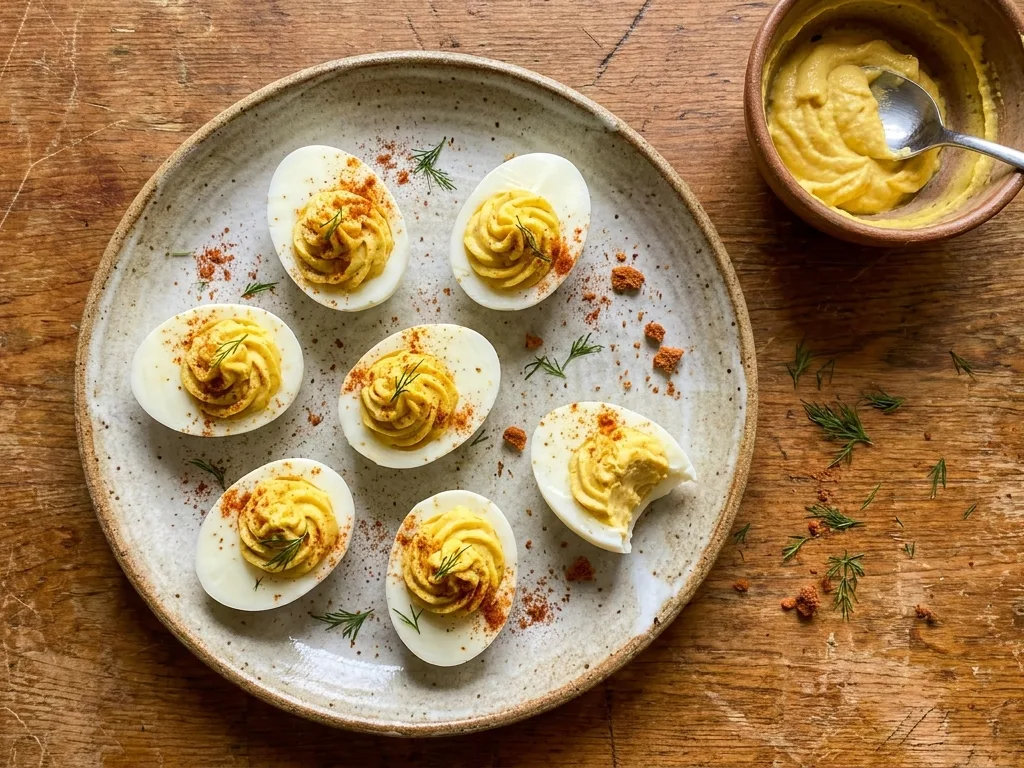
Gordon Ramsay’s devilled eggs are smooth, creamy and lightly spiced, filled with sieved yolks mixed with Greek yogurt, Dijon mustard, cider vinegar and a dash of Worcestershire sauce, then dusted with smoked paprika. This recipe is built from his techniques across four cookbooks, makes 12 halves and takes 20 minutes from pan to plate.
Ramsay doesn’t publish devilled eggs under that name, but every component appears in his books. The egg filling base comes from his egg “mayonnaise” in Healthy, Lean and Fit, where he uses yogurt instead of real mayonnaise. The sieving method comes from his gribiche sauce in Passion for Seafood. The devilling spice comes from Great British Pub Food, and the boiling and peeling technique comes from Ultimate Home Cooking.
The technique that makes these smoother than any fork-mashed version is the sieve. In Passion for Seafood, Ramsay makes a gribiche sauce by rubbing hard-boiled eggs “through a metal sieve into a bowl,” which breaks down every chalky lump the way mashing cannot. It takes 30 seconds and the filling pipes cleanly without clogging.
Cooked this recipe? Send a photo or tell me what you changed at fans@gordonramsayrecipes.uk and I’ll share your experience live on this page.
Gordon Ramsay’s Devilled Eggs Recipe
Course: AppetisersCuisine: BritishDifficulty: Easy4
servings20
minutes10
minutes115
kcal30
minutesBuilt from Ramsay’s egg “mayonnaise” filling (Healthy, Lean and Fit), his gribiche sieving technique (Passion for Seafood), and his devilling spice from Great British Pub Food. Yogurt replaces mayo for a lighter filling that lets the yolk shine.
Ingredients
6 large free-range eggs
2 tbsp Greek yogurt
1 tsp Dijon mustard
1 tsp cider vinegar
Squeeze of lemon juice
Dash of Worcestershire sauce
Pinch of cayenne pepper
3 sprigs of fresh dill, finely chopped
Sea salt and freshly ground black pepper
Smoked paprika, for dusting
Directions
- Boil the eggs: Bring a large saucepan of water to a gentle simmer and carefully lower in the eggs. Cook for exactly 10 minutes, then drain and transfer to a bowl of ice-cold water. Leave for 5 minutes.
- Peel: Tap each egg on the counter, then roll gently to crack the shell all over. Peel under cold running water so the shell lifts away cleanly.
- Halve and sieve: Slice each egg in half lengthways and scoop the yolks into a bowl. Push the yolks through a fine metal sieve into a clean bowl using the back of a spoon.
- Make the filling: Add the yogurt, mustard, cider vinegar, lemon juice, Worcestershire sauce, cayenne and chopped dill to the sieved yolks. Season with salt and pepper and stir until smooth.
- Fill and serve: Spoon or pipe the filling back into the egg white halves. Dust with smoked paprika and serve.
FAQs
Why does this recipe use yogurt instead of mayonnaise?
In Healthy, Lean and Fit, Ramsay writes that you can “lose the real mayonnaise” because “the base is much healthier than the oil and egg yolks of a standard mayonnaise.” His egg filling uses Greek yogurt with Dijon mustard, cider vinegar and lemon juice, which gives the same creamy body with a lighter, tangier finish.
The yogurt lets the egg yolk flavour lead rather than burying it under oil. If you prefer the traditional route, his homemade mayonnaise from Ultimate Home Cooking gives you more control over the richness than any shop-bought jar.
What makes these “devilled” rather than just stuffed eggs?
The cayenne pepper and Worcestershire sauce. In Great British Pub Food, Ramsay uses cayenne as the devilling spice in his devilled whitebait, and Worcestershire sauce is the backbone of his devil sauce for devilled kidneys on toast. Both are traditional British devilling ingredients that add real heat and savoury depth.
Most American devilled egg recipes rely on sweet paprika for colour rather than genuine spice. Ramsay’s British approach uses cayenne for warmth and Worcestershire for umami, then adds smoked paprika purely as a finishing garnish on top.
How do you stop the grey-green ring around the yolk?
A gentle simmer, never a rolling boil. Ramsay says “don’t boil them ferociously” because aggressive bubbling overcooks the outside of the yolk before the centre is done. Ten minutes at a simmer that barely breaks the surface gives a clean, creamy yellow centre with no discolouration.
The peeling matters too. On his boiled eggs with anchovy soldiers page, his technique is to crack the base first, set the egg back in cold water so it seeps under the shell, then “tap tap tap, pull pull pull” around the egg. The cold water loosens the membrane, which keeps the whites smooth for filling.
How far ahead can you make devilled eggs?
The filling keeps in the fridge for up to a day in a sealed container, so make it the night before. Fill the whites no more than 2 hours before serving, because the yogurt base softens the surface of the egg white over time and they start to look wet rather than clean.
For a bigger spread, serve these alongside his anchovy dip with crudités from Ultimate Home Cooking. Both are make-ahead appetisers that sit at room temperature without wilting, so they work well on the same platter for a gathering.
Is this the same egg base as scotch eggs?
Same starting point, completely different direction. Both begin with a hard-boiled egg cooked for 10 minutes and peeled cleanly, but his scotch eggs with black pudding from Ultimate Home Cooking wrap the whole egg in sausage meat and deep-fry it, while these split the egg open and fill the inside.
The peeling technique matters even more for scotch eggs because any crack in the white means the sausage meat pushes through during frying. For devilled eggs a small tear is easier to hide since the filling covers it, so these are more forgiving if you are still getting the hang of peeling.