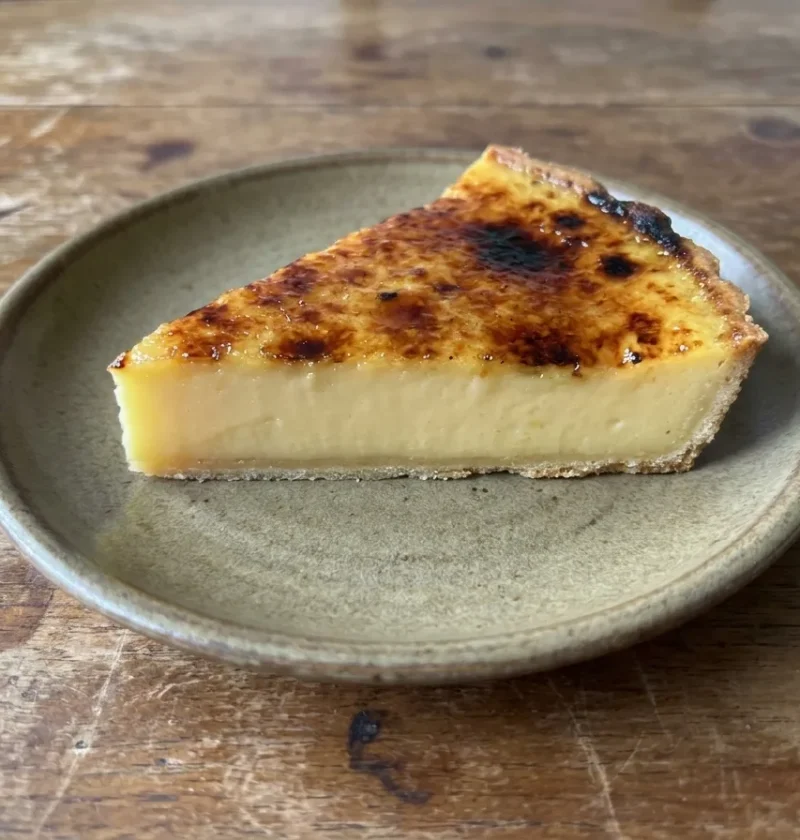
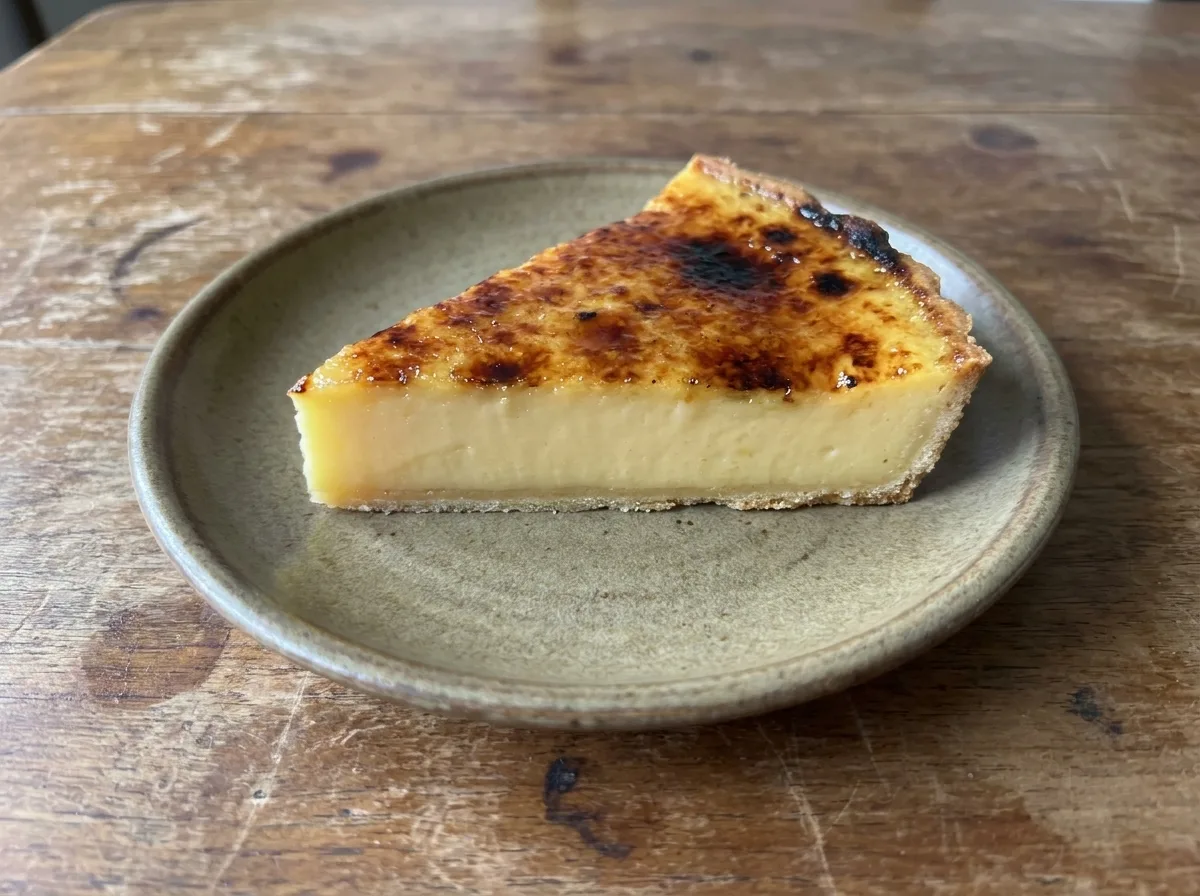
Gordon Ramsay orange and lemon tart is a thin sweet pastry case filled with citrus custard, finished with a caramelised sugar crust. It serves six, and everything about it depends on the oven being turned right down to 100°C (212°F).
He puts it on the restaurant menu and says people compliment it often, in A Chef for All Seasons, page 202. Three things make it work, according to him. Pastry rolled thin without tearing, juices boiled down hard, and an oven low enough that the filling only just sets.
That last part is why the sugar crust matters. Because the filling stays soft, it needs something crisp on top. Ramsay builds that in two thin layers rather than one thick one, torching each separately.
Cooked this recipe? Send a photo or tell me what you changed at fans@gordonramsayrecipes.uk and I’ll share your experience live on this page.
Gordon Ramsay Orange and Lemon Tart
Course: DessertCuisine: FrenchDifficulty: Hard6
servings40
minutes1
hour25
minutes650
kcal2
hours4 hr 5 min
A winter tart from A Chef for All Seasons, where 600ml of orange juice cooks down to 170ml before it meets the eggs, and the sugar crust is torched twice rather than once.
Ingredients
- For the sweet pastry:
100g unsalted butter, softened (7 tbsp)
70g caster sugar (⅓ cup superfine sugar)
1 vanilla pod
1 medium free-range egg, beaten
200g plain flour (1⅔ cups all-purpose flour), sifted with a large pinch of fine sea salt
- For the filling:
600ml orange juice (2½ cups)
Juice of 2 lemons
Grated zest of 1 lemon
Grated zest of 1 orange
180g caster sugar (¾ cup + 2 tbsp superfine sugar)
6 free-range egg yolks, beaten
150ml double cream (⅔ cup heavy cream)
- To finish:
2 tbsp icing sugar (confectioners’ sugar)
Directions
- Make the pastry: Beat the butter and sugar until smooth and creamy. Split the vanilla pod, scrape the seeds in with a knife tip, then work in the beaten egg and flour alternately until the dough comes together smoothly. Knead lightly, wrap in cling film and chill for about 20 minutes.
- Line the tin: Roll the dough as thinly as you can into a round of about 30cm (12 in), enough to line a 20cm (8 in) flan tin 2.5 to 3cm deep with plenty of overhang. Lift it in on the rolling pin, press it into the base and sides, then patch any gaps with trimmings. Leave the overhang alone and sit the tin on a baking sheet.
- Chill and heat the oven: Line the case with a large sheet of foil, bringing it well up the sides, and fill with baking beans. Chill for 20 minutes while the oven comes up to 180°C (350°F), Gas 4.
- Blind bake: Bake for 12 to 15 minutes until just set, lift out the foil and beans, then give it 5 minutes more. Trim the top level with the tin using a very sharp knife and leave to cool.
- Drop the oven right down: Turn it to its lowest setting, ideally 100°C (212°F). Most domestic ovens will not go below about 120°C (248°F). Allow roughly 20 minutes for the temperature to fall.
- Reduce the juice: Boil the orange and lemon juices together until about 170ml (⅔ cup) is left, then cool. Beat the zests with the sugar and egg yolks, add the cream, then stir in the cooled juice.
- Fill and bake: Sit the pastry case on the pulled-out oven shelf and pour the filling in slowly, taking it as close to the rim as you dare. Push the shelf back very carefully and bake for about 35 minutes, until the filling is still quite soft.
- Set and chill: Turn the oven off and leave the tart inside to cool, until it is firm enough to move without spilling. Cool completely, then chill.
- Caramelise twice: Sift half the icing sugar evenly over the top and torch it straight away. Let it cool and crisp, then sift over the rest and torch that too. Leave to cool completely.
- Serve: Cut into portions with a long sharp knife, and add a trickle of cream if you like.
Notes
- The pastry is Ramsay’s rich sweet pastry, which he gives on page 153 alongside the pear and frangipane flan, so the quantities look generous for a tart this size. He suggests a confit of orange and lemon slices as decoration, from page 215. Calories are worked out from the ingredients, since the book gives none, and the two-hour chill is my estimate rather than his.
FAQs
Why boil down the orange juice first?
Because 600ml of juice brings far too much water for a custard to set around. Boiling it to 170ml drives that water off while the citrus stays behind, which leaves the liquid about four times more concentrated than it started.
Ramsay lists it as one of the three things a good French citrus tart depends on. My own experience is that skipping it gives you a filling that stays loose no matter how long you leave it in.
Why bake it at only 100°C?
Because a custard set with six egg yolks will scramble if the oven runs hot, and once that happens the texture is gone for good. Keeping it low lets the filling thicken slowly instead, which is why he wants it out while still quite soft.
He is honest that most home ovens hover nearer 120°C (248°F). If yours does, start checking before 35 minutes. The crème brûlée runs on the same principle, where gentle heat is what keeps it silky rather than grainy.
Do you need a blowtorch?
Yes, and there is no way round it. Under a grill, the filling would warm long before the sugar caught. Crust and tart would soften together.
A small kitchen torch is enough. Since the sugar goes on in two thin layers, you are melting very little at a time. That is exactly why the crust ends up fine and even.
Why caramelise the sugar twice?
One heavy dusting melts unevenly, so parts scorch while other parts stay powdery. Two thin layers give the torch less to work through each time, and the gap between lets the first layer cool and go properly crisp.
Ramsay calls it a final flourish and says it is what people notice. It is also the only part of the recipe he tells you outright to go and try.
Do you trim the pastry before baking?
No, and leaving the overhang on is deliberate. Ramsay explains why on page 153, where he says he always rolls out far more pastry than the tin needs, precisely to allow for shrinkage.
Once the case is baked you slice the top level with the tin, using a very sharp knife. That gives a cleaner edge than trimming raw dough ever does. The pie crust page takes the opposite approach, because shortcrust behaves differently.
Why fill the tart on the oven shelf?
Because the filling comes right up to the rim, and a full tart cannot be carried across a kitchen without slopping over the side. Pulling the shelf out and pouring in place is the only way to get it that full.
Push it back slowly and evenly once it is poured. There is nothing holding the filling in but the pastry, so any jolt sends it over the edge.
How is this different from the other Gordon Ramsay lemon tart?
A completely different dessert, despite the name. The lemon tart from Ultimate Cookery Course is really a treacle tart, built on golden syrup and breadcrumbs with lemon curd spread underneath.
This one is a French custard tart with nothing in the filling but citrus, sugar, yolks and cream. Sharp and light against sticky and sweet, so it depends which you are after.