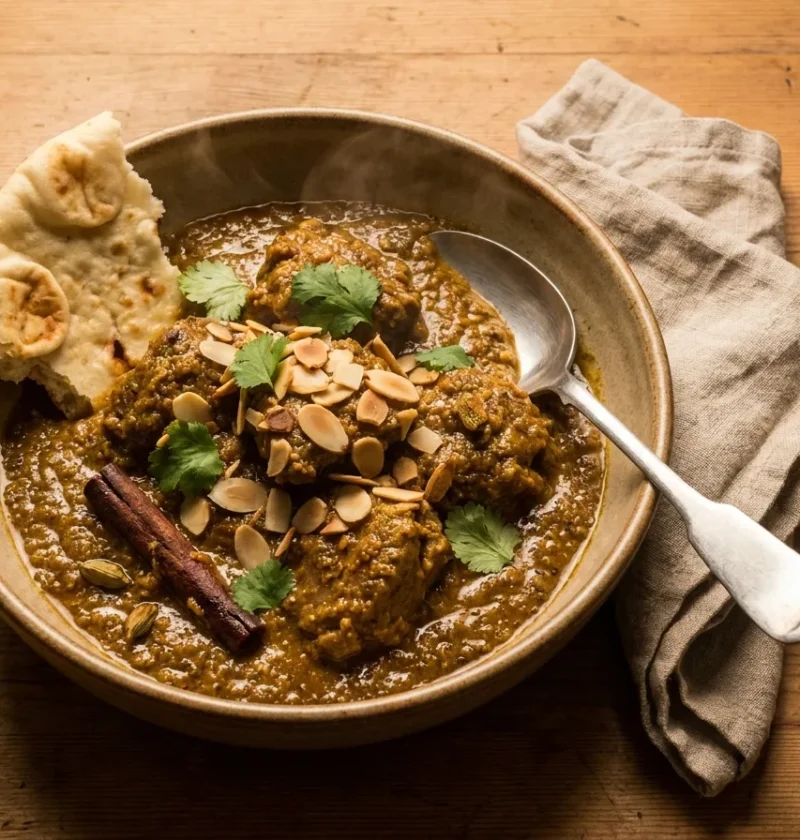
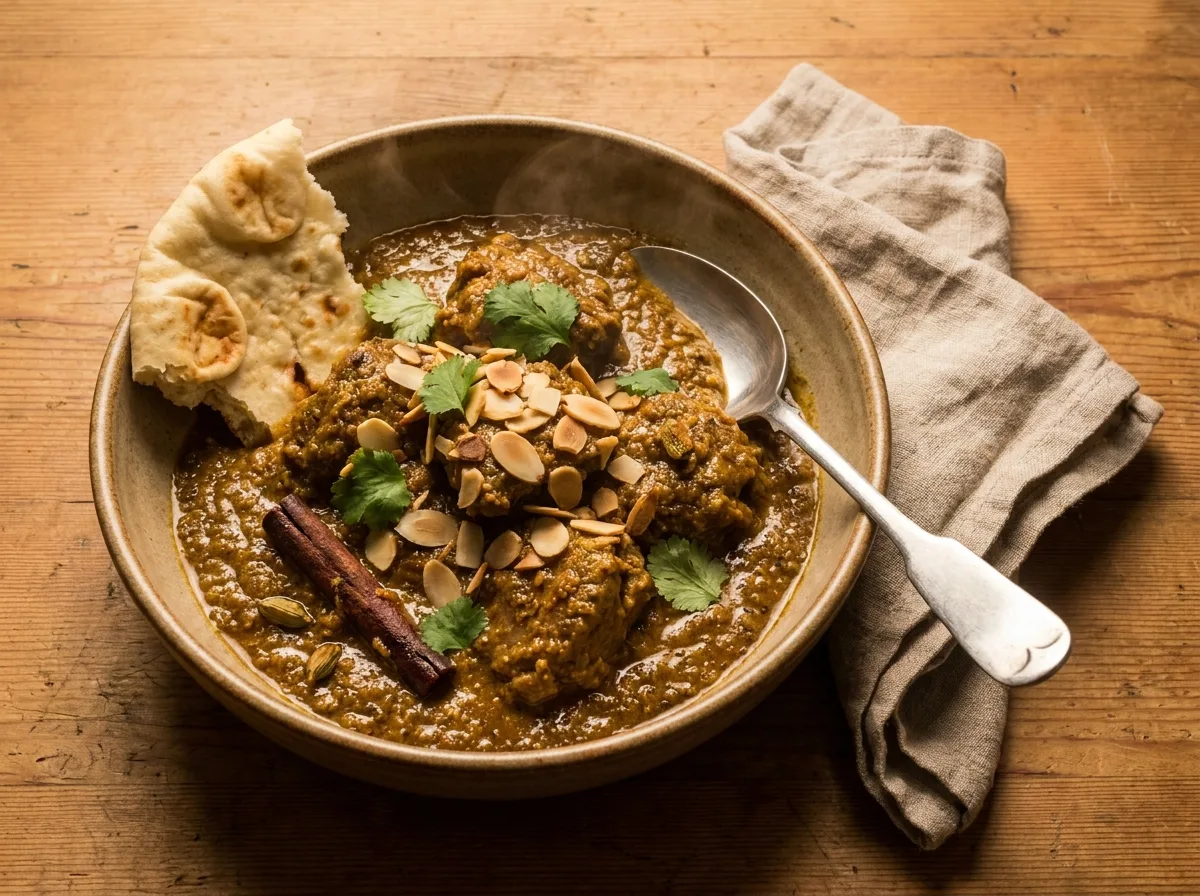
Gordon Ramsay’s chicken korma starts with a truth worth putting first: his published korma is lamb. It builds a velvety sauce from toasted almonds and cashews, yoghurt and saffron, and swaps to chicken thighs cleanly. Count on 1 hour 40 minutes for lamb, less for chicken.
The recipe is in his Great Escape India book, where he calls it “mildly spiced and creamy, quite different from your average takeaway, which I often find to be overly sweet.” True to that, there’s no sugar anywhere in it, and it finishes with lemon juice and rosewater instead.
The technique that saves the sauce is in step 5: the yoghurt gets mixed with the nut paste and saffron water BEFORE it meets the pan. Nut starch coats the yoghurt proteins, so it can simmer for an hour without splitting, which is where most homemade kormas die.
Cooked this recipe? Send a photo or tell me what you changed at fans@gordonramsayrecipes.uk and I’ll share your experience live on this page.
Gordon Ramsay’s Korma (Lamb or Chicken)
Course: DinnersCuisine: IndianDifficulty: Medium4
servings25
minutes1
hour15
minutes930
kcal1 hr 40 min
His sixteenth-century-rooted korma from Great Escape India: a toasted almond and cashew paste, saffron yoghurt, and a cream, lemon and rosewater finish, with not a gram of sugar in it.
Ingredients
- For the nut paste:
2 green chillies, deseeded and finely chopped
75g (2.6 oz) blanched almonds, lightly toasted
75g (2.6 oz) cashew nuts, lightly toasted
2 garlic cloves, peeled and finely chopped
2cm (¾ in) piece of fresh ginger, peeled and finely chopped
125ml (½ cup) water
- For the korma:
1kg (2.2 lb) boneless leg of lamb, cut into 3cm pieces (or skinless chicken thighs, see step 6)
Sea salt and freshly ground black pepper
3 tbsp vegetable oil
1 cinnamon stick
4 cloves
1 bay leaf
2 tsp ground coriander
2 cardamom pods
2 onions, peeled and finely chopped
100ml (7 tbsp) natural yoghurt
Pinch of saffron strands, soaked in 1 tbsp hot water
75ml (5 tbsp) double cream (US: heavy cream)
1 tbsp lemon juice
1 tbsp rosewater
Directions
- Blitz the nut paste: Put the chillies, almonds, cashews, garlic, ginger and water in a food processor and blend to a fine wet paste, scraping down the sides of the bowl. Set aside.
- Brown the meat: Heat half the oil in a heavy-based pan until hot. Season the lamb pieces and fry in batches for about 2 minutes on each side until browned all over, transferring each batch to a plate.
- Fry the whole spices: Add the remaining oil to the pan and tip in the cinnamon, cloves, bay leaf, ground coriander and cardamom. Stir-fry for a minute until fragrant.
- Soften the onions: Add the onions and some seasoning. Cook, stirring occasionally, for 5 to 6 minutes until soft and lightly golden.
- Stabilise and add the yoghurt: Mix the yoghurt with the wet nut paste and the saffron water in a bowl, then add to the pan, stirring well. Cook over medium-to-low heat for about 5 minutes.
- Simmer: Return the browned lamb and any juices to the pan, stir well, and gently simmer for 45 minutes to 1 hour until very tender. For chicken thighs, 25 to 30 minutes is enough.
- Finish and serve: Just before serving, stir in the double cream, lemon juice and rosewater. Heat gently, adjust the seasoning, and serve with warm naan or chapatti.
Notes
- His recipe is lamb, and in India he notes it’s made with goat or lamb. The chicken thigh swap is mine, everything else is his, line for line.
FAQs
Is Gordon Ramsay’s korma chicken or lamb?
Lamb, everywhere it’s published. The Great Escape India recipe uses boneless leg, and he notes that across India the dish is called mutton korma, made with goat or lamb. His advice if you go the goat route: “get a young, tender one,” the same young-and-tender rule behind his slow-braised goat curry.
Chicken thighs work in the same sauce with the simmer cut to 25 to 30 minutes, which is the swap in the card above. And if what you want is lamb on a weeknight clock, his minced lamb curry exists because a slow-cooked one won’t fit in 30 minutes.
Why is there no sugar in this korma?
Because sweetness is exactly what he’s pushing against, that takeaway complaint from the intro. His version gets gentle sweetness from slow-cooked onions and the nut paste, nothing added.
The finish does the balancing instead: lemon juice for lift and rosewater for perfume, stirred in off the boil. If mild-and-rich is your lane but you want the tomato-butter direction, his butter chicken recipe is the same book’s other famous answer.
What’s in the korma paste?
Toasted almonds and cashews in equal weight, blended wet with green chillies, garlic, ginger and water. Toasting comes first because heat releases the nut oils, so the paste tastes roasted rather than raw and chalky.
That paste is doing three jobs at once: it thickens the sauce, carries the aromatics, and protects the yoghurt. The takeaway shortcut of coconut milk plus ground almonds gets you colour but not that depth.
Why doesn’t the yoghurt split in this recipe?
Because of the pre-mix I flagged in the intro. Stirring the yoghurt into the nut paste before it hits the pan coats the yoghurt proteins in fat and starch, so they can’t seize into grains when the heat rises.
Add yoghurt straight to a hot pan and it curdles in seconds, which is the most common korma disaster at home. Keep the heat at medium-to-low for those first 5 minutes too, the protection has limits.
How is Ramsay’s korma different from a takeaway korma?
His runs dark gold rather than pale yellow, and he learned why in Lucknow, the city he calls the birthplace of the korma. The original he ate there was “a dark brownish-red colour.” It was lightened with yoghurt instead of cream, and thickened with ground almonds rather than coconut milk.
His book version bridges the two worlds: the yoghurt and nut base of Lucknow, plus a restrained 75ml of cream at the end. Lucknow is also where he learned biryani from a master chef, which is the story behind his chicken biryani recipe.
Does korma keep well?
The flavour does, the texture needs care. It keeps 3 days in the fridge and actually deepens overnight, but reheat it gently and never let it boil, because the yoghurt and cream will split under hard heat even after cooking.
Freezing is the honest weak spot: dairy-and-nut sauces turn slightly grainy on thawing. It’s edible but not what you made, so I’d rather halve the recipe than freeze half. And my roundup of his curry recipes helps you pick the next one.