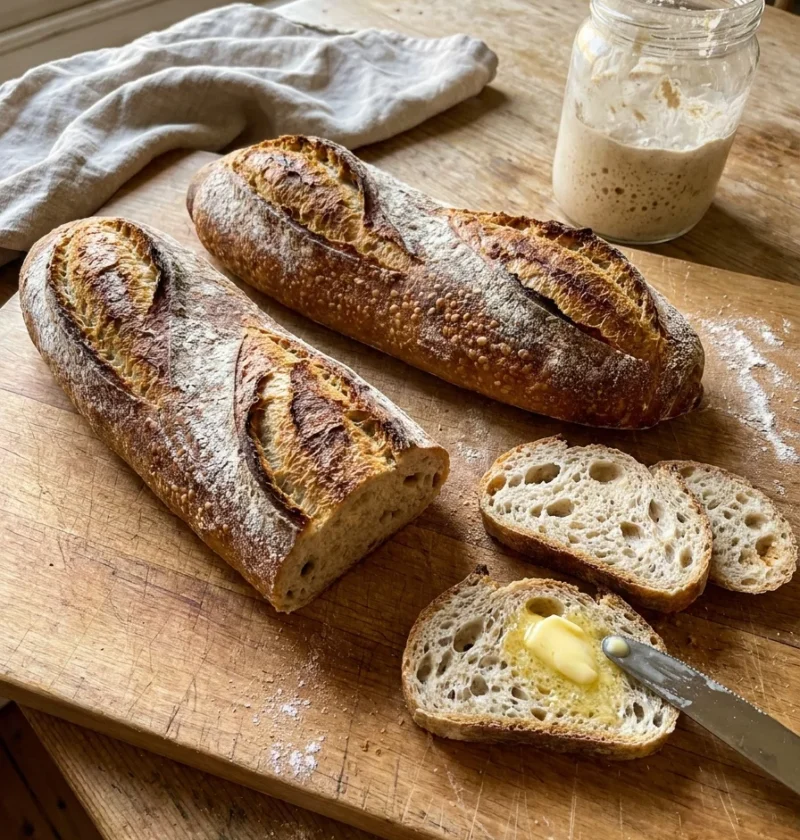
Gordon Ramsay’s sourdough uses a rye and apple juice starter fermented for 5 days, mixed with strong white flour, wholemeal, and rye, then baked at 250°C with a tray of boiling water for a crackling crust. The recipe is from his Chef’s Secrets cookbook and makes 2-3 loaves.
What makes this different from every other sourdough recipe is the starter. Ramsay uses organic apple juice, bio yoghurt, and currants alongside the rye flour, which introduces natural yeasts and lactic acid bacteria that give the bread its sour tang.
Most sourdough starters use just flour and water, so his version develops a more complex, fruity flavour from day one.
He also adds a small amount of commercial yeast to the bread dough alongside the starter, which the sourdough community considers controversial. But it’s a practical decision: the starter provides the flavour and complexity while the yeast guarantees the rise.
In the UCC video he talks about making sourdough at midnight in a three-star Paris kitchen at 22 years old. He knows what pure sourdough takes and chose to make his home version more reliable.
Cooked this recipe? Send a photo or tell me what you changed at fans@gordonramsayrecipes.uk and I’ll share your experience live on this page.
Gordon Ramsay Sourdough Bread
Course: SidesCuisine: British, FrenchDifficulty: Medium2-3
loaves30
minutes35
minutes190
kcal per slice5 days + 65
minutesFrom Gordon Ramsays Chefs Secrets cookbook. A 5-day rye starter made with organic apple juice, bio yoghurt, and currants gives this sourdough a complex fruity tang. Baked at high heat with steam for a crackling crust. Ramsay learned to make sourdough at 22 in a three-star Paris kitchen.
Ingredients
- For the starter (begin 5 days ahead)
125g strong flour, preferably organic unbleached
125g rye flour, plus up to 150g extra for sprinkling
170ml organic unfiltered apple juice
150g organic low-fat live bio yoghurt
50g organic currants, washed and dried
- For the bread
10g fresh yeast, or 2 tsp dried active yeast
200ml tepid spring water (20°C)
300g rye starter from above
375g strong white flour, preferably organic unbleached
125g strong wholemeal flour
50g rye flour
2 tsp Maldon salt, finely crushed
100ml organic unfiltered apple juice
Extra white flour and semolina, for dusting
Sunflower oil, for oiling
Directions
- Start the starter (day 1): Place both flours in a plastic bowl with the apple juice, yoghurt, and currants. Beat well for about 5 minutes to a smooth, thick batter. Sprinkle the top lightly with rye flour, cover, and leave in a warm place at about 28°C for 24 hours.
- Feed the starter (days 2-5): Lightly beat the starter and sprinkle again with rye flour. Cover and return to the warm place. Repeat every day for 5 days total until you have a lively, bubbling starter of about 600g. Use half for the bread and refrigerate or freeze the other half.
- Activate the yeast: Crumble the fresh yeast into a bowl, add the tepid water, and stir to dissolve. If using dried yeast, mix with the water and 2 pinches of caster sugar and leave for 10 minutes until it begins to sponge.
- First mix: Combine the yeast liquid with 300g of starter and half the white flour. Cover loosely with cling film and leave in a warm place until the mixture bubbles, about 1 hour.
- Make the dough: Mix the wholemeal, rye, and remaining white flour with the salt in a large warm bowl. Add the bubbling yeast dough and apple juice. Mix with your hands until no longer sticky, then tip onto a clean surface and knead well until smooth and the dough holds a thumbprint when pressed. Place in a lightly oiled bowl, cover, and leave to rise for about 1 hour until doubled.
- Second rise: Knock back the dough, knead for 3 minutes, return to the bowl, cover, and prove for another hour.
- Shape: Knock back again and divide into 2 or 3 pieces. Roll into batons about 25-30cm long. Oil a heavy baking sheet and dust with semolina. Place the batons well apart, slash 4-5 diagonal cuts along each with a sharp knife, sprinkle with flour, and leave until risen by about a third. Preheat the oven to 250°C (480°F)/Gas 9 and boil the kettle.
- Bake with steam: Place a roasting tin half-filled with boiling water on a lower shelf. Put the batons on a higher shelf and bake for 5 minutes. Drop the temperature to 200°C (400°F)/Gas 6 and bake for another 25-30 minutes until the crust is mid-brown and the base sounds hollow when tapped. Cool on a wire rack.
FAQs
Why does Ramsay use apple juice and currants in the starter?
Most sourdough starters use nothing but flour and water. Ramsay adds organic apple juice, bio yoghurt, and currants because they’re packed with natural wild yeasts and bacteria that kickstart fermentation faster than flour alone.
The apple juice feeds the yeast with natural sugars while the yoghurt introduces lactic acid bacteria, which is what creates the sour flavour. The currants add another layer of wild yeast from their skins.
By day 5 you’ve got a starter with more complexity than a basic flour-and-water version could develop in twice the time.
Why does he add commercial yeast if it’s sourdough?
This is the part that divides bakers. Traditional sourdough uses only wild yeast from the starter, no commercial yeast at all. Ramsay adds 10g of fresh yeast alongside the starter because it guarantees the rise.
He learned sourdough in a professional Paris kitchen where failure wasn’t an option, so his home version builds in that safety net. The starter still provides all the flavour and tang, the commercial yeast just makes sure the loaf rises properly even if your starter isn’t at peak strength.
If your starter is bubbling strongly after 5 days, you can skip the yeast and go fully traditional.
Why does he put boiling water in the oven?
The tray of boiling water creates steam during the first 5 minutes of baking at 250°C. That steam keeps the surface of the dough moist so it can expand fully before the crust sets, which is how you get those deep slashes opening up into ears.
Without steam the crust forms too early, traps the rising dough inside, and you get a dense loaf with tight slashes that barely opened. Professional bakeries have steam-injected ovens for exactly this reason. The roasting tin is Ramsay’s home workaround.
How long does sourdough keep?
This is where sourdough beats every other bread in this subniche. Ramsay writes in Ultimate Home Cooking that sourdough is “the most versatile” bread because “it can still be used even when several days old.”
Day one it’s ideal for sandwiches. Days two and three it can be toasted or used for bruschetta. By day four it’s perfect for making croutons.
Compare that to the soda bread which Ramsay says must be eaten the same day, the beer bread which lasts two days, or his white bread from Chef’s Secrets which sits between the two. Sourdough’s natural acidity slows mould growth so it genuinely lasts longer without preservatives.