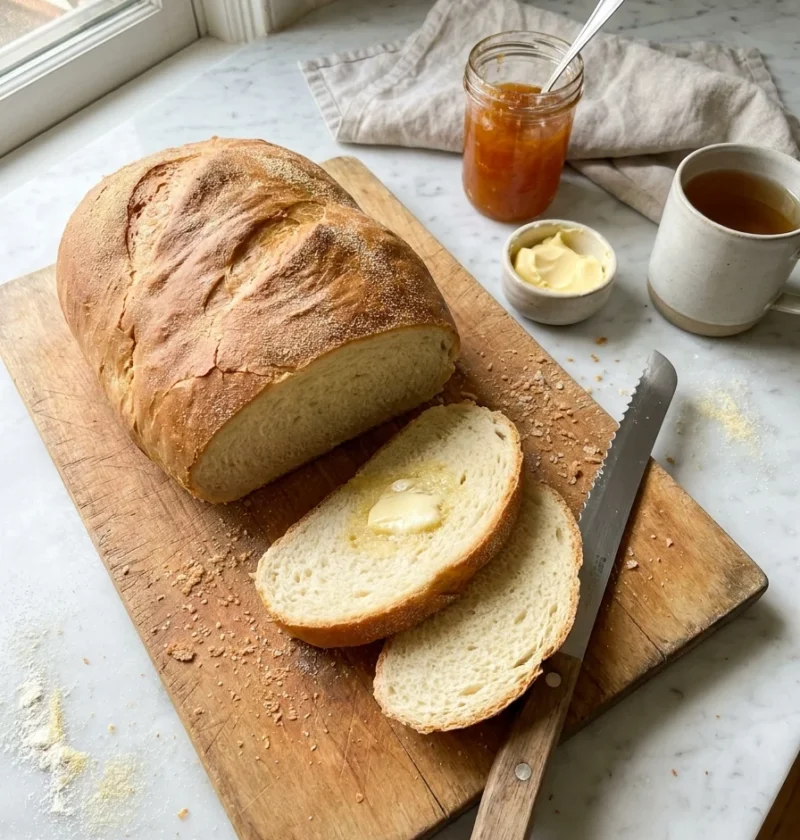
Gordon Ramsay’s white bread is a Pain de Mie from his Chef’s Secrets cookbook, made with a yeast sponge method that develops flavour for an hour before you even start the dough. Plain flour, strong flour, butter, milk, and semolina, baked at 200°C then dropped to 180°C. Makes one large loaf or 8 rolls.
Ramsay calls this “a gorgeous French bread, a cross between a brioche and a simple white loaf.” What makes it different from every other white bread recipe is the sponge. You activate the yeast in warm milk and flour for a full hour before mixing the bread dough.
That extra step is a professional technique from his time baking at Le Gavroche and Guy Savoy in Paris. In Chef’s Secrets he writes “I’ll never forget the night the bread oven broke down at 3am. In panic, I rang the head chef at his home to ask for help… his reply was unrepeatable.”
He also says “making bread is like making love, it’s a passion not an item. So no bread machines for me.” In UCC he puts it simpler: “If you ever stop to read the list of ingredients in your average supermarket bread, with its emulsifiers and fungicides and stabilisers, you’ll be amazed at how little goes into a proper old-fashioned loaf.”
Cooked this recipe? Send a photo or tell me what you changed at fans@gordonramsayrecipes.uk and I’ll share your experience live on this page.
Gordon Ramsay White Bread
Course: SidesCuisine: French, BritishDifficulty: Easy1 loaf or 8 rolls
15
minutes30
minutes200
kcal per slice2 hrs 45 min
Pain de Mie from Gordon Ramsays Chefs Secrets cookbook. A professional sponge method developed during his time baking at Le Gavroche and Guy Savoy in Paris. Two flours, butter rubbed in like pastry, semolina on the base for crunch. Can be shaped as one loaf or 8 individual rolls.
Ingredients
15g fresh yeast, or 1¼ tsp dried active yeast
125ml whole milk, warmed to tepid (20°C)
125g plain white flour, preferably organic unbleached
160g strong white flour, preferably organic unbleached
1 tsp crushed Maldon salt or fine sea salt
20g butter, in small pieces
2 tsp caster sugar
4 tbsp cold milk
Semolina, to sprinkle
Oil, to brush
Directions
- Make the sponge: Crumble the fresh yeast into a medium bowl and whisk in the tepid milk until dissolved. Beat in the 125g plain flour until smooth. Cover with cling film and leave in a warm place (about 28°C) for 1 hour to sponge. If using dried yeast, blend with a little of the tepid milk and 2 tablespoons of the plain flour, wait until it bubbles, then mix in the rest.
- Build the dough: Sift the strong flour and salt into a bowl and rub in the butter with your fingertips, like making pastry. Stir in the sugar. Make a well in the centre.
- Combine: Add the sponged dough and cold milk to the well. Mix to a soft dough, then knead vigorously for 5-10 minutes on a very lightly floured surface. The dough is ready when you can press it and leave a thumbprint.
- First rise: Place in a bowl, cover with cling film, and leave in a warm spot for about 1 hour until doubled in size.
- Shape: Knock back the dough on a clean surface and shape into a large oval. Sprinkle the top with semolina, pressing lightly so it stays. Oil a heavy baking sheet and sprinkle the base with semolina. Place the dough on the sheet.
- Second rise: Leave to prove until doubled again, about 45-60 minutes. Preheat the oven to 200°C (400°F)/Gas 6.
- Bake: Spray the baking sheet around the dough with cold water, then immediately bake for 10 minutes. Reduce to 180°C (350°F)/Gas 4 and bake for a further 15-20 minutes until golden brown and crisp. The base should sound hollow when tapped. Cool on a wire rack.
FAQs
Why does Ramsay use a sponge method?
Most home bread recipes dump everything in a bowl at once. Ramsay activates the yeast separately in warm milk and flour for a full hour before building the dough. This is a professional bakery technique he learned at Le Gavroche.
The sponge gives the yeast time to develop complex flavours that a quick mix can’t produce. It also means the yeast is fully active before it meets the salt and butter, both of which slow fermentation.
Why does he use two different flours?
The sponge uses plain flour because it’s softer and easier for the yeast to feed on during that first hour. The dough uses strong flour because its higher protein content builds the gluten network that gives the bread its structure and chew.
Most recipes use one flour for everything. Ramsay’s two-flour approach is another bakery technique: soft sponge for flavour, strong dough for structure.
Can you make rolls instead of a loaf?
Yes, from the same page in Chef’s Secrets. Shape the dough into 8 balls, roll the tops back and forth a few times to smooth them, then press each one into a bowl of semolina. Place on a lined baking sheet, cover loosely, and prove until doubled.
Bake at 200°C for just 12 minutes. No temperature drop needed because the smaller size means they cook through faster.
What about Ramsay’s seeded honey loaf?
In Healthy Appetite he has a different bread altogether: 225g wholemeal flour, 225g strong white flour, mixed seeds (poppy, sesame, pumpkin, linseed, sunflower), olive oil, and honey. Same knead-and-prove method but heartier and nuttier.
That version is better for toast and sandwiches where you want more texture. The Pain de Mie is better when you want something soft and light, closer to a French bakery loaf.
Does Ramsay have a ciabatta or cheese bread recipe?
No ciabatta recipe in any of his 22 cookbooks. He mentions making ciabatta during his Paris training and uses shop-bought ciabatta in several recipes, but never publishes one to bake at home.
For cheese bread, he talks about making it at midnight in Paris: “one o’clock white bread, two o’clock brown bread, three o’clock sourdough, four o’clock cheese bread.” But the cheese bread recipe never made it into any book. The closest is his Parmesan focaccia from Bread Street Kitchen where grated Parmesan melts into the dimples during baking.