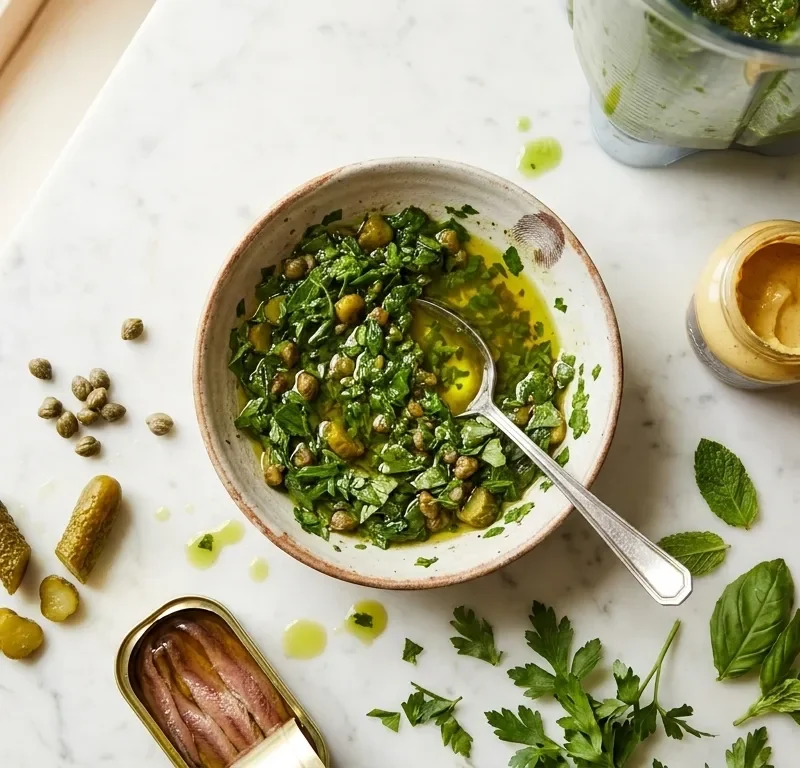
Gordon Ramsay’s salsa verde is parsley, basil and mint blitzed with capers, cornichons, anchovies, Dijon and red wine vinegar. Olive oil loosens it until it spoons. Five minutes in a blender, no cooking, and it wakes up everything from beef fillet to tuna steaks.
He has three versions across his books and I’ve made all of them. The card below is the Bread Street Kitchen blender version with exact gram weights, spooned over ‘nduja tuna in the book. The pestle and mortar version under his Ultimate Home Cooking beef fillet calls salsa verde “a sharp, punchy condiment from Italy.”
The technique warning travels across both books: pulse or pound it roughly, never smooth. The anchovies and capers bring salt, the vinegar and mustard bring acid, the three herbs bring freshness. A salsa verde blitzed into a paste is just a pesto that lost its way.
Cooked this recipe? Send a photo or tell me what you changed at fans@gordonramsayrecipes.uk and I’ll share your experience live on this page.
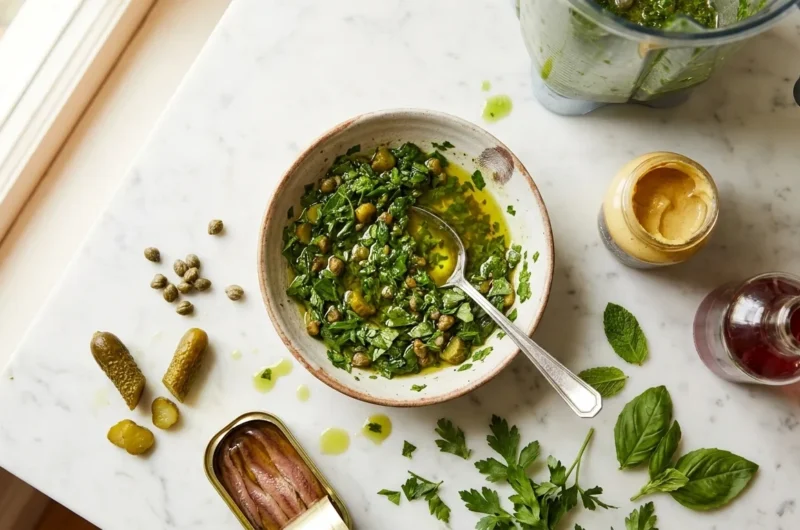
Gordon Ramsay Salsa Verde (Bread Street Kitchen Version)
Course: SauceCuisine: ItalianDifficulty: Easy4
10
minutes20
minutes140
kcal30
minutesHis green sauce from Bread Street Kitchen, built for searing-hot ‘nduja tuna but good on almost any rich, plain or charred plate: three fresh herbs pulsed with capers, cornichons, anchovies and Dijon, sharpened with red wine vinegar. Make it 20 minutes before dinner and it meets you at the table.
Ingredients
25g cornichons, drained weight
35g small capers, drained weight
1.5 tsp Dijon mustard
3 tinned anchovy fillets, drained
Small bunch of fresh flat leaf parsley (about 25g)
Small bunch of fresh basil (about 25g)
Small handful of fresh mint (about 10g)
1 tbsp red wine vinegar, or to taste
4 to 5 tbsp extra virgin olive oil, to loosen
Sea salt and freshly ground black pepper
Directions
- Load the blender: Put the cornichons, capers, mustard, anchovies, parsley, basil, mint and vinegar into a blender.
- Pulse, don’t blend: Pulse a few times until roughly chopped and well combined, adding enough olive oil to loosen the mixture to your preferred consistency. You want flecks and texture, not a smooth paste.
- Season and adjust: Season well with salt and pepper. If the salsa is very thick, stir in 1 tablespoon of cold water to loosen. Taste: more vinegar if it needs lift, more oil if it bites too hard.
- Rest and serve: Cover and set aside until needed. It’s at its best after 20 minutes, once the flavours have settled into each other.
FAQs
How does Gordon Ramsay make salsa verde for beef fillet?
By hand, with a pestle and mortar, and with one trick the blender version doesn’t have. In Ultimate Home Cooking he pounds the anchovies with a teaspoon of their oil, capers, garlic and HALF the herbs into a paste, stirs in the mustard and vinegar, then stirs the remaining herbs through whole. Half paste, half leaves, so the sauce has both depth and freshness in the same spoonful.
That version goes over a 1kg fillet of beef browned with garlic, thyme and rosemary, butter-basted and roasted 10 to 12 minutes for rare. His headnote calls fillet “the Rolls-Royce cut from the Rolls-Royce of meats” and warns: “please, not well done. That would be a travesty.”
Blender or pestle and mortar, which is better?
His books use both, so this is genuinely a choice, not a rule. The Bread Street Kitchen blender version is faster and gives an even, spoonable sauce. The Ultimate Home Cooking pestle version takes ten minutes longer and gives a rougher, layered result, because pounding releases the herb oils differently than blades do.
I make the blender one on weeknights and the pestle one when the beef cost more than the wine. Overworked salsa verde announces itself: the colour darkens from bright green to khaki and the texture turns to wet paste. Stop while you can still see individual herb flecks.
Is there a version without anchovies?
Yes, his own. The cauliflower steaks in his newer books come with a green sauce built for plant-based eating: mint, dill and oregano with red wine vinegar, dark brown sugar, Dijon and 80ml of olive oil. No anchovies, no capers, and the brown sugar covers the savoury depth the fish would have brought.
He serves it over charred cauliflower steaks with butter-toasted almonds and cumin. If you’re cooking for someone vegetarian, that’s the version to make rather than just deleting the anchovies from this one, because the balance was designed without them.
What do anchovies actually do in salsa verde?
They dissolve. Nobody eating a proper salsa verde tastes fish, they taste a deep savoury saltiness they can’t place, because the fillets break down completely into the sauce. It’s the same job anchovies do in a Caesar dressing: seasoning, not flavour.
Three fillets across four servings is the dose. If someone claims they hate anchovies, don’t announce them, serve the sauce, and collect the compliment.
What should you serve salsa verde with?
His books answer this twice: searing-hot tuna steak spread with ‘nduja in Bread Street Kitchen, and rare roast beef fillet in Ultimate Home Cooking. Between those poles it works on lamb chops, grilled chicken, white fish, and it’s quietly brilliant over burrata or boiled new potatoes.
The rule of thumb: rich, plain, or charred things love it, anything already sauced doesn’t need it. Its South American cousin, his chimichurri, plays the same role with oregano and chilli heat, and the classic sauces guide maps which of his sauces belongs on which plate.
How long does it keep?
Three days in the fridge in a sealed jar, with a thin layer of olive oil poured over the surface to keep the herbs from browning. The flavour actually improves on day one as the vinegar settles into the herbs, then slowly fades.
Don’t freeze it: the herbs turn dark and the texture goes to sludge. It takes ten minutes to make fresh, which is faster than defrosting anyway. Give it a stir and a taste before serving, it sometimes wants one more drop of vinegar after a night in the cold.