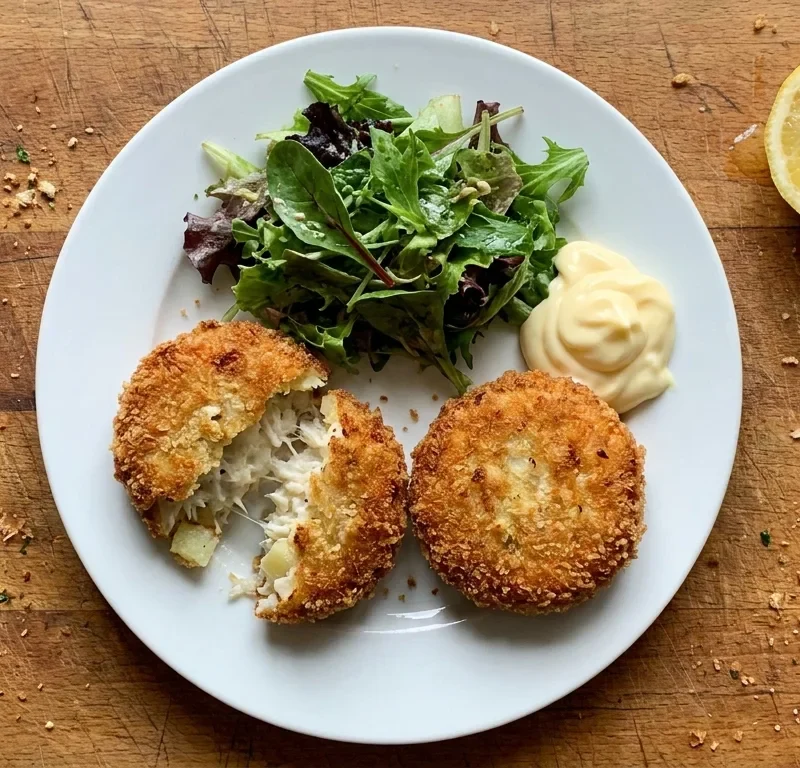
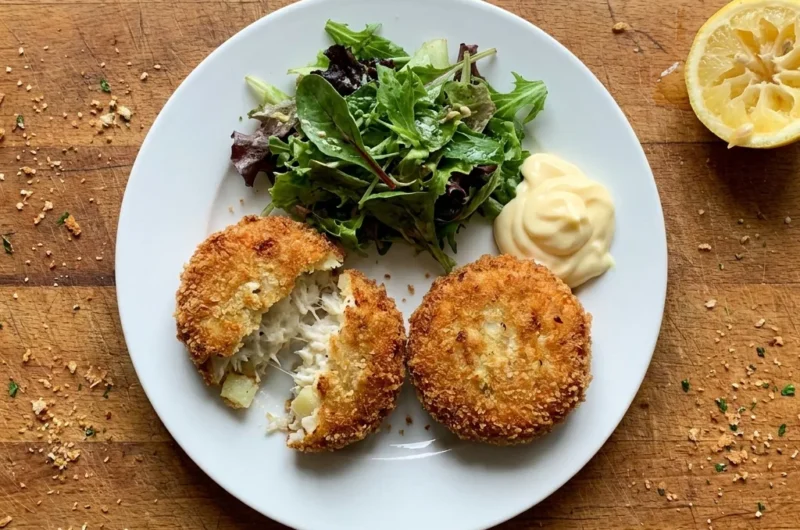
Gordon Ramsay’s crab cakes from Great British Pub Food use mashed potato as the binder instead of the breadcrumbs that almost every other recipe calls for. White crabmeat, a sweated shallot, homemade mayonnaise, lemon zest and fresh herbs are folded through the potato, shaped into patties and triple-coated in flour, egg and fine breadcrumbs. They serve 6 as a starter and take about an hour including the chilling.
Chilling is where most homemade crab cakes fail. Ramsay builds in two separate rests: 30 minutes after shaping, then another 30 after the breadcrumb coating goes on. On The F Word he goes further, saying “the most important thing about making an amazing crab cake is shape it, format it the night before, set it in the fridge so it gets nice and firm.”
The cooking has two stages because frying alone leaves the centre cold. He colours the crab cakes in groundnut oil for 2 to 3 minutes each side, then finishes them on a hot baking sheet in the oven at 200°C for 8 to 10 minutes. On The F Word he explains this gives “nice and crisp on the outside and nice and warm in the middle.”
Cooked this recipe? Send a photo or tell me what you changed at fans@gordonramsayrecipes.uk and I’ll share your experience live on this page.
Gordon Ramsay Crab Cakes Recipe
Course: AppetisersCuisine: BritishDifficulty: Medium6
servings30
minutes35
minutes310
kcal1 hr 5 min
1 hr
From the Catch of the Day chapter in Great British Pub Food. Ramsay uses equal parts potato and crab so the cakes hold together without drying out. Double chill, triple coat, oven finish. He says to shape them the night before for the best results.
Ingredients
500g (1 lb 2 oz) potatoes, peeled
20g (¾ oz) butter
Sea salt and freshly ground black pepper
1½ tbsp olive oil
1 large shallot, peeled and finely chopped
2 to 3 tbsp mayonnaise
Finely grated zest of 1 lemon
1 tbsp lemon juice
Handful of mixed herbs (chervil, basil, parsley), chopped
500g (1 lb 2 oz) white crabmeat
25g (1 oz) plain flour
2 medium eggs, lightly beaten
100g (3½ oz) fine white breadcrumbs
Groundnut oil, for frying
Directions
- Boil and mash the potatoes: Cut the potatoes into even chunks and boil in salted water for 15 to 20 minutes until soft. Drain and press through a potato ricer or mash until smooth. Beat in the butter and season generously.
- Sweat the shallot: Heat the olive oil in a small pan, add the shallot with some seasoning and sweat over medium heat for 6 to 8 minutes, stirring occasionally, until soft and translucent.
- Build the mix: Beat the shallot into the mashed potato, then fold through the mayonnaise, lemon zest, lemon juice and chopped herbs. Season well. Pick through the crabmeat discarding any stray shell, then fold gently into the potato mixture. Cover and chill for 30 minutes.
- Shape and coat: Divide into 6 even portions and shape into patties. Season the flour with salt and pepper. Coat each patty in seasoned flour, then dip in beaten egg, then press into the fine breadcrumbs. Place on a lined tray and chill for another 30 minutes.
- Fry and finish: Preheat the oven to 200°C (400°F / Gas 6) with a baking sheet inside. Heat a thin layer of groundnut oil in a large frying pan and fry the crab cakes for 2 to 3 minutes on each side until golden brown. Transfer to the hot baking sheet and finish in the oven for 8 to 10 minutes.
- Serve: Place on each plate with a pile of mixed salad and herb leaves alongside and a dollop of mayonnaise.
FAQs
Why does Ramsay use mashed potato instead of breadcrumbs?
Potato holds moisture inside the crab cake while it cooks. Breadcrumb binders absorb the liquid from the crab, which dries out the filling and makes it crumbly. Potato creates a starchy network that traps the juices, so the inside stays soft while the coating goes crisp.
He writes “try to ensure that you end up with at least as much crabmeat as mashed potato.” That equal ratio is the balance point: too much potato and the crab flavour disappears, too little and the cakes fall apart in the pan.
Can you use brown crabmeat as well as white?
Ramsay says “you can use a mixture of white and brown meat for these crab cakes.” Brown meat is richer and more intensely flavoured, so a 50/50 split gives a deeper taste. The GBPF recipe defaults to pure white, which makes them sweeter and more delicate.
If using brown, fold it into the potato first and mix thoroughly since it is pastier. Then fold the white meat in gently so the lumps stay visible. That way you get the depth from the brown and the texture from the white.
What sauce does Ramsay serve with crab cakes?
In GBPF he serves them with his homemade mayonnaise and a pile of mixed salad leaves. On the Bon Appétit video he builds a remoulade instead: mayonnaise, capers, mustard, red onion, lemon juice and fresh tarragon. For something sharper, his tartar sauce with crème fraîche works well since the acidity cuts through the richness of the potato.
The plain mayo lets the crab lead. The remoulade has more punch. The tartar sauce adds sharpness. All three work because the crab cake itself is mildly seasoned, so the sauce does the heavy lifting on flavour.
Are the frozen “By Chef Ramsay” crab cakes the same recipe?
No. The frozen crab cakes sold at Walmart under the “By Chef Ramsay” brand use wheat flour, corn starch and red bell pepper as the base, with no potato at all. The GBPF recipe uses mashed potato as the binder and contains no pepper or corn starch. They are completely different products.
The frozen product works in an air fryer or microwave. The cookbook recipe is a proper pan-fry and oven finish. If you want these alongside other seafood, his sea bass with pepper sauce from The F Word makes a good main while the crab cakes serve as starters.
Why does Ramsay season before the coating goes on?
On The F Word he is specific about this: “underneath that flour, egg wash, breadcrumb, we seasoned it.” If you season after coating, the salt sits on the breadcrumbs and burns in the hot oil. Seasoning the patty first means the flavour is inside the crust where it belongs.
He uses the same approach for his scotch eggs in Ultimate Home Cooking, where the sausage meat is seasoned before the three-stage coating goes on. The principle is always the same: season the food, then armour it.