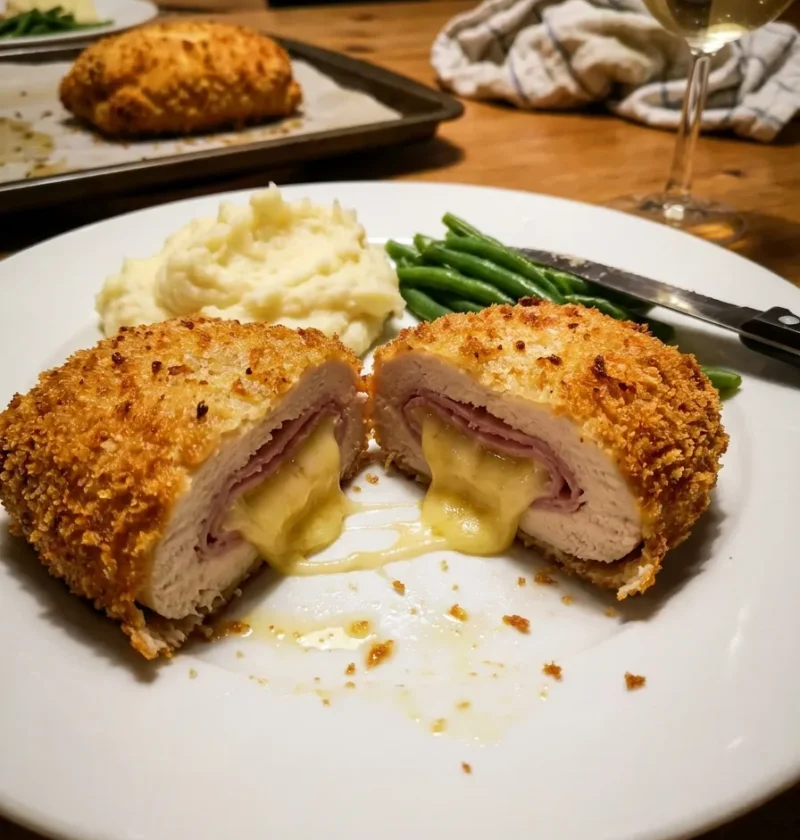
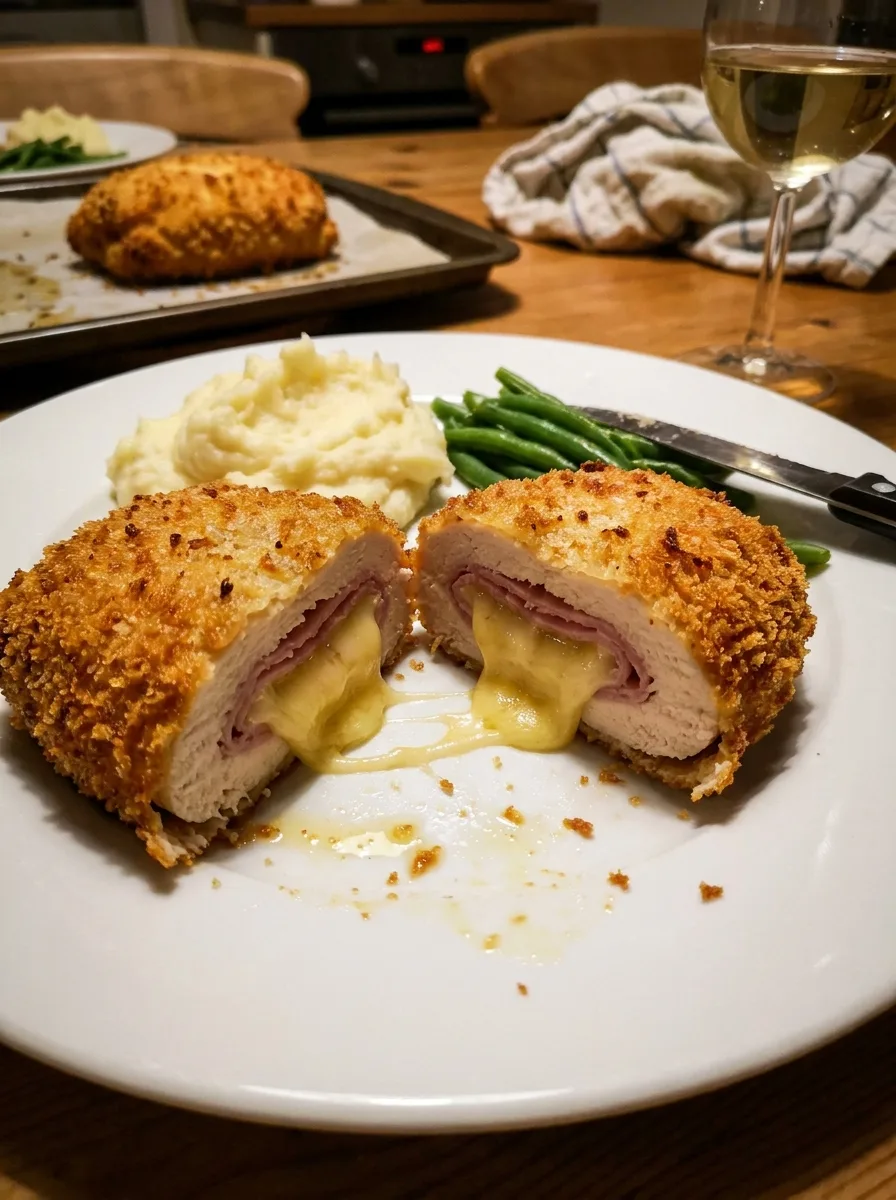
Gordon Ramsay’s chicken cordon bleu is a breast slit open and stuffed with ham and Gruyère, folded closed, coated in seasoned flour, egg, and panko breadcrumbs, then pan-fried until golden and finished in the oven until the cheese melts inside. Serves 2, about 30 minutes plus chilling.
Ramsay doesn’t publish a cordon bleu specifically, but the technique combines two of his cookbook methods. The stuffing and sealing comes from his Healthy Appetite stuffed chicken, where he slits the breast, fills it, wraps it, and chills for “1-2 hours to firm up slightly.” The breading comes from his Ramsay in 10 schnitzel, where he coats in panko and says to “roll between two pieces of baking paper with a rolling pin to really press the crumbs into the meat.”
The two-stage cooking is what makes this work. Pan-frying first gives the breadcrumbs a golden crust, then 12-15 minutes in the oven melts the cheese and cooks the chicken through without burning the outside.
Cooked this recipe? Send a photo or tell me what you changed at fans@gordonramsayrecipes.uk and I’ll share your experience live on this page.
Gordon Ramsay Chicken Cordon Bleu
Course: DinnerCuisine: FrenchDifficulty: Medium2
servings15
minutes18
minutes520
kcal33
minutesBuilt from Ramsay’s stuffed chicken method (Healthy Appetite) and his schnitzel breading technique (Ramsay in 10). Chicken breast stuffed with ham and Gruyère, triple-coated in flour, egg, and panko, pan-fried golden then oven-finished until the cheese melts. The rolling pin trick presses the crumbs in so they stay on. About 520 kcal per serving.
Ingredients
2 large boneless, skinless chicken breasts
4 slices good quality ham
60g (2 oz) Gruyère, thinly sliced
50g (2 oz) plain flour, seasoned with salt and pepper
2 large eggs, beaten with 1 tbsp soy sauce
75g (2½ oz) panko breadcrumbs
1½ tbsp olive oil
Sea salt and freshly ground black pepper
Directions
- Stuff the chicken: Cut a deep slit along one side of each breast without slicing right through, then open out like a book. Season inside with salt and pepper. Lay 2 slices of ham and half the Gruyère on one side of each breast. Fold closed to enclose the filling.
- Seal and chill: Wrap each stuffed breast tightly in cling film, twisting the ends to hold the shape. Chill in the fridge for 1-2 hours until firm. This stops the filling falling out during coating and cooking.
- Bread the chicken: Remove the cling film. Set up three shallow bowls: seasoned flour, beaten egg with soy sauce, and panko breadcrumbs. Coat each breast in flour, shake off excess, dip in egg, then press firmly into the panko. Roll gently between two sheets of baking parchment with a rolling pin to press the crumbs into the meat.
- Pan-fry: Preheat the oven to 180°C (350°F). Heat the olive oil in an ovenproof frying pan over a medium-high heat. Fry the breaded chicken for 2-3 minutes on each side until the panko is golden brown.
- Oven finish: Transfer the pan to the oven and cook for 12-15 minutes until the chicken is cooked through and the cheese inside has melted. The breast should feel firm when pressed.
- Rest and serve: Rest for 5 minutes before slicing on the diagonal. The melted Gruyère should ooze from the centre when you cut through. Serve with steamed greens and mashed potato.
FAQs
Why chill the stuffed chicken before breading?
Ramsay chills his stuffed chicken for “1-2 hours to firm up slightly” before cooking. The cold firms the cheese inside so it doesn’t melt and leak out during the breading stage. It also sets the shape of the folded breast so it holds together when you coat it.
Skip this step and the cheese leaks through gaps in the breadcrumb coating, burning on the pan and leaving the inside empty. If you’re short on time, 30 minutes in the freezer works as a quicker alternative.
Why add soy sauce to the egg wash?
This comes from Ramsay’s schnitzel recipe in Ramsay in 10. The soy sauce adds salt and umami to the egg wash, which seasons the breadcrumb layer from the inside. Regular egg wash just sticks the crumbs on. Soy-spiked egg wash makes the coating taste of something.
It also helps the panko turn a deeper golden colour because the sugars in the soy sauce caramelise in the hot oil. You won’t taste “soy sauce” in the finished dish, just a richer, more savoury crust.
What cheese works best for cordon bleu?
Gruyère is traditional because it melts smoothly without going stringy or oily. Emmental works the same way. Avoid cheddar, it splits and goes greasy when it melts inside the sealed chicken.
The cheese needs to be sliced thin so it melts quickly in the oven. Thick chunks take too long and the chicken overcooks waiting for the cheese to melt. If you enjoy stuffed chicken, his chicken Kiev uses the same concept with garlic butter instead of ham and cheese.
What is the rolling pin trick?
After breading, Ramsay places the coated chicken between two sheets of baking parchment and rolls gently with a rolling pin. He says this presses “the crumbs into the meat” so they don’t fall off during frying.
He uses this exact technique for both his schnitzel and his chicken parmesan. It takes 10 seconds and is the difference between a coating that stays on and one that slides off in the pan. Rest the breaded chicken for 5-10 minutes after rolling to let the egg set.
What to serve with chicken cordon bleu?
This is a French-inspired dish, so French sides work best. His dauphinoise potatoes are the classic pairing, creamy and rich enough to match the melted cheese inside. Steamed French beans or a green bean salad keep it balanced.
For a sauce, the chicken doesn’t need one because the melted cheese is the sauce. But if you want something for dipping the crispy edges, a Marie Rose sauce or a simple Dijon cream works well alongside.
Does chicken cordon bleu store well?
Assemble and bread them uncooked, then freeze on a tray before bagging. They’ll keep for 3 months. Cook from frozen by pan-frying as normal, then give them 20 minutes in the oven instead of 12-15 to make sure the centre is cooked through.
Cooked cordon bleu reheats reasonably well in a 180°C oven for 10 minutes. The coating stays crispier than most breaded chicken because the cheese inside keeps the meat moist. Don’t microwave it or the panko goes soggy and the cheese turns rubbery.