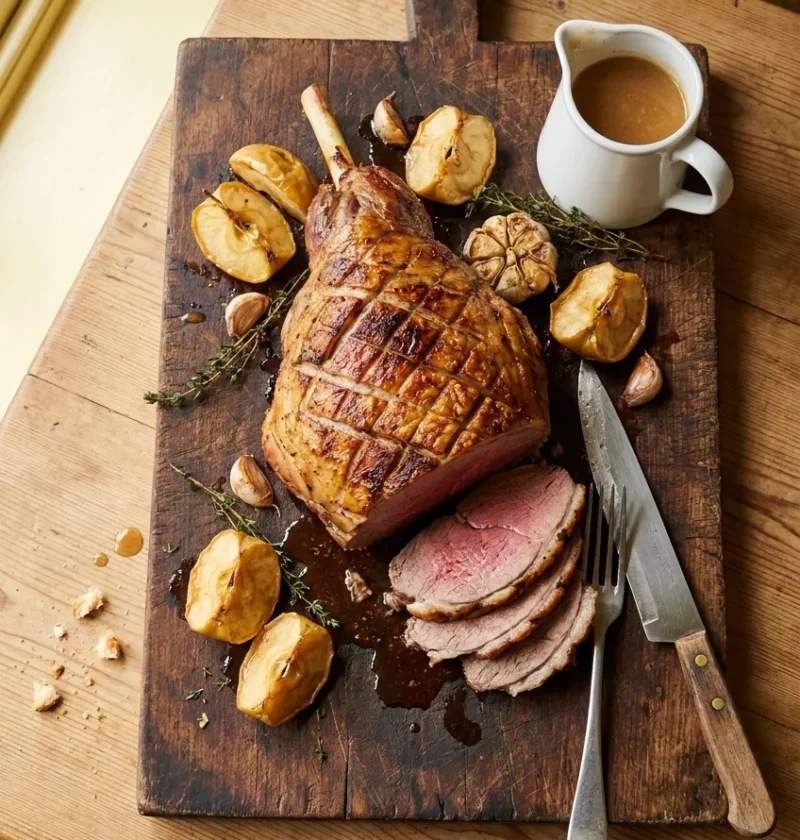
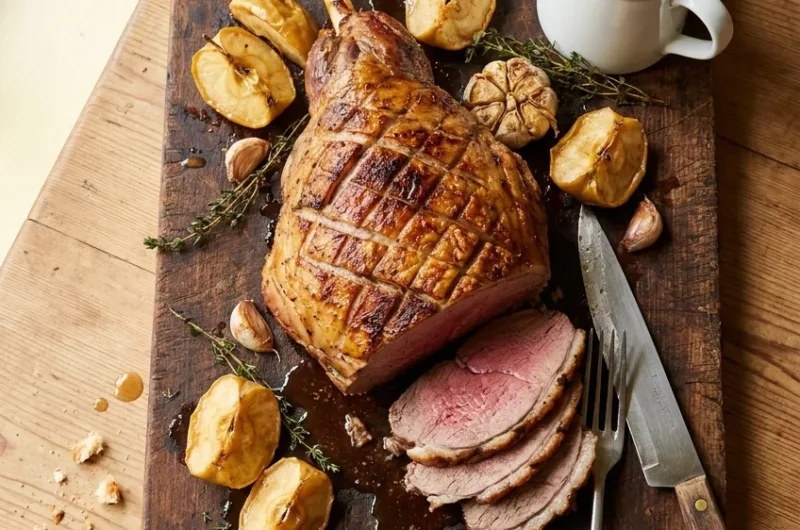
Gordon Ramsay’s roast leg of lamb is scored, rubbed with olive oil and blasted at 220°C for 20 minutes to build a crust, then finished low on a bed of cooking apples that collapse into the gravy. Basted with dry cider and honey, it’s ready in about 90 minutes.
Ramsay has at least five leg of lamb recipes across his books and YouTube. In Great British Pub Food, he pushes anchovy halves, rosemary and garlic into slits for a salty depth no other roast uses. In the Easter video, he rubs boneless legs with fennel, smoked paprika and cinnamon, then pokes whole cinnamon sticks through the meat.
The thread across every version is getting flavour inside the joint, not on the surface. Slits for rosemary in one book, holes for cinnamon in another, and in the goat cheese video he butterflies the leg, stuffs it with mint, garlic and goat cheese, then ties and roasts it hot.
Cooked this recipe? Send a photo or tell me what you changed at fans@gordonramsayrecipes.uk and I’ll share your experience live on this page.
Gordon Ramsay’s Roast Leg of Lamb
Course: DinnerCuisine: BritishDifficulty: Easy6
servings15
minutes1
hour20
minutes680
kcal95
minutesRoasted leg of lamb basted with dry cider and honey on a bed of cooking apples, which collapse into a gravy. One of five Ramsay leg of lamb recipes cross-referenced from Great British Pub Food, Ultimate Cookery Course and two YouTube videos. Approximately 680 kcal per serving.
Ingredients
1 bone-in leg of lamb, about 2kg (4.5 lb), fat trimmed
Olive oil for drizzling
3 to 4 garlic cloves, skin on, halved
Few sprigs of fresh thyme
Juice of half a lemon
4 tart cooking apples (Bramleys work well)
500ml (17 fl oz) dry cider
3 tbsp clear honey
300ml (10 fl oz) lamb or chicken stock
Sea salt and freshly ground black pepper
Directions
- Preheat the oven: Set it to 220°C (425°F) / Gas 7. Calculate your cooking time: 25 minutes per kg for medium rare, 30 minutes per kg for medium, including the initial high-heat blast.
- Score and season: Score the fat in a crisscross pattern with a sharp knife. Drizzle with olive oil and rub all over with salt and pepper.
- Build the roasting tin: Place the lamb in a deep tin and scatter the garlic and thyme over and around the leg. Squeeze over the lemon juice and drizzle with a little more olive oil.
- Blast at high heat: Roast for 20 minutes until the outside colours and the fat begins to crisp.
- Add the apples: Quarter and core the cooking apples. Remove the lamb and reduce the oven to 180°C (350°F) / Gas 4. Scatter the apples around the lamb.
- Baste with cider and honey: Pour the cider over the lamb and drizzle 2 tablespoons of honey on top. Turn the leg over and return to the oven for 30 minutes.
- Finish roasting: Turn the lamb around, baste with the pan juices and drizzle the remaining honey over the meat. Continue roasting for the calculated time. A thermometer reading 55°C (130°F) means medium rare, 62°C (143°F) means medium.
- Rest: Lift the lamb onto a carving board, cover loosely with foil and rest for 15 to 20 minutes. The temperature climbs another 3 to 5 degrees while it rests.
- Make the gravy: The apples and garlic should be completely soft. Press the entire contents of the tin through a fine sieve into a saucepan, pushing hard with a ladle to get every bit of flavour. Add the stock, bring to the boil and let it bubble until thickened. Season to taste.
- Carve and serve: Carve into thin slices and serve with the apple and cider gravy.
FAQs
How long do you roast a leg of lamb?
Ramsay gives a formula: 25 minutes per kg for medium rare, 30 minutes per kg for medium, including the 20-minute blast at high heat. For a 2kg bone-in leg, that’s about 50 minutes total for pink or 60 minutes for medium.
A meat thermometer is more reliable though, because every leg is shaped differently. Pull it at 55°C for medium rare or 62°C for medium, then let it rest for 15 to 20 minutes. The best way to cook a leg of lamb is to trust the thermometer, not the clock.
What does Gordon Ramsay serve with roast leg of lamb?
The cookbook suggests crisp roasted potatoes and steamed broccoli alongside the apple and cider gravy. His mint sauce is the traditional British partner for any roast lamb, sharp enough with white wine vinegar and fresh mint to cut through the richness.
His parsnip purée adds a sweet, earthy side that works with the honey and apple in this gravy. And his cauliflower cheese rounds out a proper Sunday roast spread if you’re feeding a crowd at Easter or Christmas.
Why does Ramsay push anchovies into roast lamb?
In Great British Pub Food, he cuts slits all over a lamb shoulder and pushes in rosemary sprigs, garlic slices and anchovy halves. The anchovies don’t make the meat taste fishy. They dissolve completely during roasting and leave a salty, savoury depth that salt alone can’t match.
It’s the same principle as anchovies in a bolognese or a Caesar dressing. You’d never guess they were there, but you’d notice something missing without them. Try this on your leg of lamb by pushing an anchovy half into each slit alongside the garlic.
Should you roast a bone-in or boneless leg of lamb?
For this cider and honey roast, bone-in is better because the bone conducts heat evenly through the thickest part and adds flavour to the pan juices that become the gravy. The recipe specifies a full bone-in leg with the fat trimmed.
Boneless is better when you want to stuff the cavity. In the goat cheese video, Ramsay has the butcher “bone it out and butterfly it” so he can fill it with goat cheese, fresh mint and garlic, then roll and tie it. He calls leg of lamb “the king of all joints” and says the cheese “makes the centre nice and creamy.”
What other rubs does Ramsay use on leg of lamb?
In the Easter video, he builds a Moroccan spice rub from fennel seeds, smoked paprika, cayenne, cloves, turmeric and cinnamon. He pokes holes through boneless legs with a paring knife and pushes whole cinnamon sticks and thyme through, so the spice perfumes from inside out.
In Ultimate Cookery Course, his Moroccan Lamb with Sweet Potato and Raisins uses saffron, cumin seeds and a cinnamon stick with boneless leg cut into chunks for a slow-cooked tagine. One is a fast roast, one is a slow braise, but both use the same North African spice profile on the same cut.