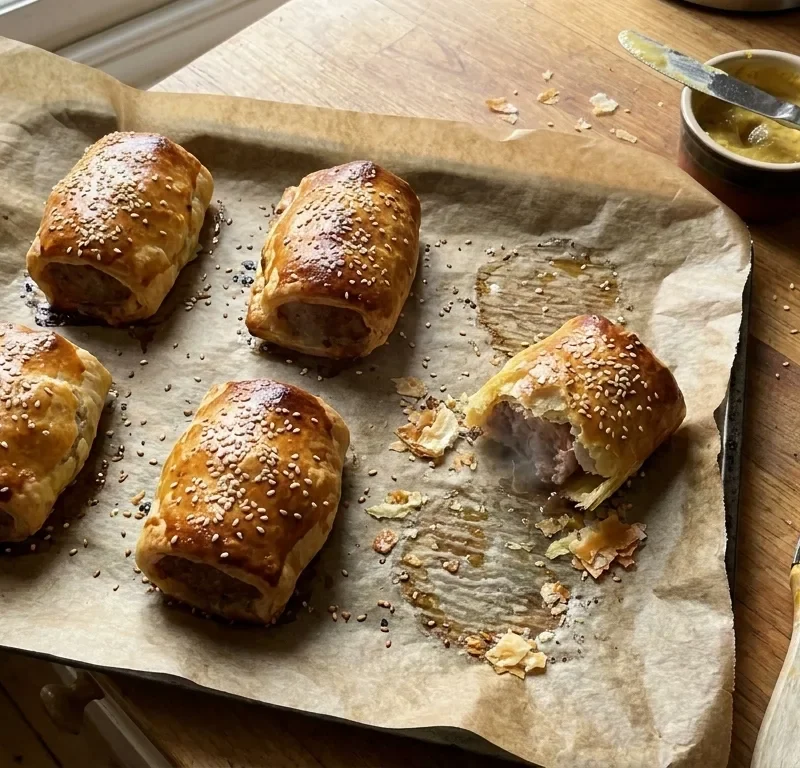
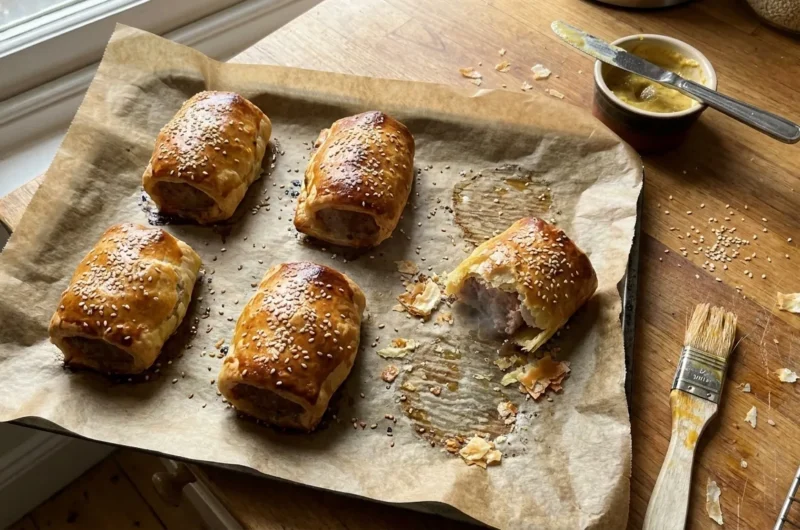
Gordon Ramsay’s sausage rolls are proper butcher’s sausages wrapped in butter puff pastry that’s been painted with English mustard on the inside, glazed twice with egg, and baked at 200°C for 25 to 30 minutes until the pastry shatters. Six big rolls from 500g of pastry, ready in about an hour.
This is the wild boar version from his Great British Pub Food book, and the headnote says it’s “one of several versions we serve at the pubs.” I couldn’t find wild boar sausages the first time I made these, and the book covers that too: any good sausage works, but he wants “a higher meat/lower fat content, preferably from a good butcher.” Cheap sausages leak fat and the pastry boils instead of crisping.
The detail that separates these from every supermarket sausage roll is the mustard, brushed inside the pastry before the sausage goes in. It bakes into a thin sharp layer between meat and pastry that you can’t quite name but would miss instantly. That, and the twenty minutes in the fridge between the two egg washes, so the pastry firms up and the glaze bakes to a proper shine.
Cooked this recipe? Send a photo or tell me what you changed at fans@gordonramsayrecipes.uk and I’ll share your experience live on this page.
Gordon Ramsay Sausage Rolls (Pub Recipe with Mustard)
Course: AppetizerCuisine: BritishDifficulty: Easy6
15
minutes30
minutes540
kcal1 hr 5 min
The bar snack from his Great British Pub Food book: whole skinned sausages rolled in mustard-painted puff pastry, double egg-washed with a fridge rest between, topped with sesame seeds and baked until golden. Best eaten warm within an hour of the oven, which has never been a problem here.
Ingredients
500g good-quality butter puff pastry
1.5 to 2 tsp English mustard
6 thick good-quality wild boar sausages, about 450g (or any high-meat-content sausages)
1 large egg yolk, beaten with 1 tsp water, to glaze
Sesame seeds, to sprinkle
Plain flour, for rolling
Directions
- Roll and cut the pastry: Roll out the pastry on a floured surface to a large rectangle about 3mm thick. Cut out 6 rectangles of roughly 10cm x 12cm, just large enough to wrap around a sausage, so use one sausage as your guide.
- Paint the mustard: Brush each pastry rectangle with a light coating of English mustard. This is the layer that makes them taste like the pub version, so don’t skip it.
- Roll the sausages: Peel the skins off the sausages. Lay a sausage along one longer side of a rectangle and roll the pastry around it, overlapping the ends slightly and pressing lightly to seal. Place seam-side down on a baking sheet lined with greaseproof paper, leaving space between them for expansion.
- First glaze and rest: Brush the tops with the beaten egg yolk and rest the rolls in the fridge for at least 20 minutes while the oven heats to 200°C/Gas 6.
- Second glaze and bake: Brush the rolls with egg again, sprinkle with sesame seeds, and bake for 25 to 30 minutes until the pastry is golden brown and the sausages are cooked through.
- Cool slightly: Transfer to a wire rack and leave for a few minutes. The book is right that they’re good cold, but they’re at their best warm and freshly baked.
FAQs
Why does he use whole sausages instead of sausagemeat?
Because a skinned butcher’s sausage is already seasoned, bound and portioned, so each roll gets an identical filling with zero mixing bowls. The book lists sausagemeat as the alternative, and it works, but whole sausages mean the filling was made by someone whose job is making sausages.
It’s also why his substitution rule matters: the sausage IS the recipe. He asks for “a higher meat/lower fat content, preferably from a good butcher,” because a fatty sausage leaks into the pastry and turns the base soggy instead of flaky.
What does the mustard inside actually do?
It bakes into a thin, sharp seam between the meat and the pastry, cutting through the richness of both. You don’t taste “mustard” in the finished roll, you taste a sausage roll that’s somehow more interesting than the ones from the shop, and that gap is the mustard.
English mustard specifically, because it’s hot enough to survive 30 minutes in the oven. Dijon fades to nothing at that temperature, and wholegrain tears the pastry when you brush it.
Why two egg washes with a fridge rest between?
The fridge rest does two jobs at once: it relaxes the pastry so it doesn’t shrink in the oven, and it dries the first coat of egg so the second coat builds on it. Two thin layers of glaze bake to a deeper shine than one thick one, which is why pub sausage rolls look lacquered and homemade ones often look pale.
It’s also the natural pause for the oven to reach a true 200°C, since puff pastry into a half-heated oven equals leaked butter and no rise.
Can you make them ahead or freeze them?
Yes, and they’re a Christmas lifesaver for it. Assemble the rolls to the end of the first egg wash, then either fridge them overnight or freeze them solid on the tray and bag them. Bake from frozen at the same 200°C, adding about 10 minutes, with the second egg wash and sesame seeds going on just before baking.
Baked leftovers keep 2 days in the fridge and re-crisp in 10 minutes at 180°C. The microwave turns the pastry to cloth. They share freezer logic with his beef wellington bites, the other pastry-wrapped party snack that bakes from frozen, so one prep afternoon stocks two trays for the same party.
What sausages should you actually buy in the UK?
Wild boar if your butcher has them, which is the book’s pub version. Otherwise any sausage over 90% meat content does the job: Cumberland brings pepper, Lincolnshire brings sage, and a good pork-and-leek makes a roll people ask about. The supermarket premium ranges work, the value ranges don’t, because the extra fat and rusk leak out.
If you’d rather go full British classic with the same sausages, his bangers and mash starts with proper plump pork sausages, and the butcher who skins yours for rolls will sell you the gravy-worthy ones too.
What do you serve them with?
At the pub they’re a bar snack, so the honest answer is a pint and a napkin. At home I do a dipping pot, and the best thing I’ve tried is his bacon jam, smoky and sticky against the hot pastry, made once and lived off for weeks.
For a proper British spread, they sit naturally next to his pork pie with its hot water crust, the sturdier cousin built for picnics where puff pastry wouldn’t survive the journey.