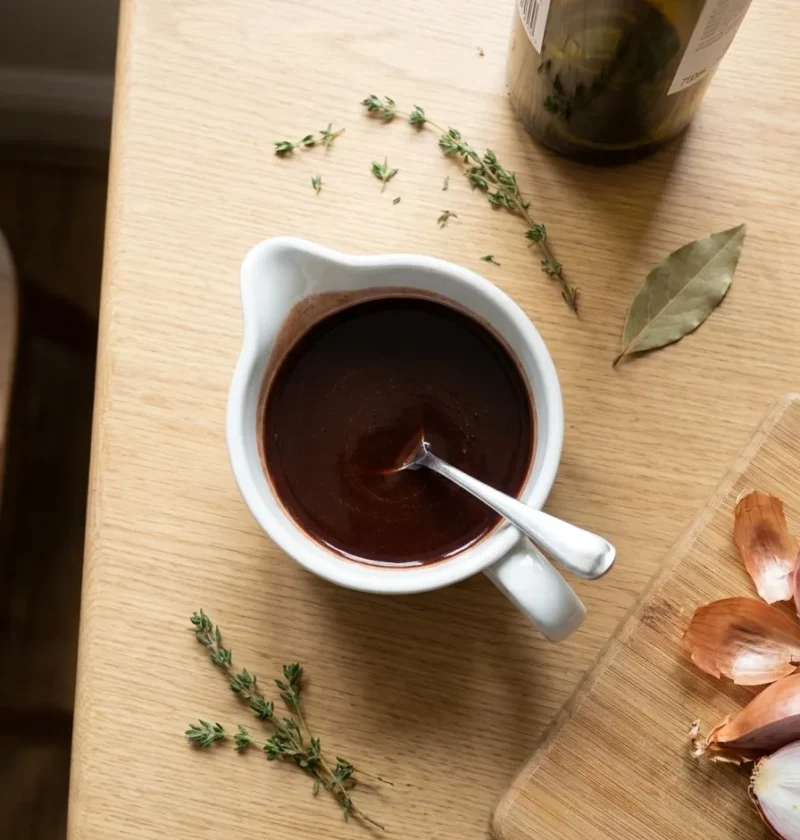
Gordon Ramsay’s red wine jus is dark, glossy and deeply savoury, made with beef trimmings, shallots, a full bottle of red wine and beef stock, reduced for an hour until it coats the back of a spoon. No flour, no cornstarch, just pure reduction. That’s what makes it a jus and not a gravy.
In the Ultimate Cookery Course, Ramsay builds this sauce as part of his beef wellington recipe, calling it a red wine sauce. In Bread Street Kitchen he scales it up to a full restaurant beef jus, writing that “the biggest difference between cooking at home and eating out is the quality and depth of the sauces.” The technique is the same in both books: brown the trimmings, reduce the wine, add stock, simmer, strain.
The step every competitor gets wrong is the wine reduction. Ramsay boils the red wine until “almost completely reduced” before the stock goes near it. That’s not reduced by half. It’s almost dry. All the alcohol burns off, the tannins concentrate, and you’re left with a dark, sticky wine syrup. When the stock hits that, the flavour is already locked in.
Cooked this recipe? Send a photo or tell me what you changed at fans@gordonramsayrecipes.uk and I’ll share your experience live on this page.
Gordon Ramsay Red Wine Jus Recipe
Course: SaucesCuisine: British, FrenchDifficulty: Medium4-6
servings10
minutes1
hour20
minutes85
kcal90
minutesGordon Ramsay’s red wine sauce from the Ultimate Cookery Course beef wellington recipe. A full bottle of wine reduced with beef trimmings, shallots and stock, strained through muslin. No flour, no shortcuts.
Ingredients
2 tbsp olive oil
200g (7 oz) beef trimmings
4 large shallots, peeled and sliced
12 black peppercorns
1 bay leaf
1 thyme sprig
Splash of red wine vinegar
1 × 750ml bottle red wine (Cabernet Sauvignon or Merlot)
750ml (3 cups) beef stock
Sea salt and freshly ground black pepper
Directions
- Brown the trimmings: Heat the olive oil in a large pan until smoking hot. Add the beef trimmings and cook over a medium heat until well coloured on all sides, about 5 minutes.
- Cook the shallots: Add the sliced shallots, peppercorns, bay leaf and thyme to the pan. Cook for about 5 minutes, stirring frequently, until the shallots turn golden brown.
- Deglaze with vinegar: Pour in the splash of red wine vinegar and let it bubble for a few minutes until almost dry.
- Reduce the wine: Pour in the full bottle of red wine and boil until almost completely reduced. This takes about 15-20 minutes. Don’t rush it.
- Add stock and simmer: Add the beef stock and bring back to the boil. Lower the heat and simmer gently for 1 hour, skimming any scum from the surface, until you have a glossy sauce that coats the back of a spoon.
- Strain and serve: Pass the sauce through a fine sieve lined with muslin into a clean pan. Season to taste. Reheat gently before serving.
Notes
- This is measured in British millilitres, so US cooks can turn the millilitres into cups and ounces.
FAQs
Why does Ramsay reduce the wine almost completely before adding stock?
Most red wine sauce recipes say “reduce by half.” Ramsay reduces until “almost completely reduced,” which means near-dry. That’s the difference between a thin, boozy sauce and a concentrated, glossy jus.
When the wine is almost gone, all the alcohol has burned off and the tannins have concentrated into a dark, sticky syrup. The stock then adds body without diluting the wine flavour. Skip this and you get something that tastes like watered-down wine.
Is this the same sauce Ramsay serves with beef wellington?
Yes. In the Ultimate Cookery Course, this red wine sauce sits directly under the beef wellington. It’s designed to be made while the wellington rests, then served alongside it.
The same technique scales up to a standalone jus. In Bread Street Kitchen he makes a larger batch using port as well as red wine, with a 2-hour reduction to produce 300ml of concentrated sauce. The home version above gives you the same result in half the time.
Why does Ramsay use shallots instead of onions?
On The F Word he explains it directly: “onions are far too strong, a shallot, it’s quite mellow.” Shallots caramelise faster, break down more evenly, and don’t leave a harsh bite in the finished sauce.
Every Ramsay red wine sauce across all his books uses shallots, never onions. The GBPF red wine gravy is the only exception, and that uses onion because it’s a rustic roast dinner gravy thickened with flour. A completely different product.
Why does Ramsay add vinegar before the wine?
A splash of red wine vinegar goes in after the shallots and before the wine. It deglazes the pan, lifting all the caramelised bits from the beef trimmings. On The F Word, Ramsay says the acidity “wakes everything up.”
In Sunday Lunch he uses raspberry vinegar instead of red wine vinegar for his venison sauce, adding a fruity edge that works with game. The principle is the same: a hit of acid before the wine concentrates the flavours.
Does red wine jus only go with red meat?
No. On The F Word, Ramsay serves a red wine sauce with brill, a white fish. In Sunday Lunch he pairs it with venison and whisks in grated bitter chocolate for richness.
Ramsay’s duck breast is another natural pairing.
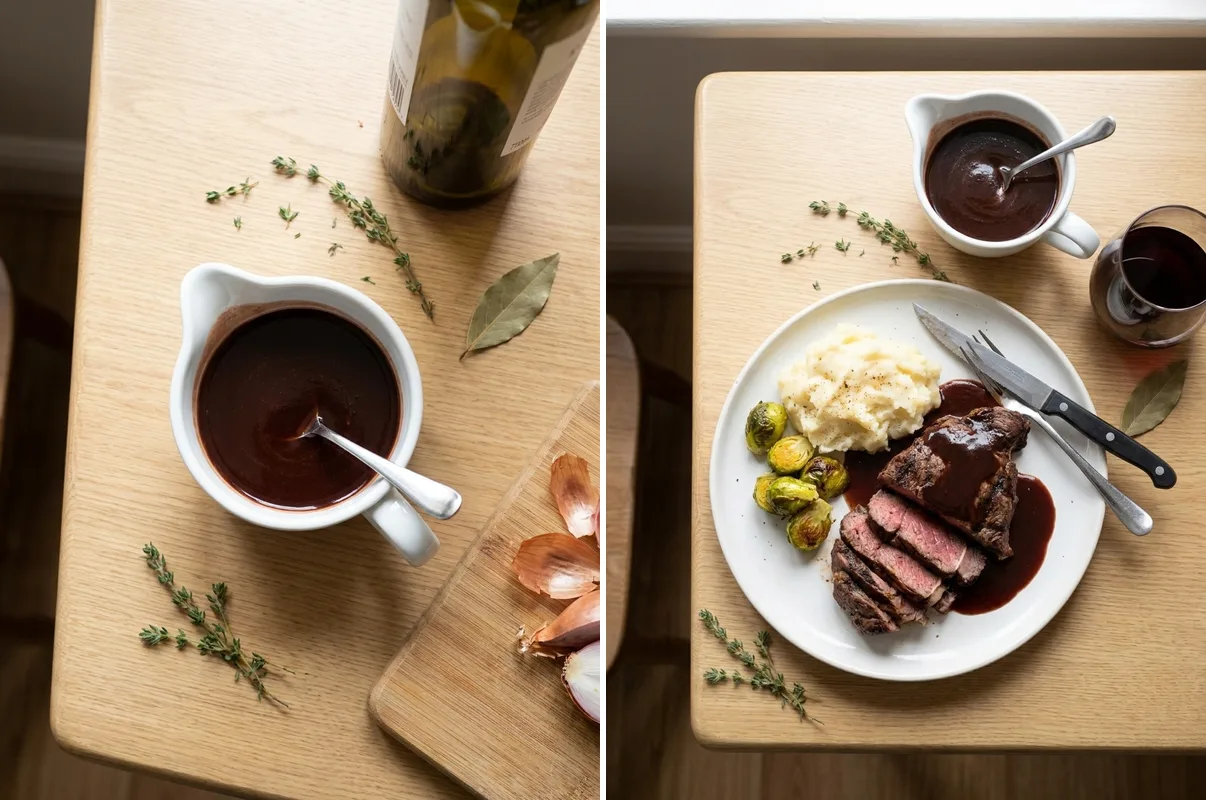
The jus works anywhere you want a rich, glossy, savoury sauce. Steak is the obvious choice, but it’s just as good spooned over roast lamb, a pork fillet, or even roasted root vegetables for a vegetarian Sunday lunch.
Does red wine jus keep well?
Brilliantly. In Bread Street Kitchen, Ramsay writes that it can be “cooled, then stored in an airtight container in the fridge for up to 5 days, or you can freeze it for up to a month.”
This is the best make-ahead sauce in the whole subniche. Freeze it in ice cube trays and you’ve got restaurant-quality jus ready to reheat in 5 minutes. One cube per steak, two for a roast.
One cube melted into a shot glass makes a perfect dip for wellington bites at a party. It actually tastes better the next day because the flavours settle overnight.
What is the difference between bordelaise sauce and red wine jus?
They start out identical. The shallots, red wine and beef stock base is the same. Bordelaise is just this jus taken two steps further for a richer, restaurant finish.
The two additions are demi-glace, which gives it more body, and traditionally bone marrow, which melts in for a silky richness. So a jus is the lighter, cleaner version, and bordelaise is the deep, glossy one you get in a restaurant.
How do you turn this into a bordelaise sauce?
Make the jus exactly as above, then near the end stir in a spoonful or two of demi-glace. If you cannot get demi-glace, just reduce the sauce a little further for the same depth.
For a proper bordelaise, poach a couple of marrow bones and scoop out the soft marrow. Dice it and melt it through for the last two minutes before you strain. Finish with cold butter for shine and you have bordelaise.
Is red wine jus the same as a red wine demi-glace?
Not quite, but they are close cousins. A demi-glace is a thick French base made by reducing veal or beef stock right down until it is glossy and concentrated. A jus reduces wine and stock together, so it stays lighter.
If you want a red wine demi-glace, stir a spoonful of demi-glace into the finished jus, or simply reduce it further until it heavily coats the spoon. That gives you the deeper, stickier restaurant body.
What is the difference between red wine jus and red wine gravy?
A jus is pure reduction. You boil the wine and stock down until they thicken on their own, with no flour. A gravy is thickened with flour or a roux, so it comes out heavier and more opaque.
Gordon’s version is a jus, which is why it stays glossy and pourable rather than thick and matte. For a red wine gravy, whisk a little flour into the shallots before the wine goes in.