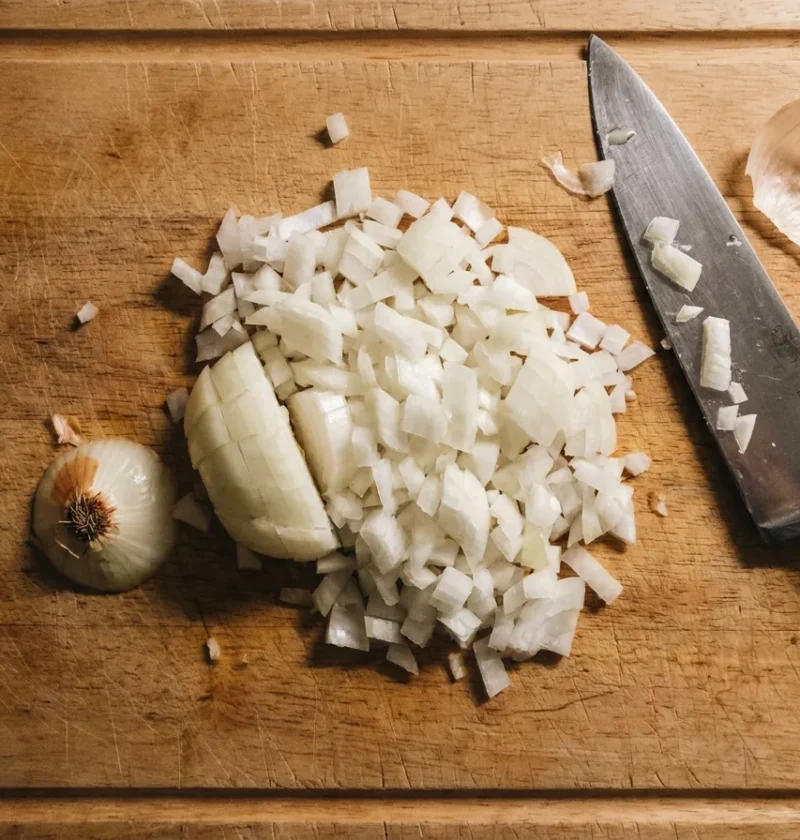
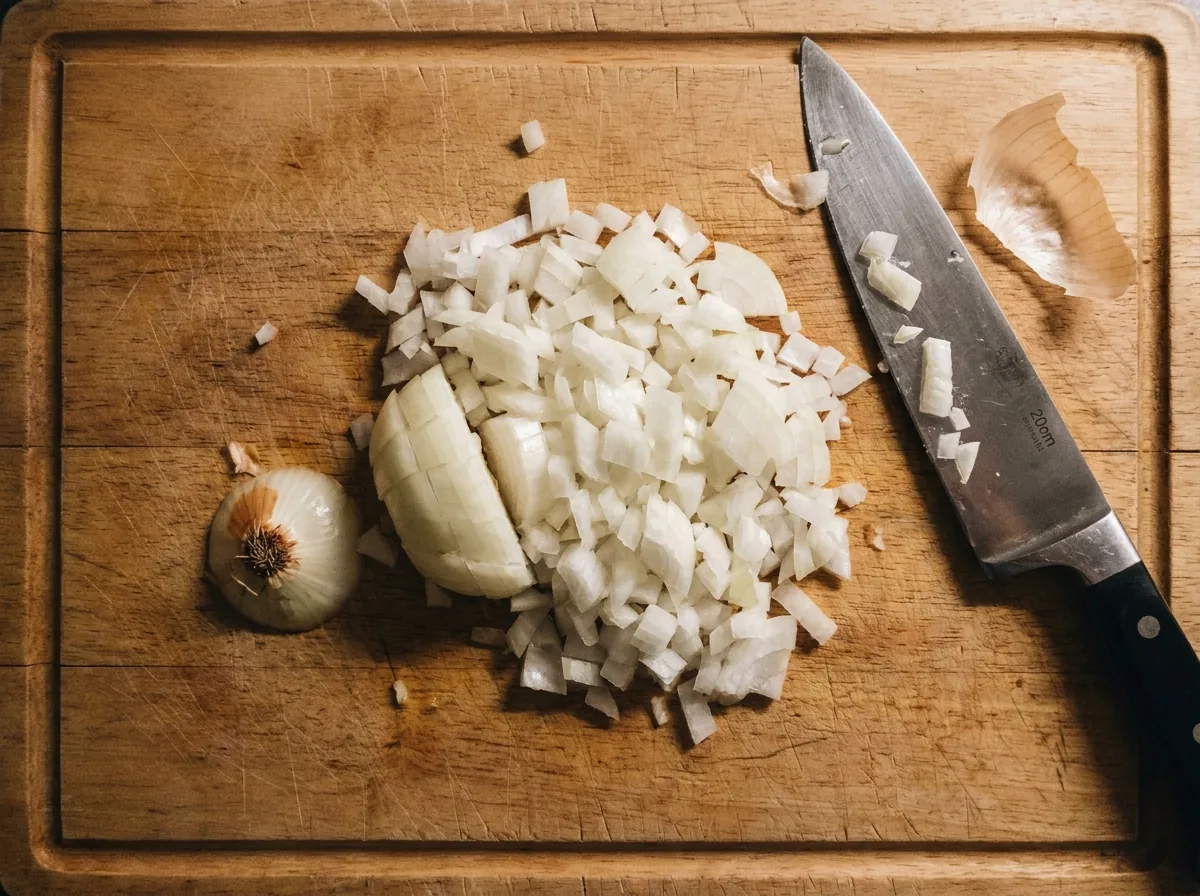
I have ruined more onions than I care to admit, sliding all over the board and crying into the bin. Then I watched how Gordon actually does it, and it comes down to one thing nobody tells you: the root. Halve it through the root, a few cuts each way, and slice it into a fine, even dice in about a minute.
He does not dress it up. In his video on dicing an onion he says it straight: “this is the root, that’s absolutely crucial, leave that on. If you cut that off the onion will start to bleed and you’ll start crying rapidly.” I found the exact same method in his Ultimate Cookery Course, so this is properly his, not something invented for a recipe blog.
The bit I had wrong for years was my hand, not the knife. He holds the onion like a tennis ball and lets his knuckle guide the blade, walking his fingers back towards the root as he goes. That is what keeps every piece the same size and your fingertips out of the way.
His method, step by step
- Halve it through the root. Cut the onion in half lengthways, straight down through the pointed top and the root. Peel the papery skin off but leave the root on, because that is the bit holding the whole thing together.
- Make your vertical cuts. Slice down the length of each half in parallel cuts, stopping just short of the root so it does not fall apart.
- Make your horizontal cuts. Lay a hand flat on top and cut across the onion twice, again stopping before the root.
- Grip and slice. Hold it like a tennis ball, fingertips tucked under, knuckle out. Let the knuckle guide the blade straight down and walk your fingers back towards the root as you slice.
- You are done. A neat little pile of fine dice and just the root left, which you can trim further or keep for the stockpot.
That is the dice that starts half the cooking I do. It is the base of a proper French onion soup, where the pieces need to be even so they catch and caramelise at the same rate, and it is the first thing in the pan for his cottage pie too.
FAQs
Why does Gordon Ramsay leave the root on the onion?
Because the root is the bit that makes you cry. When you cut through it you burst the cells that fire off the gas that stings your eyes, so Gordon keeps it whole right until the end. Like he says, cut the root off and the onion starts to bleed and you start crying.
It pulls double duty as well. The root holds all the layers together, so the onion stays as one solid piece while you work instead of skidding apart. That is the whole secret to an even dice, and it is why I never lop the root off first anymore.
How do you cut an onion without crying?
Two things, and Gordon does both without making a fuss about it. Leave the root intact, since that is where the eye-stinging gas comes from, and use a properly sharp knife so you slice cleanly instead of crushing the onion and squeezing more of it out.
The blunt knife is the hidden troublemaker, and his books are firm on this: a dull blade bruises the onion and skids about, which makes you cry more and is honestly more dangerous for your fingers. If I am doing a big batch I pop the onion in the fridge for ten minutes first, which helps too.
What knife does Gordon Ramsay use to chop an onion?
A normal 20cm cook’s knife, kept sharp. In his Ultimate Cookery Course he says he favours Wüsthof, a German make, but he is clear that the brand matters far less than the knife feeling balanced and comfortable in your hand.
The sharpness is the part he will not budge on. He tells you to run the blade against a honing steel every time you use it, because a sharp knife does the work for you and is far safer than a blunt one dragging through. It is the same knife and grip whether you are dicing for a Bolognese or a big pot of chilli con carne.
What is the Gordon Ramsay onion cutting prison story?
It is a real moment from his show The F Word. Gordon visited HMP Doncaster, met a prisoner named Kieron Tarff, and challenged him to an onion chopping race. The prisoner won.
Impressed, Gordon offered him a job on the spot and asked when he would be released. It is a genuinely wholesome clip. What happened to Kieron after his release is not clearly documented, so I will not pretend to know.