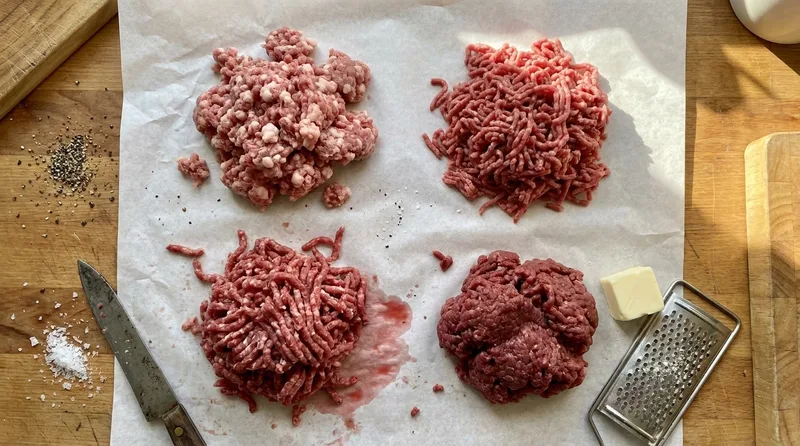
The best burger meat blend is chuck plus a fattier cut at roughly 80/20 lean to fat. Gordon Ramsay uses four different blends depending on the burger: his Bread Street Kitchen restaurants run short rib, chuck and brisket with added minced fat, while his grill burger is a simpler 85/15 chuck and brisket.
I’ve pulled every blend from his books, his restaurant site and his published videos, with the exact weights for each one. They disagree with each other, which is the point: there’s no single “Ramsay blend,” there’s a system, and once you see all four side by side you can pick the right one for how you’re cooking.
The one rule that never changes across all of them is the fat. His Quick and Delicious bacon cheeseburger specifies 20% fat mince, and in interviews he says the same thing about pre-ground meat: look for chuck at minimum 20% fat. Everything else, the cuts, the ratios, the extras, flexes around that number.
The four blends, side by side
| Blend | Mix | Best for | Source |
|---|---|---|---|
| BSK Burger | 400g chuck, 200g short rib, 200g brisket, 80g minced beef fat | Thick pan-fried pub burger | Bread Street Kitchen book |
| Celebration Burger | 85% chuck, 15% brisket, frozen butter grated in | Outdoor grill, thin patties | His YouTube channel |
| American Dirty Burger | 40% chuck, 40% rib, 20% fat, two thin 100g patties | Smash-style stacking | gordonramsay.com |
| Simple 20% | 1kg 20% fat beef mince, nothing added | Weeknight bacon cheeseburger | Quick and Delicious book |
Each cut has one job. Chuck is the base of every blend because it brings structure and a deep beefy flavour with enough natural fat to stay honest. Short rib is there for moisture, brisket for a darker, almost smoky depth, and the minced fat is the engine that bastes the patty from inside as it cooks.
Look across the four and a pattern shows up: chuck never drops below 40% of the mix. What changes between blends is how the fat arrives. The BSK burger adds it as minced fat, the Celebration burger grates in frozen butter, the Dirty Burger builds it into the ratio, and the simple version just buys it in the mince.
FAQs
What is the best meat for burgers?
Chuck, and it’s the one cut all of Ramsay’s blends share. In an interview about burgers he put it plainly: if you’re using a single cut, go with chuck, because it has a nicely balanced flavour, and if you’re buying pre-ground, look for ground chuck that is at least 20% fat. Every blend in his books builds on it.
Chuck comes from the shoulder, a muscle that works hard, which is why it tastes more of beef than leaner cuts do, and its natural fat sits close to the 20% mark already. His Bread Street Kitchen meatballs use the same shorthand for the butcher counter: “preferably chuck or something not too lean.”
What is the best fat ratio for burgers?
An 80/20 split, and it’s verified from two of his sources. His Quick and Delicious bacon cheeseburger calls for “1kg 20% fat minced beef,” and his interview advice repeats the same number for pre-ground chuck. Less fat than that and the burger dries out before the centre cooks. More and it shrinks hard and floods the pan.
The fat isn’t there for richness alone. It bastes the patty from inside as it melts, carries the seasoning through the meat, and stops the shrinkage that makes a wide patty come out the size of the gherkin. His frozen butter trick on the grill burger is the same principle pushed further.
Can you just use supermarket mince?
Yes, and that permission comes from the BSK book itself: “If you can’t get hold of the different cuts, regular minced beef will still work a treat.” Check the label for 20% fat and avoid anything sold as lean or extra-lean for full-size burgers, and you’re most of the way there.
The same page offers the upgrade path: “Ask your butcher to mince the beef for you or invest in a mincer for a lifetime of great burgers.” It’s worth doing for thick patties where the beef is the whole show. For a smash burger, skip it, because the 90-second sear matters far more than the blend.
When does lean mince actually work?
Three documented cases in his books, and each one replaces the missing fat with something else. His Healthy Appetite beef burger uses 600g lean mince with smoked paprika and cayenne, served with beetroot relish and cucumber raita, so the wet sides do the fat’s job. His World Kitchen blue cheese burger mixes 100g of blue cheese into lean mince, melting richness through from inside. And his kids’ mini burgers in Make It Easy use lean mince shaped thin and small, cooked fast before it can dry out.
The pattern is the rule: lean only works when something else carries the richness. A relish, a cheese in the mix, or sheer speed. Lean mince in a thick plain patty has nothing to save it.
Does the blend matter more than the technique?
No, and his own burgers prove it, because the simplest blend with his technique beats the fanciest blend without it. His 10-minute bacon cheeseburger uses plain mince and an egg yolk, and it works because of the hot pan, the single flip, the rest and the staged seasoning, not the meat.
Where the blend does show is a thick patty with minimal toppings, where the beef is the whole point. The BSK burger is eaten with little more than cheese and a spoonful of char siu butter, and that’s exactly when short rib and brisket earn their place. Honest ranking: technique first, fat second, cuts third.
Should you grind your own meat at home?
Worth it if you make burgers more than once a month, and the BSK book calls a mincer an investment “for a lifetime of great burgers.” Grinding at home means you control the cuts, the fat and the coarseness, and the meat is fresher than anything that’s been sitting pre-ground in a tray.
The free version of the same result: pick your cuts at the butcher and ask them to mince them for you, which most will do on the spot. Go coarse for thick burgers. Then pick what to cook from the burger recipes roundup and put the grind to work.