Gordon Ramsay’s vegetable curry throws celeriac, cauliflower, broccoli and courgette raw into one pan with Madras paste and cardamom. Everything simmers in the tomatoes, then thick Greek yoghurt goes in off the heat. About 30 minutes, and the peeling is the hardest part.
It’s the Easy vegetable curry from his Fast Food book, and he demonstrated it on camera for The Times. Curry, he says, is “never boring” for a chef. The book builds it on a jar of Madras paste, because Fast Food’s whole promise is speed.
His secret is in his own words: “the vegetables are going in raw and the whole thing is almost sort of cooking from fresh.” No pre-roasting, no par-boiling. Each vegetable enters the pan in order of toughness and cooks in the sauce itself, so the sauce tastes of them.
Cooked this recipe? Send a photo or tell me what you changed at fans@gordonramsayrecipes.uk and I’ll share your experience live on this page.
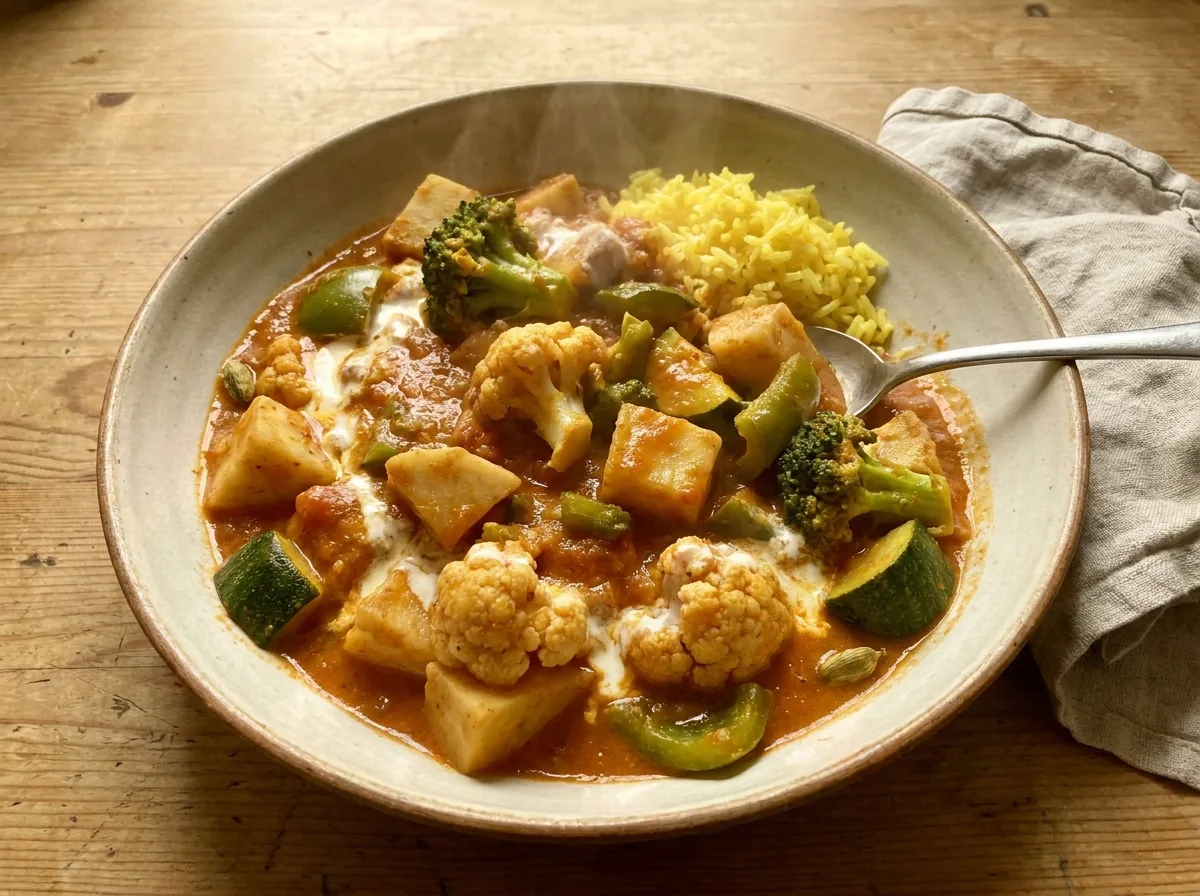
Gordon Ramsay’s Vegetable Curry
Course: DinnersCuisine: IndianDifficulty: Easy4
servings15
minutes15
minutes240
kcal30
minutesThe Fast Food one-pan veggie curry he demonstrated for The Times: a whole celeriac and half a cauliflower cooked from raw in Madras-spiced tomatoes, made vegetarian-dinner-party safe by the yoghurt finish.
Ingredients
2 tbsp vegetable oil
1 banana shallot (or 2 regular), peeled and roughly chopped
1 garlic clove, peeled and finely chopped
2 long red chillies, deseeded and finely chopped
1 small celeriac, peeled and chopped
Sea salt and freshly ground black pepper
3 tbsp Madras curry paste
A few cardamom pods
1 green pepper, cored, deseeded and roughly chopped
½ large cauliflower, cut into florets
400g (14 oz) can chopped tomatoes
½ head of broccoli, cut into florets
1 large courgette, roughly chopped
About 250ml (1 cup) Greek-style natural yoghurt
Directions
- Start the aromatics: Heat the oil in a large, wide pan and add the shallot, garlic and chillies. Cook, stirring, for a minute or so until the garlic is fragrant.
- Celeriac first: Add the celeriac and some seasoning. Cook over a high heat for a couple of minutes, it takes the longest of all the vegetables.
- Paste and hard veg: Stir in the Madras curry paste and cardamom pods, then add the green pepper and cauliflower. Stir well to coat everything in the paste.
- Tomatoes and water: Tip in the chopped tomatoes, then fill the empty can with water and pour that in too. Bring to the boil.
- Soft veg last: As it starts to boil, add the broccoli and courgette. Simmer for 8 to 10 minutes, until the vegetables are tender but still have a little bite.
- Yoghurt off the heat: Take the pan off the heat and stir through the yoghurt. Taste, adjust the seasoning, and serve over rice, he plates his over saffron rice.
Notes
- The book allows 2 regular shallots if banana shallots are out, and the video adds one more instruction: don’t flood it with water, the tin’s worth is the ceiling.
FAQs
Why do the vegetables go in raw, in stages?
That cooking-from-fresh secret in the intro only works if the order is right. Celeriac leads because, as he puts it, “being a root vegetable” it brings what he calls a “really nice strong flavour,” and roots need the head start. Broccoli and courgette arrive last because they’d collapse on the full journey.
His doneness cue from the video: “not crunch, but just a really nice bite in the vegetables.” The same staged-entry thinking runs his Southern Indian fish curry, where even the fish gets its own slot.
Does Ramsay use jar paste or homemade?
Both, and he’s on camera doing each. The jar in the intro is the weeknight answer. But on The F Word, facing Jo Brand and her jar of balti paste, he called her a “lazy bugger” and made his own from scratch.
That paste, in his words: “coriander seeds, poppy seeds, turmeric, garlic, ginger and chilli powder into a pestle and mortar, then from there a tablespoon of groundnut oil and then just a tablespoon of white wine vinegar.” He rates it “ten times tastier” than bought. The F Word cook-off is on YouTube, Jo’s Haribo stew stories included.
What is celeriac, and what can replace it?
The knobbly root of a celery variety, sold whole in every UK supermarket veg aisle, at its best from October to March. It tastes like celery crossed with potato, and peeling its craggy skin is genuinely the recipe’s hardest job, a sharp knife beats a peeler.
Swede is the closest swap and behaves almost identically. Pumpkin and butternut squash work too, sweeter and softer, so add them a stage later with the cauliflower, though at that point his butternut squash chicken curry is the fuller answer. Potato does the same job more quietly.
Should I use water or stock?
His answer from the video settles it: “you could add a really nice fragrant vegetable stock, but I make it with water. It’s just as good.” The tin of tomatoes, three tablespoons of paste and six vegetables are already carrying the flavour.
Water also keeps the sauce clean enough that each vegetable stays identifiable, which is the whole point of the dish. Save the stock cube for soups that need it.
Is this vegetable curry vegan, and can I add chickpeas?
Vegetarian as written, and one swap from vegan. The only animal product is the yoghurt, and he’s deliberate about its job: “I’m quite generous with the yogurt because it cools everything down in a way that it becomes less fiery.” You taste the vegetables instead of the heat. Thick coconut yoghurt does the same cooling, same off-heat stir.
Chickpeas take it from side to full meal: a drained can goes in with the broccoli and warms through in the simmer. For the fully dairy-free lane, his lentil curry recipe converts just as easily.
How long does vegetable curry keep?
His own verdict from the video: “if you think that’s delicious now, wait ’til you taste that in a couple of days time.” He calls it a midnight feast, and the mechanism is real, the paste keeps settling into the vegetables overnight.
Three days in the fridge is the window, with the vegetables softening a little each day. Freezing is the one weakness, the yoghurt splits on thawing, so freeze a batch before the yoghurt stage if you’re planning ahead. My roundup of his curry recipes is where I’d pick what’s next.